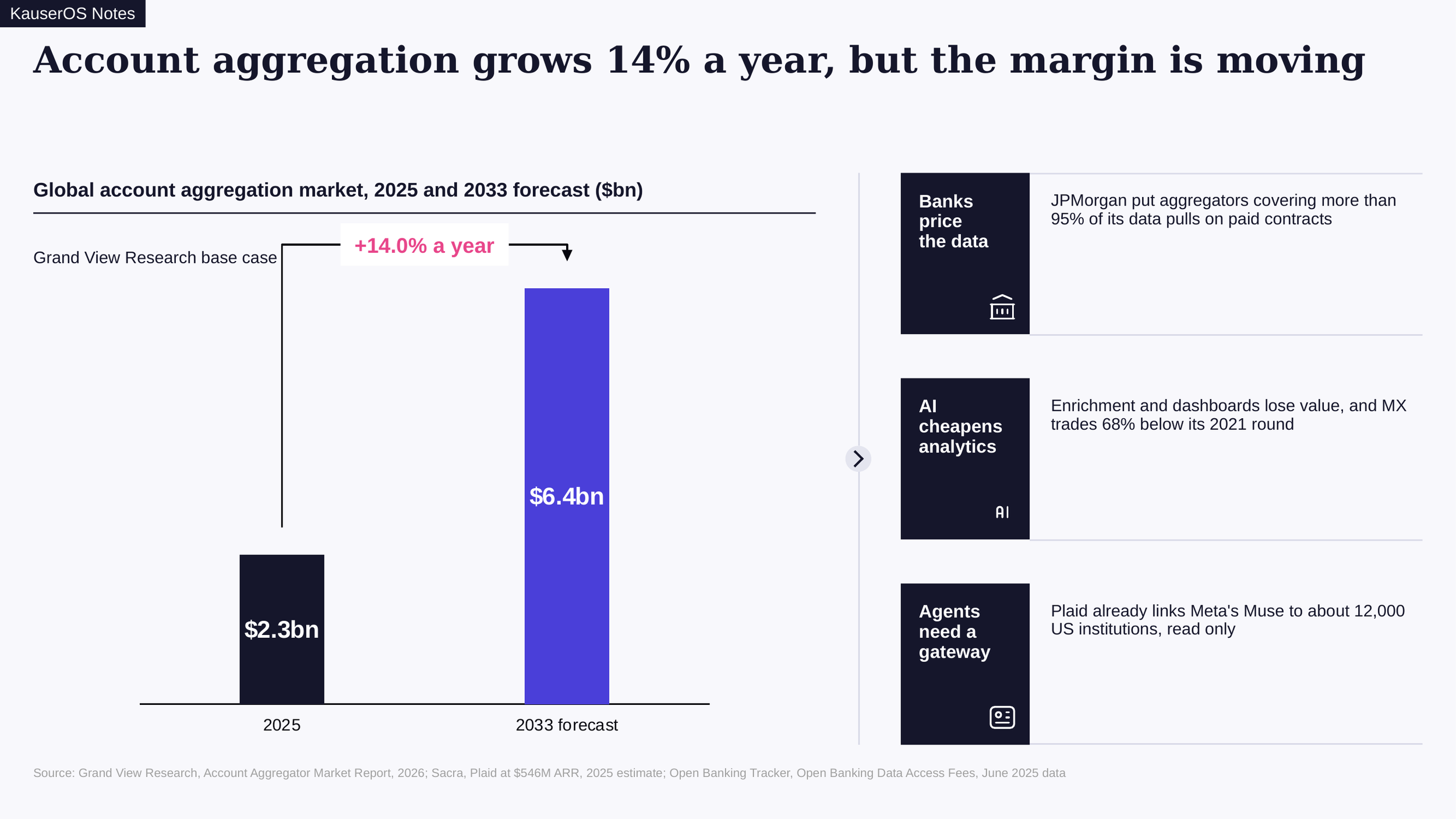
Who Wins Open Banking Now That Banks Charge and AI Agents Arrive?
The account aggregation market grows 14% a year to $6.4bn by 2033. Banks now charge for data and AI agents want access. Who keeps the margin?
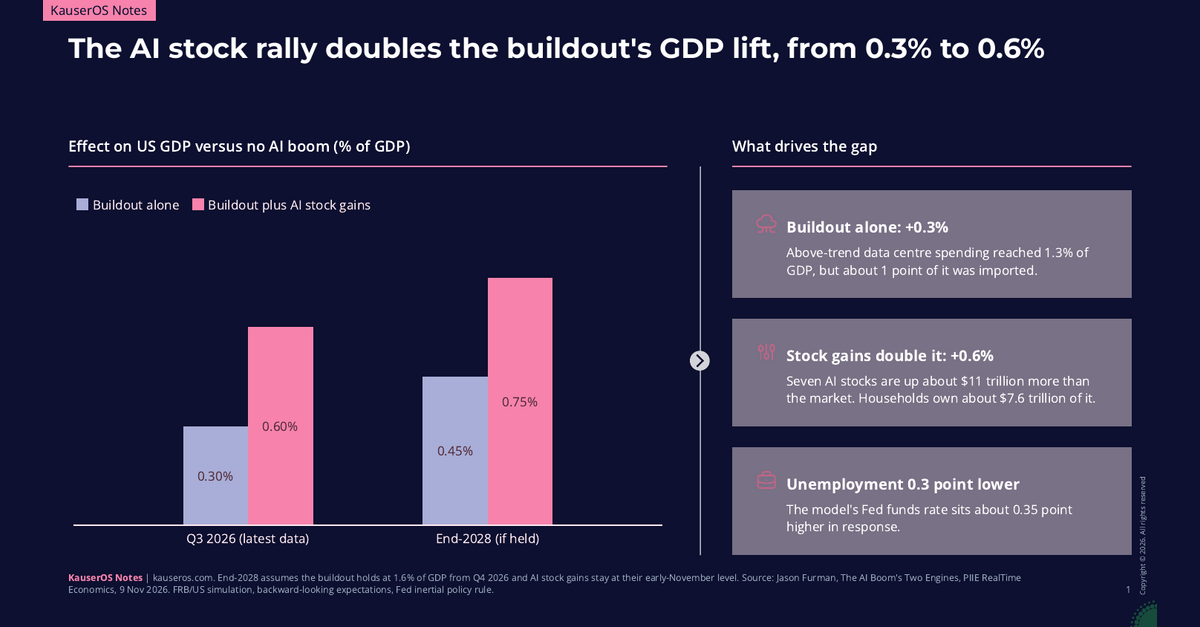
The AI boom has two engines. Private credit is fuelling the quieter one
The AI boom runs on two engines: the data centre buildout and the AI stock rally. The buildout has lifted US GDP by only about 0.3%, because most kit is imported. AI infrastructure financing puts private credit on the first engine. LP portfolios ride the second.
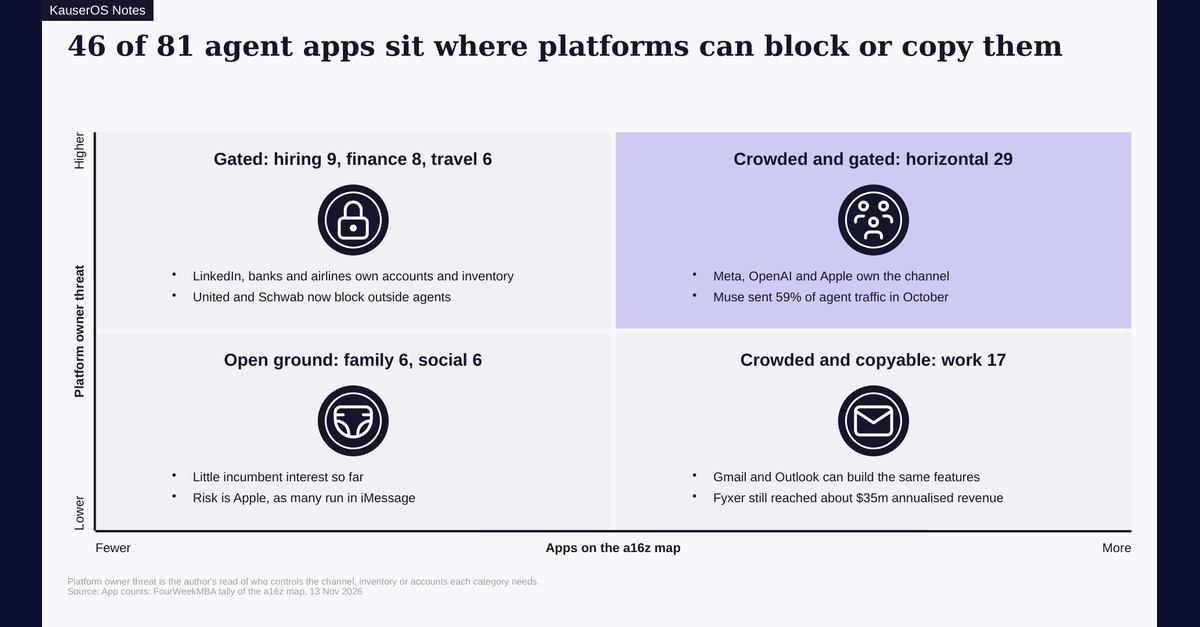
Who Wins the AI Agent Economy When Amazon, United and LinkedIn Fight Back?
a16z mapped 81 consumer AI agents. The platforms those agents depend on are blocking, taxing or copying them, and OpenAI has answered with ChatGPT Wallet. A strategy read on where agents still have room.
Four buckets for quarter end
Jensen Huang quit as Nvidia CEO a week before Anthropic's IPO. I sorted a fund's quarter end into four buckets: what AI takes first and what stays human.
What is KauserOS? An AI-native platform for private markets, delivered by forward-deployed engineers
KauserOS is an AI-native operating platform for private equity and private credit managers, delivered by forward-deployed engineers, starting with fund finance controls.
The Crown Jewel: AI and the Private Markets Operating Stack
AI labs started with public filings. Why the private markets back office, where one EBITDA figure sits in eight places, is the stickiest prize in finance.
Anthropic before the bell: the cap table is the supply chain
Anthropic's S-1 shows about $637B of named obligations to suppliers such as Google and Amazon that are also its investors, distributors and competitors.
From AI Assistants to Agent Economies: Who Controls the Agent, and Who Captures the Value?
Notes from a Chicago Booth roundtable on agent economies. Why capability is not authority, what Project Deal showed, and where controls should sit.
Mastercard Agentic AI: Who Gets Paid When Agents Shop
Notes from Mastercard's London AI Innovation Centre on Agent Pay, the $1.5 billion BVNK deal and why 52 cents of each gross network dollar goes back out.
One Agent Is a Workflow. A Fund Is a World.
AI agents in a GP fail when one number has several valid bases. Why lineage, basis rules and task-level entitlement come before any agent goes live.
Dubai bet on people, not funds. Then the war marked it to market.
The DIFC reached 102 hedge funds in 2025, up 37%, while managed assets grew 4%. Why Dubai chased people over funds, and how the 2026 war tested that bet.
The Analysis Got Cheap. The Data Got Priceless.
Why Octus, 9fin and Cognitive Credit sit in different layers of the credit stack, and what a floated $4 billion Octus price says about data access today.
Pricing the Agent Economy: A Founder's Field Guide to Monetising AI-Native SaaS
How to price AI agents between a value ceiling and a falling compute floor, with lessons from Salesforce Agentforce, Sierra and Microsoft 365 Copilot.
Legal AI Is Worth More Than the Market It Sells Into. That Should Worry You, Not Excite You
Harvey and Legora carry about $16.6bn of value against a legal AI market of $3bn to $6bn a year. Why renting both models and content makes that fragile.
A Third of the World’s Biggest Asset Managers Already Use Hebbia. The Real Question Is Whether It Survives Its Own Supplier.
Hebbia counts a third of the largest asset managers as customers. Now Anthropic sells ten finance agents. Five moves for Hebbia, ranked by defensibility.
The Financial Economics of the Commercial Space Industry
SpaceX's S-1 shows Starlink earning 61% of revenue while the rockets lose money. What that means for a space economy heading to $1.8 trillion by 2035.
The AI Supercycle Is Eating Itself? Where is the Smartest Money flowing?
AI spending is moving into power, fibre and transformers. Morgan Stanley sees $2.9 trillion of data-centre construction through 2028. Where the gaps sit.
The $63 Billion Illusion: MicroStrategy, Modigliani-Miller
Modigliani-Miller applied to Strategy. How a 2.0x premium to Bitcoin NAV fell to near parity after Q1 2026, and who wins and loses in the capital stack.
The Data Oligarchs Just Had Their Worst February in Memory. Here’s Why MSCI Is Different from Everyone Else in the Blast Radius.
Why MSCI differs from Gartner and FactSet after the $285 billion AI rout. Its Index arm has a 76.4% margin, 95.9% retention and $2.34 trillion in ETF AUM.
Rethinking Tax & Accounting Technology for Asset and Wealth Managers amidst wave of Democratisation of Private Assets
K1x cites about a 66% cut in K-1 cycle time. Why tax technology for asset and wealth managers is a data, workflow and control problem, and what to build.