First published in RoSoft Notes on LinkedIn on 22 July 2026. Figures and market references are as of that date.
In short
AI has made reading financial documents cheap, so the value in credit data has moved to the data itself and to who can reach it. Octus is the platform, 9fin the intelligence engine and Cognitive Credit the structured fundamentals layer underneath. They sit in different layers of one stack, and the market is repricing all three upward for access and provenance.
- Permira paid roughly $1.33 billion for Octus in 2022, and the price floated for a sale late last year was around $4 billion.
- 9fin raised $170 million in March at a $1.3 billion valuation, after growing recurring revenue by 100% a year for several years.
- In the same stretch S&P bought a private markets data firm for $1.8 billion and BlackRock paid $3.4 billion for Preqin.
- CLO cash flow modelling still runs through Intex, and none of the three challengers plays in CLO structures, loan benchmarks or secondary bond pricing.
- Octus serves more than 35,000 clients and is expanding through Sky Road and a pending deal for LevPro.
Why Cognitive Credit, 9fin and Octus aren't fighting the same war, and what their price tags are really telling us.
I want to start with a number that stopped me, because I think it explains most of what is happening in credit data right now.
Late last year, word got out that Permira was talking to bankers about selling Octus, the credit intelligence business most people still think of as Reorg. The figure being floated was around four billion dollars. Permira had paid roughly one and a third billion for it in 2022. A few months later, in March, a younger rival called 9fin raised a hundred and seventy million at a one point three billion dollar valuation, and mentioned almost in passing that it had grown recurring revenue by a hundred percent a year for several years running. In the same stretch, S&P bought a private markets data firm for one point eight billion, and BlackRock paid three point four billion for Preqin.
That is not a run of coincidences. That is a repricing. And the interesting part is not the size of the cheques. It is what, exactly, is being paid for.
Here is my honest answer, and it is the thread that runs through everything below. The thing all of these businesses were built on, which is teaching a machine to read a financial document and pull the numbers out, is getting cheaper by the month, because the large language models now do a lot of it for free. And yet the businesses are getting more valuable, not less. That only makes sense if the value has quietly moved somewhere else. It has. It has moved to the data itself, and to who can actually get hold of it.
Let me take that slowly, because it is the whole story.
Three companies, three completely different games
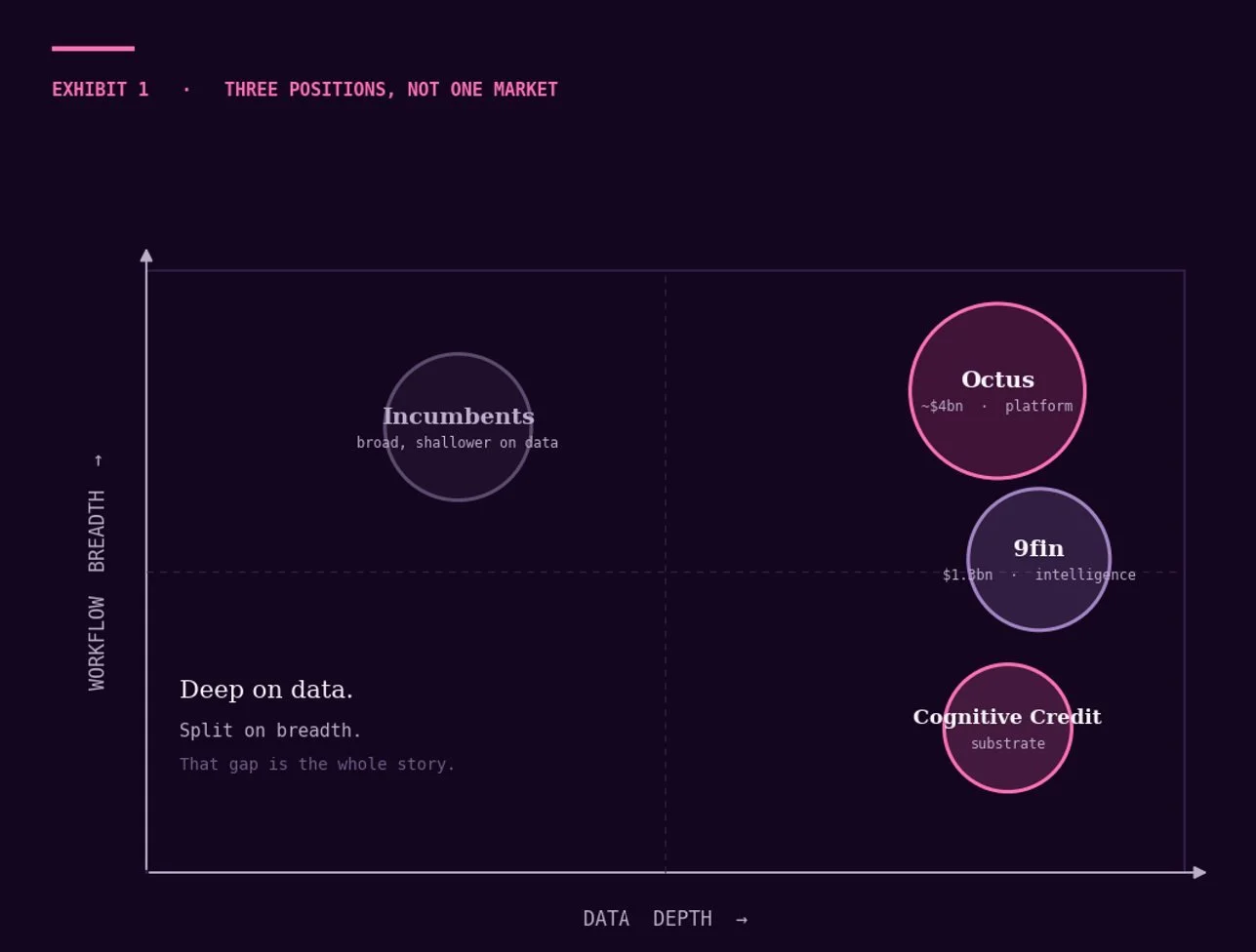
The instinct when you see Cognitive Credit, 9fin and Octus mentioned together is to rank them. Which one is winning. It took me a while to realise that is the wrong question, because they are not really competing. They are sitting on top of each other, in three different layers of the same stack.
Octus is the platform. It grew out of the deepest heritage in the group, which is restructuring and distressed intelligence, the world of journalists and analysts and lawyers reading court filings to work out which company is about to fall over. Under Permira it has been buying its way outward, into document custody, into portfolio management with Sky Road, and now into front office workflow with a pending deal for a business called LevPro. It serves more than thirty five thousand clients. It is trying to become the thing you never have to leave, the operating system for a credit desk.
9fin is the intelligence engine, and it is the most openly ambitious of the three. It was founded by an ex JP Morgan banker and a Deutsche Bank engineer, and its pitch is essentially "the only platform a credit professional will ever need." It pulls together everything scattered across data rooms and emails and PDFs, and puts an AI layer on top, across leveraged finance and private credit and distressed. The money it just raised is going into exactly that, plus a hard push into the United States.
Cognitive Credit is the quietest and the narrowest, and in a way the purest. It does one thing. It takes a company's financial disclosure, including the private stuff that arrives as a lender pack in a password protected data room, and turns it into a clean, structured model of that borrower's numbers, exactly as the company reported them, traceable back to the source, updated within minutes of a result landing. It lands in your spreadsheet and in your systems, not in some separate screen you have to go and visit. It is not an intelligence service. It is not a covenant shop. It does not touch CLO structures. It is the layer underneath, the raw financial truth that everything else reasons on top.
So who is actually being disrupted.
This is where I think a lot of the commentary goes wrong, because it treats "credit data" as one thing that is being eaten. It isn't.
The parts genuinely being disrupted are the slow, manual, document heavy jobs. Spreading a company's financials by hand. Reading a hundred page credit agreement to pull out the covenants. Working through earnings transcripts. The first pass of watching a portfolio for trouble. These used to eat analyst hours, and they are exactly what structured data plus AI compresses. This is where all three of these companies create real value over the old way of doing it, which was a Bloomberg terminal and a lot of spreadsheets.
The parts that are not being disrupted matter just as much, and naming them keeps you honest. CLO cash flow modelling still runs through Intex, which everyone uses precisely because everyone uses it, so that you and the trustee and the rating agency are all speaking the same language. None of these three challengers plays there. The benchmark businesses, the leveraged loan indices, are written into fund documents and move at a glacial pace. And the actual price of a bond in the secondary market comes from the pricing incumbents with their contributor networks. So the honest map is that the challengers are taking the analytical and document layer, and leaving the structural and pricing layers well alone. Being brilliant at leveraged finance intelligence does not automatically make you good at CLO structures, or investment grade, or price discovery. Those are different games, and pretending they are one game overstates how much ground is actually moving.
The moat question, and the word everyone misuses
If you strip out the jargon, there are only a few things that actually protect a business like this over time, and it is worth being strict about which is which.
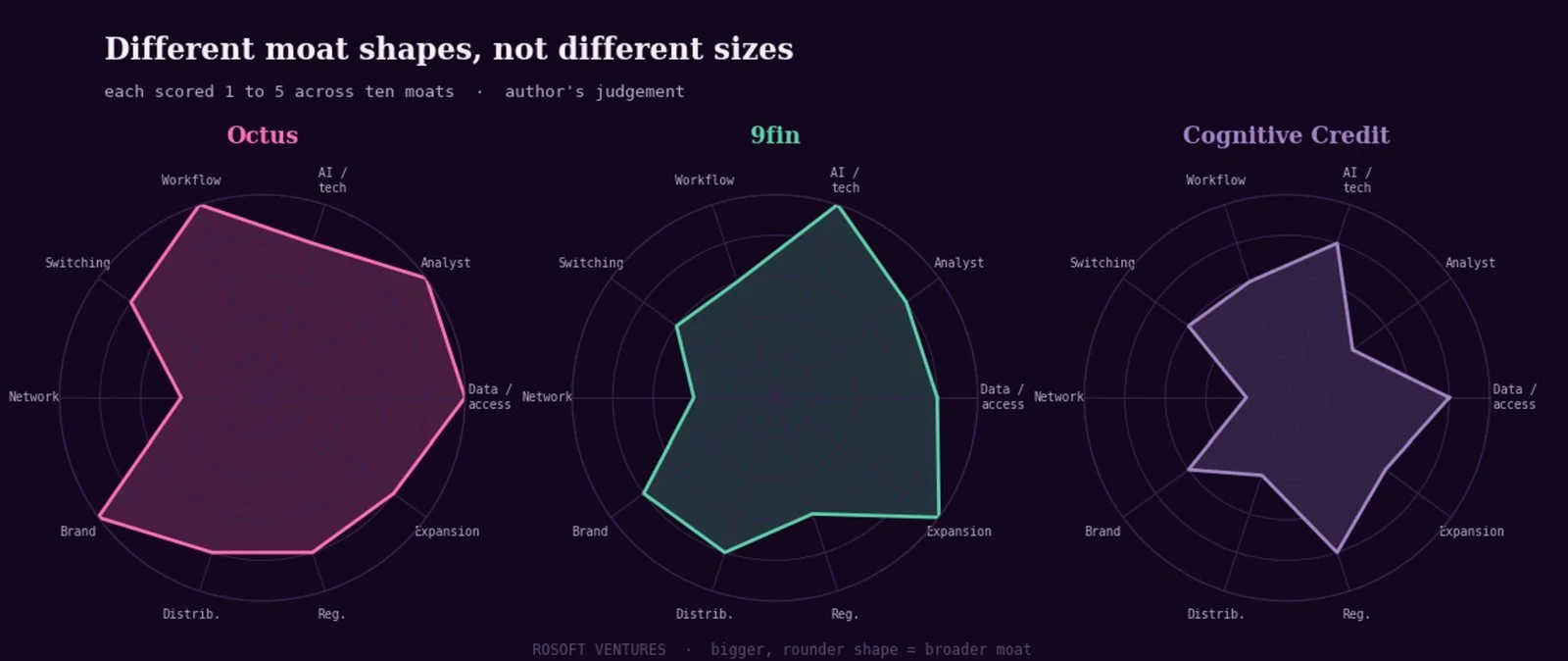
The strongest one is access to data that others simply cannot reach. This is not the same as being clever at reading it. Octus hosting millions of permissioned documents, or Cognitive Credit handling the private lender packs without you having to send them off to a third party, those are access advantages, and a language model cannot read a document it cannot open. That lasts. Being good at extraction, on the other hand, is a skill that is levelling out fast as the models improve, and the incumbents will catch up on it.
Then there is switching cost, which is real but ordinary. Once your history lives in a tool, once your identifiers are mapped and your workflow is wired in, moving is a pain. That makes the incumbent sticky. It is strongest for Octus, because it is a whole platform, and weakest for Cognitive Credit, because it sits in the one layer where you can most easily run a second supplier alongside it as a check, which many firms do.
Here is the one I want to be blunt about. People love to call this a network effect. It almost never is. A credit dataset does not usually get more valuable to me because you also subscribe. That is a scale effect, not a network effect. The only real exception is contributor priced data, where more contributors genuinely improve the marks for everyone, and that sits with the pricing incumbents, not with these three. So when you hear "network effects" attached to a credit data pitch, I would push back unless someone can show you the contributor mechanism actually working.
The last one is quietly becoming the most interesting. Call it regulatory defensibility. As the supervisors lean harder on data quality, on how private assets are valued, on model risk, the ability to prove where every single number came from turns into an asset in its own right. That favours the trustworthy, auditable, boring specialist. It is a tailwind for this whole corner of the market, not a headwind.
Who buys this, and the mistake specialists make
A quick point that took me years of watching procurement to really absorb. There is no single buyer called "the credit team." The decision splits depending on how deep the tool reaches into how the firm actually runs. The structural modelling tool gets chosen from the bottom up by the quants. A portfolio management system is a joint decision between the front office and operations, and operations usually holds the deciding vote, because they are the ones who have to live with it. Benchmarks are a chief investment officer's call. And the fundamentals layer is chosen jointly by the analysts and the middle office, because valuation and control both lean on it.
The thing I find genuinely useful here is that expanding one of these tools inside a firm is never really about the vendor selling harder. It is about the tool crossing an internal boundary. From one desk to the next, often for a completely different reason, because a high yield desk and a private credit desk have different pain. Then across the line from front office into the back office, usually triggered by something like an audit or a valuation being challenged, when suddenly the ability to trace a number back to its source is what saves you. Then from paying per user, to paying for a data feed, to paying extra for the AI on top.
Octus is furthest along that path. 9fin is climbing it quickly. And Cognitive Credit's single best expansion, the one where it becomes the one consistent record of a borrower across a firm's public and private books, is the one that does not sell itself, because no single desk owns that benefit. Somebody senior has to reach down and force it. And that, in my experience, is exactly the sale a focused specialist most often walks past.
On pricing, one strong opinion
All three sell subscriptions, and all three face the same trap in the AI era. The productivity they hand you keeps going up, while the cost of the thing underneath keeps falling. That combination quietly tempts everyone into giving away the most valuable new capability inside an old per seat price.
My view is simple. The value is migrating from seats, to feeds, to premium AI agents, and the pricing should follow it there. For the platforms, that means charging properly for the agent layer as its own thing, which Octus has actually started doing, rather than bundling it away. For Cognitive Credit, sitting in the layer where the buyer holds the most leverage, it means growing through scope, more coverage, more of the private book, the data feed, rather than trying to charge more for the same names. The one mistake all three must avoid is the same. Do not let AI-enabled productivity leak out through a seat price. That is where the money is quietly lost.
The autonomy question nobody wants to answer straight
This is the one everyone circles and few will say plainly, so let me say it plainly.
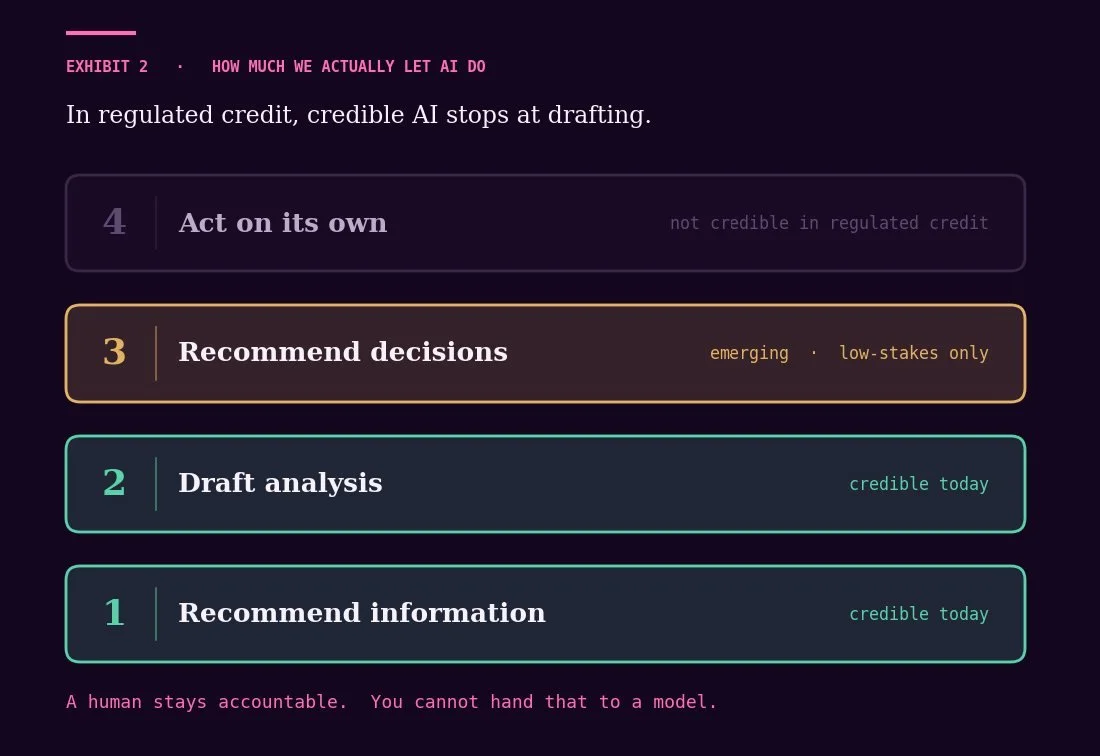
It helps to think about AI in four steps. It can hand you information. It can draft the analysis. It can recommend an actual decision. Or it can act on its own, without a human signing off first. Across public credit, private credit, CLOs, trading, valuation and compliance, the credible reality today sits at the first two, drafting, edging into the third for low stakes screening. The fourth, acting on its own, is not credible in regulated credit, and I do not think it is coming soon.
And the reason is not just nerves. It is structural. A model that makes things up is dangerous the moment its output becomes a valuation input. Data leaking, or a model being manipulated through the back door of a cleverly written document, turns autonomy into a security hole. And "the model decided" is simply not an answer you can give a regulator, because you cannot hand your accountability to a piece of software. When you read the reporting about frontier models behaving strangely in testing, being deceptive or doing unexpected things, the honest way to read it is that these are controlled experiments run on purpose, and they are an argument for keeping a human firmly in the loop, not evidence that some model broke loose and started trading. They make the case for caution, and caution is the point.
Which leads somewhere that I think a lot of people underrate. If the winning posture is grounded, checkable AI, sitting on top of trustworthy data, with a person still accountable, then the firm that owns the trustworthy data underneath is advantaged precisely because the autonomy is capped. The ceiling on AI is the floor under the data business.
The regulation, in one breath
None of the regulatory direction slows the underlying demand. What it does is channel it. The EU AI Act pushes towards being able to explain yourself. The FCA's scrutiny of how private assets are valued raises the premium on numbers you can actually stand behind. The operational resilience rules harden how firms think about depending on outside providers. Data protection constrains how information moves around. Add it up and it all points the same way, towards explainable, well documented, audit ready products, and away from black boxes making unsupervised calls. That is good for the trustworthy specialist and bad for anyone whose pitch quietly depends on AI being let off the leash.
Where I think this lands in five years
Nobody can promise a market structure, so here is my base case rather than a forecast.
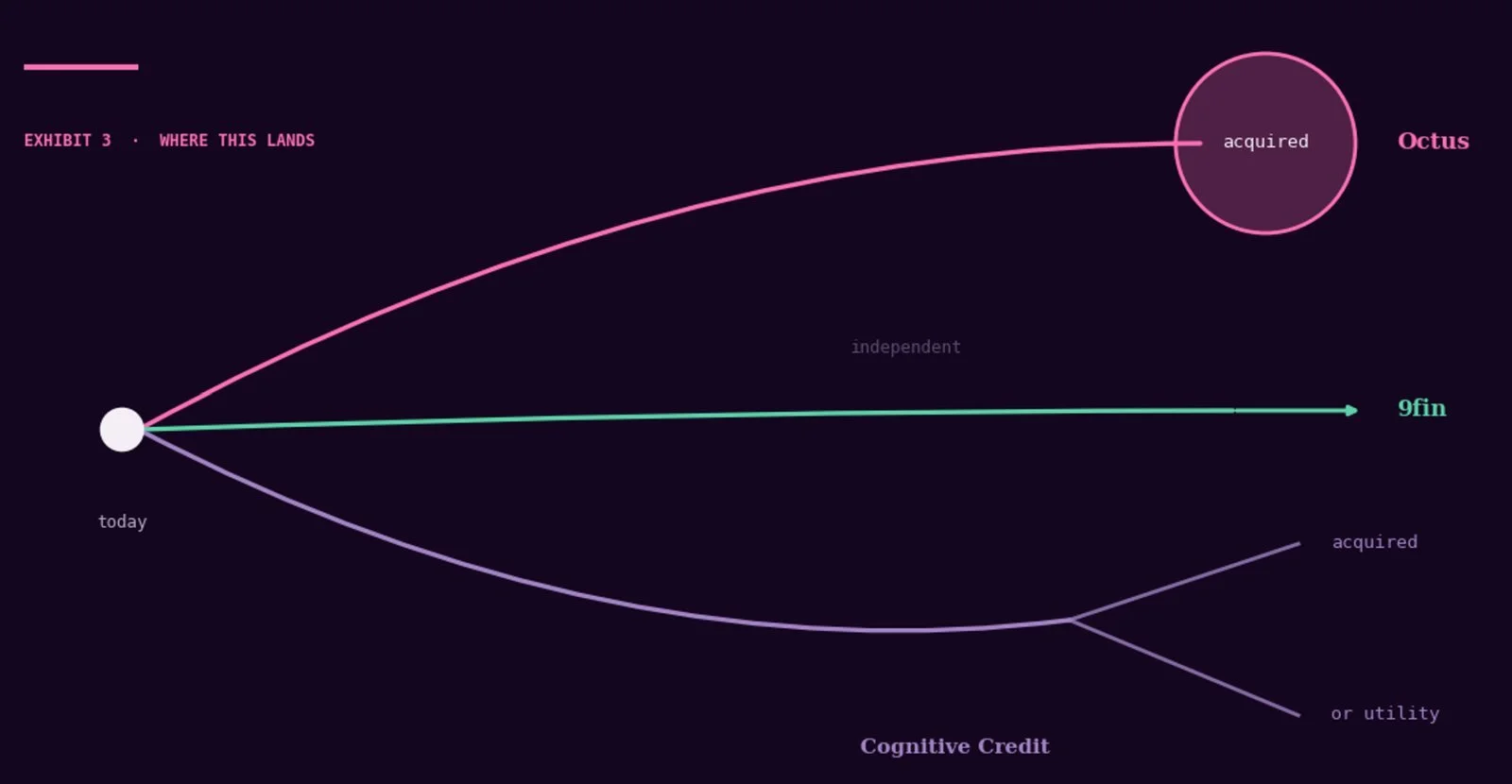
The top of the stack consolidates, and Octus is the most likely of the three to be bought by a larger data or infrastructure player, at or above that four billion figure being floated. 9fin carries on as an independent, scaled up challenger, having either grown into its valuation by compounding or been forced to. And Cognitive Credit is either acquired, and it is worth knowing that Fitch is already an investor and that the pattern of a strategic quietly buying out a company it seeded is well worn in this sector, or it settles in as a durable, focused utility that everyone relies on and nobody talks about.
Each has one mistake to avoid, and they are different. Octus has to resist bundling itself into a monolith so heavy that sophisticated buyers start pushing back on the whole thing, and it has to fold in Sky Road and LevPro without diluting the intelligence core that is its actual moat. 9fin has to avoid mistaking breadth for depth, because "the only platform you need" is a strength right up until it spreads too thin against focused specialists, and its valuation now needs it to keep compounding. And Cognitive Credit has to stop thinking of itself as an extraction company, because on extraction alone, which AI is commoditising, it cannot out spend either of the others. Its future depends on owning the harder ground, the access and the provenance, before the better funded players get there first.
The one line I would leave you with
Cognitive Credit, 9fin and Octus are not three answers to one question. They are three bets on which layer of the credit stack holds its value once AI has made the analysis cheap. The substrate, the intelligence, or the platform.
The market is quietly repricing all three upward because it has worked out, ahead of most of the commentary, that the scarce thing was never the analysis. It is the trusted data underneath it. The winners will be the ones who turn a fading advantage in reading documents into a lasting advantage in owning and reaching them, before the incumbents and the models catch up.
That is the whole game. And it is being played out one funding round and one quiet acquisition at a time.
I would genuinely like to know where others land on this. Do you think regulated credit will ever let AI move from recommending to actually acting, and if it does, which workflow goes first?
These are my own views, shared personally.This is not investment advice, and it is not an endorsement of any company mentioned. It draws on publicly available information as of July 2026. Anything about private companies, revenues or valuations is an estimate and may change after this is published.
Frequently asked questions
What is the difference between Octus, 9fin and Cognitive Credit?
They work at three layers of the credit stack. Octus, once known as Reorg, is a platform with restructuring roots and more than 35,000 clients. 9fin is an AI intelligence engine across leveraged finance, private credit and distressed debt. Cognitive Credit turns company disclosures, including private lender packs, into structured borrower data traceable to source.
What protects a credit data business as AI improves?
Access to data others can't reach lasts, because a language model can't read a document it can't open. Skill at extraction is levelling out as models get better. Switching costs help but are ordinary. The ability to prove where every number came from is becoming an asset as supervisors focus on data quality and private asset valuation.
Will AI make decisions on its own in private credit?
The author places AI in regulated credit today at supplying information and drafting analysis, edging into recommendations for low-stakes screening. Acting without human sign-off isn't credible. A model that invents figures corrupts valuation inputs, a crafted document can manipulate it, and a firm can't hand its accountability to software when a regulator asks who decided.
KauserOS applies the provenance point to fund finance, where every facility term traces back to the clause it came from. See how the KauserOS platform works.
About the author
Mohsin Qadir is the founder of KauserOS, an AI-native operating platform for private equity and private credit managers. He was divisional CFO and COO of Private Assets at Fidelity International and interim Head of Investment Operations at Bridgepoint, and earlier worked at ICG and BNP Paribas CIB. He writes RoSoft Notes.