First published in RoSoft Notes on LinkedIn on 8 September 2026. Figures and market references are as of that date.
In short
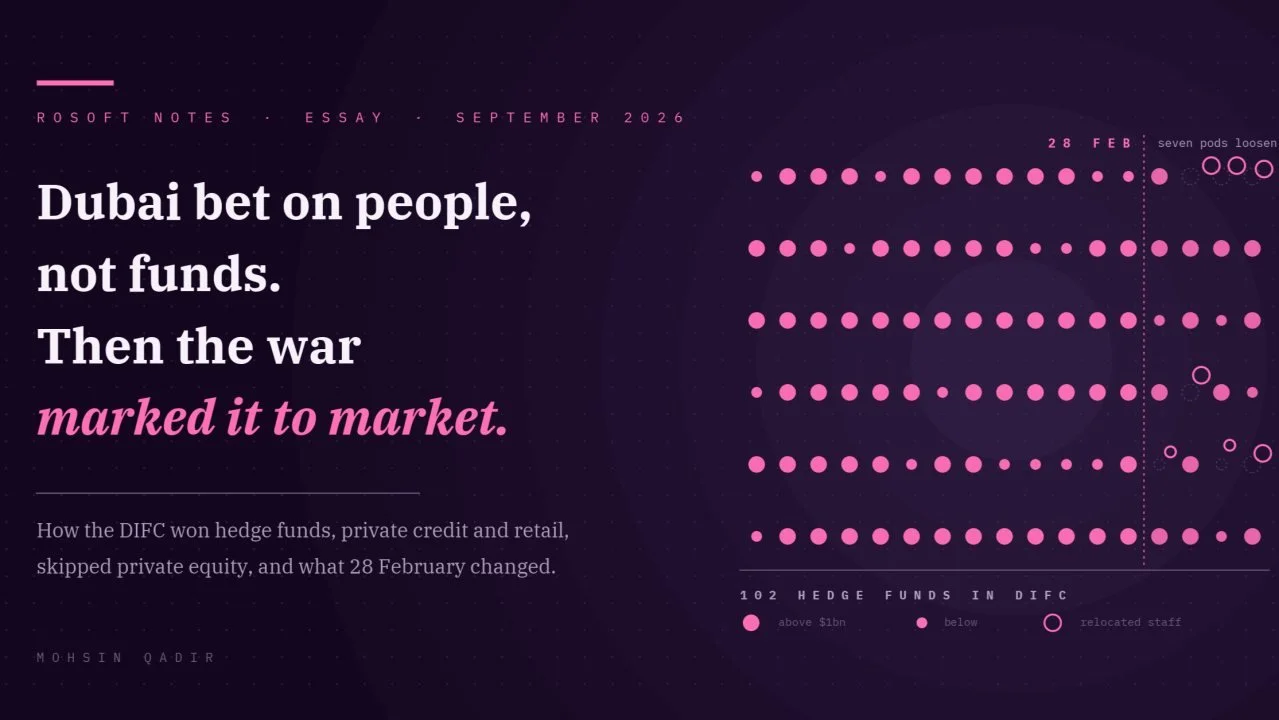
Dubai's DIFC chose to compete for mobile people, chiefly hedge fund portfolio managers, and left closed-ended private markets funds to Abu Dhabi and its sovereign capital. That took the DIFC to 102 hedge funds by the end of 2025 while managed assets grew 4%. The 2026 war exposed the weak spot. Pods can leave, and locally domiciled retail feeder funds stay put.
- The DIFC ended 2025 with 102 hedge funds, up 37%, while assets under management rose 4% to $176bn and assets under advisory rose 22% to $220bn.
- Since 1 April 2024 public distribution to onshore UAE retail has been limited to locally domiciled funds, which led Franklin Templeton, BlackRock and PIMCO to launch DIFC funds over European masters.
- ADIA, Mubadala and ADQ together run around $1.7tn, and EQT, KKR, Partners Group and most of the private markets cohort opened in Abu Dhabi.
- On 9 April 2026 the DIFC and DFSA published a relief package that included temporary relief on governance and staffing arrangements.
- The World Bank cut its 2026 GCC growth forecast from 4.4% to 1.3%.
How the DIFC won hedge funds, family offices and retail distribution, why private markets went to Abu Dhabi, and how the thesis has held through 2026
ROSOFT NOTES · Mohsin Qadir · 8 September 2026 ·
Dubai never competed for your fund. It worked out early that fund domicile is sticky, low-margin and mostly unwinnable, so it built a product for the one thing in asset management that is genuinely mobile: the individual.
That bet produced a top-five global hedge fund hub in under two years. By the end of 2025 the DIFC had 102 hedge funds, up 37% on the year, and by mid-2026 it had 592 wealth and asset management firms. Managed assets over the same period grew 4%. The distance between those two numbers is the whole strategy, and this essay is about what it was designed to do, what it has delivered to the local economy, and where its limits sit.
It also got a live test this year. The conflict that reached the Gulf on 28 February put every assumption in the model under load for six months, and I use that evidence where it bears on the argument. The subject is the strategy. The war is the stress test.
Here is the argument. Dubai never competed for your fund. It worked out early that fund domicile is sticky, low-margin and mostly unwinnable, so it built a product for the one thing in asset management that is genuinely mobile: the individual. That bet produced a top-five global hedge fund hub in under two years. It also produced a financial centre whose most valuable residents can leave on thirty days' notice, and in March, some of them did.
1. The number that gives the game away
The DIFC finished 2025 with 102 hedge funds, up 37% on the year. It crossed 100 in December, having doubled from 50 at the start of 2024. Eighty-one of them run more than $1bn.
Now put that next to the money. Assets under management: $176bn, up 4%. Assets under advisory, the thing that tracks where decisions get made rather than where capital sits: $220bn, up 22%.
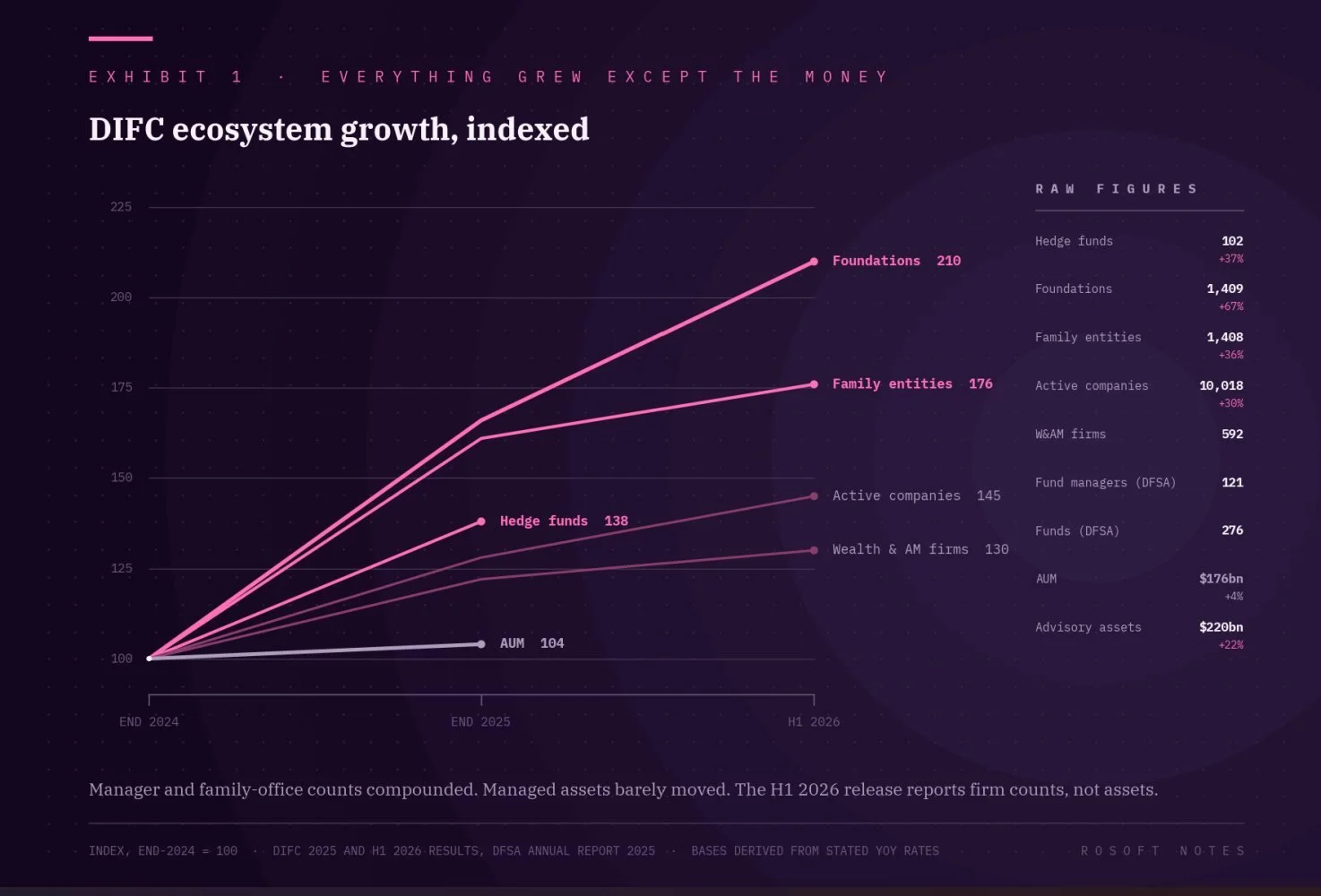
Every count compounded. Foundations up 67%. Family-related entities up 36%. Active companies up 28% to 8,844, and then past 10,000 by mid-2026. The one series that barely moved is managed assets. And in its H1 2026 results, published on 28 July with the war five months old, The H1 release reports firm counts and not assets, so the AUM series will not update until the annual results.
That is not a failure. It is the design, and understanding why requires one structural point that almost every commentator gets wrong.
> Push back on me. If you think the 4% AUM figure is an artefact of how DIFC measures ecosystem assets rather than a real signal, I would like to hear the argument. My view is that the advisory-versus-AUM gap is the cleanest evidence available that decision-making relocated and capital did not. Tell me where that breaks.
2. What can actually move, and what cannot
A closed-ended fund cannot move. A private equity, infrastructure or real estate vehicle is a ten-year contract with drawn capital, consent thresholds in the LPA, side letters, a depositary chain and an ISIN. There is no mechanism to redomicile it mid-life and no incentive to try. It arrives in a new jurisdiction only as a new vintage, once every three to five years, and the incoming LP base decides the domicile, not the GP.
An open-ended hedge fund technically can move, and never does. The vehicle is already in Cayman, already tax-neutral, and no investor is asking for a change. Moving a running master means re-papering the prime broker, the administrator and the subscription documents with no natural event to hide the disruption behind.
So neither vehicle moves. But the value sits in different places. In private equity it sits in the GP entity, the deal team and the carry. In a hedge fund it sits in one portfolio manager's book. A multi-manager pod is a self-contained P&L: a PM, two analysts, a risk allocation. You lift it out of London and set it down in the DIFC without touching the fund, the LPs or the prime broker.
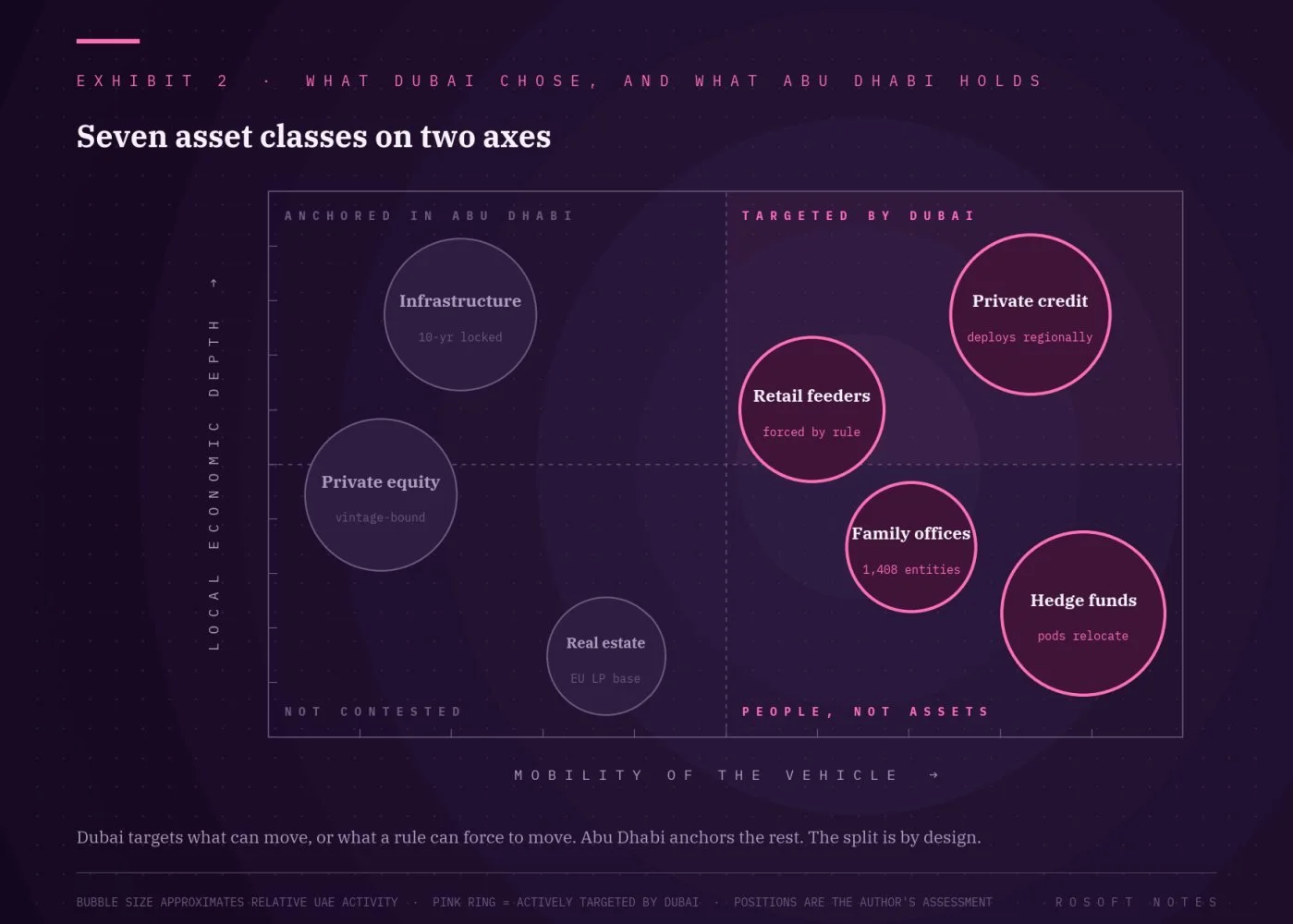
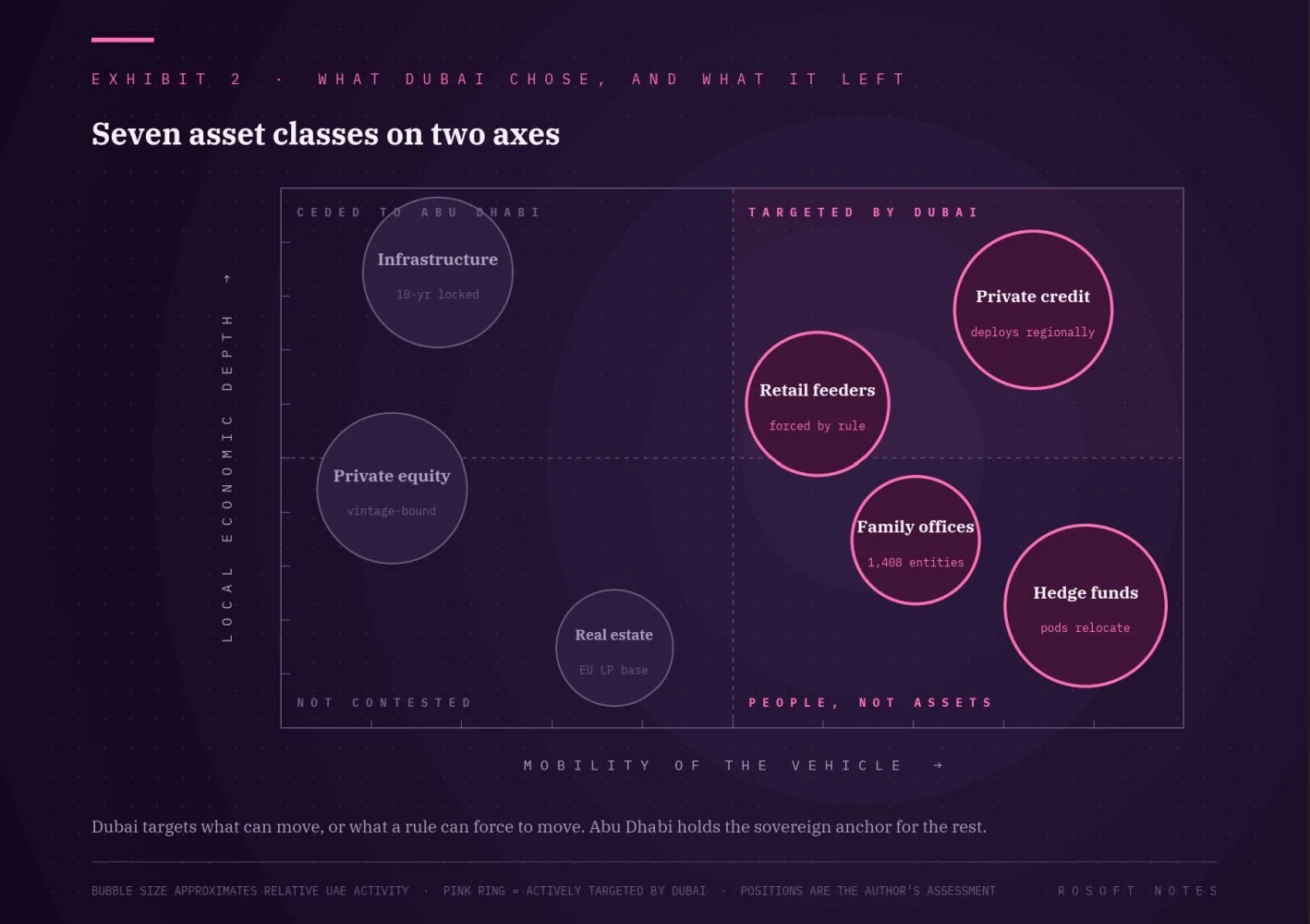
Private equity is immobile because the fund is a contract. Hedge funds are mobile because the fund is irrelevant.
Dubai went after the mobile thing.
3. Why hedge funds, why private credit, why retail
Hedge funds, because the acquisition cost is zero and the product is personal tax. No subsidy, no incentive, no domicile change required. Zero income tax and zero capital gains tax on a bonus that is a PM's entire economic year, a change measured in tens of percentage points rather than basis points on NAV. There is a mechanical accelerant most people miss: under the pass-through expense model the large platforms run, the pod's compensation, rent and technology are charged to the fund rather than to the manager's own P&L. Relocating a pod is close to cost-neutral for Millennium and enormously accretive for the individual. That asymmetry, more than any brochure, explains the 37%. Most of those pods came out of London, and a good share left because of UK policy choices, the end of non-dom status and the carried interest reforms among them, rather than because of anything Dubai said. Dubai caught what London dropped.
It also bought credibility faster than anything else could. Getting Millennium, Brevan Howard, BlueCrest, Squarepoint and Silver Point on the ground is a reputational down payment. And the time zone is a genuine operating advantage for macro and systematic books, because Dubai trades the Asian close and the European open inside one day.
Private credit, because it is the only asset class where the fund, the manager and the people can all sit in one place. If a strategy is lending into UAE and Saudi assets, nothing about it needs Europe. PwC projects GCC and Egypt private credit growing from around $5bn in 2024 to between $11bn and $20bn by 2030, a 15% to 30% compound rate. Abu Dhabi's private credit strategy names attracting international managers to establish local presence as an explicit priority. This is the bet with the longest payoff and the one Dubai shares with Abu Dhabi rather than owns.
Retail, because it is the only lever that has demonstrably forced a vehicle into the UAE. Since 1 April 2024, public distribution to onshore UAE retail has been limited to locally domiciled funds. Watch what happened next. Franklin Templeton launched seven DIFC feeder funds in July 2024 whose stated sole objective is investing in its own Luxembourg and Ireland domiciled UCITS. BlackRock incorporated five DIFC public funds in October 2024. PIMCO added two in June 2025. Amundi, Fundsmith, Principal, Allianz Global Investors and Standard Chartered all followed the same shape: a locally domiciled wrapper over a European master that never moved.
For scale, Aditum, the largest DIFC feeder platform, ran 15 funds holding just over $250m as at April 2025 with 13 people. Fifteen entries added to the fund count. Small per vehicle. Recurring for as long as the fund exists, and, as it turns out, the most resilient structure Dubai has.
Tax moves people. Only rules move vehicles. That lesson has been sitting in plain sight since 2024.
4. Why not private equity and infrastructure
Two reasons, and the second is the honest one.
The first is structural, covered above. Closed-ended funds relocate only at the next vintage, and even then European institutional investors constrain the answer. German insurers under the Anlageverordnung, Dutch and Nordic pension mandates, Solvency II look-through: all of it pushes toward EEA domicile whatever the GP would prefer.
The second reason is that Dubai does not have the anchor capital, and Abu Dhabi does. ADIA, Mubadala and ADQ together run somewhere around $1.7tn. Private markets funds are anchored by sovereign cheques, and those cheques are 130 kilometres down the E11.
So look at where the private markets cohort actually landed. EQT, Bain Capital, Barings, Partners Group, HarbourVest, PATRIZIA, Muzinich, Monroe, PGIM, Nuveen, KKR, Adams Street, Investindustrial. Abu Dhabi, almost without exception.
Dubai did not lose that contest. It declined to enter it. I think that was deliberate and I think it was right.It is also how the UAE works. Dubai and Abu Dhabi divide the market by design, people and distribution in one, sovereign capital and private markets in the other, and the firms that do best in the country have seats in both.
> A question for anyone running a Gulf office. Of the twenty or so European and US managers that opened in Abu Dhabi since 2024, most hold advisory and arranging permissions only. That means they raise money and do not deploy it. As far as I can find, one European GP has crossed into managing a locally domiciled fund. If your firm is one of the advisory-only cohort, what would it take to make the upgrade, and is anyone actually asking you to?
5. What Dubai gets, and what it does not
Here is where I part company with the more enthusiastic version of this story.
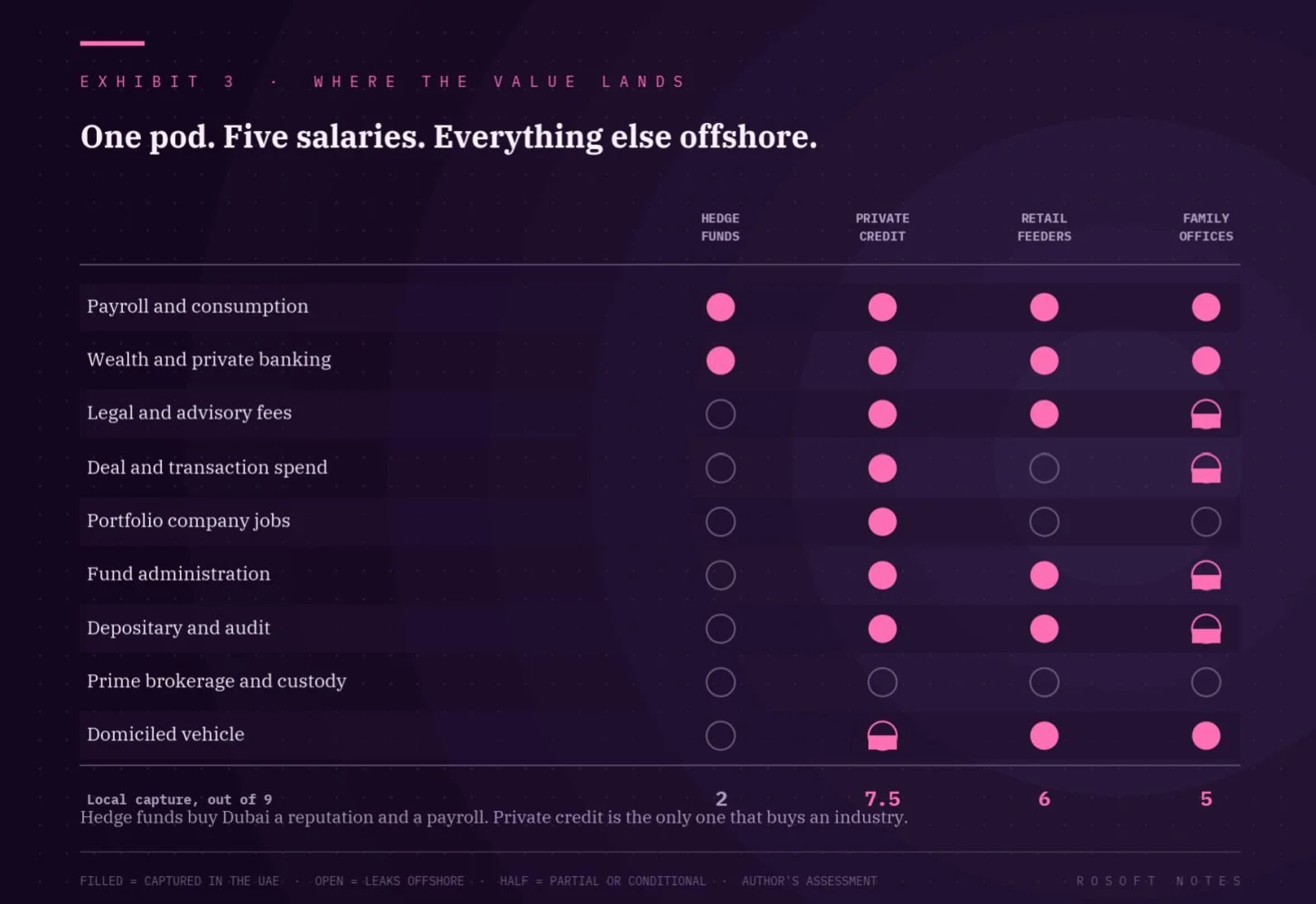
A hedge fund pod is five well-paid jobs and almost nothing else. Prime brokerage books in London or New York. The administrator and auditor sit in Cayman. There is no depositary. The vehicle is Cayman, so no local directors, no local administration fee, no local ISIN. Under the pass-through model, even the salaries and rent are charged to the fund rather than appearing as local corporate profit. Millennium's roughly 120 people across 25 Dubai pods is the largest single footprint anyone has, and it is 120 people against a DIFC workforce of 50,200.
What Dubai does get is real, just not what the AUM headline implies.
Consumption. Very high earners, taxed at zero, spending into property, schooling, hospitality and private aviation. Dubai monetises residents directly through real estate in a way most financial centres cannot.
Wealth conversion, which is the actual revenue line. DIFC family-related entities reached 1,408 by mid-2026, up 36%, and foundations 1,409, up 67%. Hedge fund principals become family office clients. That is where recurring fee income lands, and it is the strongest commercial argument for the whole strategy.
Ecosystem gravity. Execution desks, data vendors, recruiters and eventually administrators follow the traders. Thin today. The tell that somebody is betting on it: Hillhouse bought Virtuzone in January 2025 and then Clara in February 2026, ADGM's largest licensed corporate service provider, running around 2,000 entities, before it opened its own office. Buying the plumbing ahead of the flow.
Scale. More than 10,000 active companies, 1,134 regulated firms, 592 wealth and asset management firms by H1 2026. Whatever you think of the AUM line, the ecosystem compounds.
6. Then the war
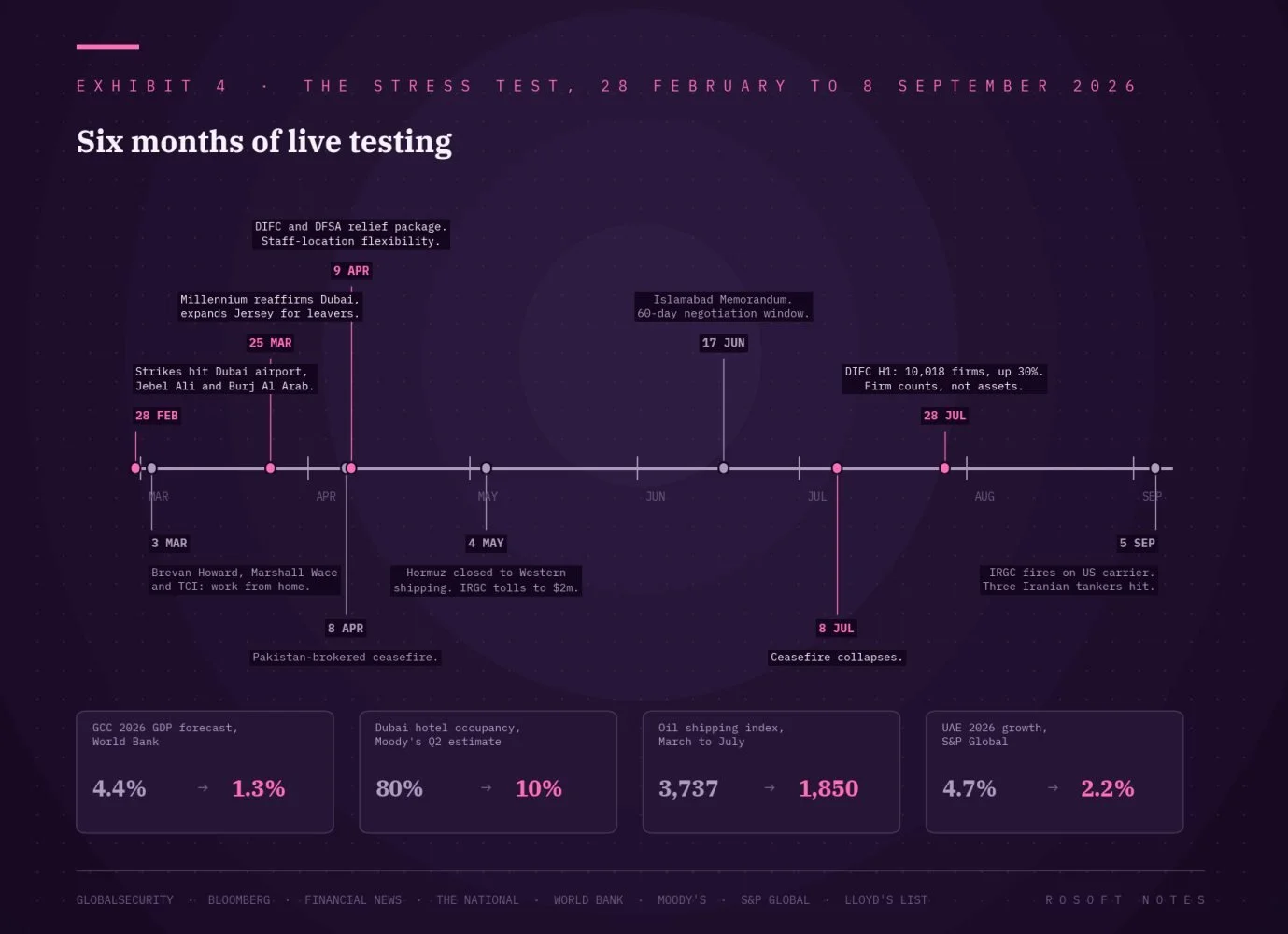
The first fortnight looked like a run. Brevan Howard, Marshall Wace and TCI told Abu Dhabi staff to work from home on 3 March. Some funds put employees in hotels outside the DIFC. Others mapped evacuation routes through Oman. A security firm reported seven corporate clients, including major finance and consulting houses, seeking to move between 1,000 and 3,000 employees out of the region by early March.
Then something more interesting happened. Firms that never comment on anything started issuing public endorsements.
On 25 March Millennium reaffirmed its commitment to Dubai in an internal email, while confirming it was exploring ways to relocate employees who no longer wanted to be there and preparing to expand Jersey for staff who refused to return. Verition extended its Dubai lease by five years. Hudson Bay, having opened an Abu Dhabi office on top of its Dubai operation, stressed the long-term prospects of the UAE. Brevan Howard gave Abu Dhabi staff the option to relocate temporarily to any of its nine global hubs. The phrase that stuck with me came from an expat banker quoted in the trade press: it feels more like Covid than a war zone.
Read those two facts together. The signalling asset held. The people asset wobbled. Millennium kept the office and lost some of the pods. That is the strategy's core vulnerability behaving exactly as predicted, in public, in real time.
On 9 April, the day after the Pakistan-brokered ceasefire, the DIFC and DFSA published a relief package. The DIFC side was cash-flow relief: instalment plans for licence renewals, flexible payment terms for tenants, grace periods on administrative fees, on top of Dubai's Dhs1bn stimulus. The DFSA side is the one that matters for this argument. Four areas of temporary, risk-based regulatory relief, and one of them is governance and staffing arrangements, with adjustments reflecting remote working practices and evolving staff location arrangements.
That is a regulator responding to reality within a day of the ceasefire, and it is to the DFSA's credit.. Mark Steward, the DFSA chief executive, described it as assistance to firms on request as a bridge to the resumption of normal trading.
The ceasefire held until 8 July and then collapsed. The Strait of Hormuz has been effectively closed to Western-allied shipping since 4 May, with the IRGC operating a toll regime of up to $2m per vessel payable in yuan or crypto. On 5 September Iranian missiles were fired at a US carrier and CENTCOM answered by disabling two Iranian crude carriers and sinking a third. As I write, day 192, Tehran is saying it will declare a restricted maritime zone within days.
The macro damage is on the board. The World Bank cut its 2026 GCC growth forecast from 4.4% to 1.3%. S&P took UAE growth from 4.7% to 2.2%. Moody's expected Dubai hotel occupancy to fall from 80% to 10% in the second quarter. More than 30,000 flights to the region were cancelled in the first month and jet fuel ran 90% above its annual average. Fitch had already flagged a Dubai property correction of up to 15% before the war, with UBS ranking the city fifth-highest bubble risk of 21 major markets, and expatriate departures now put direct pressure on that.
7. The war inverted the hierarchy
This is the part I did not expect.
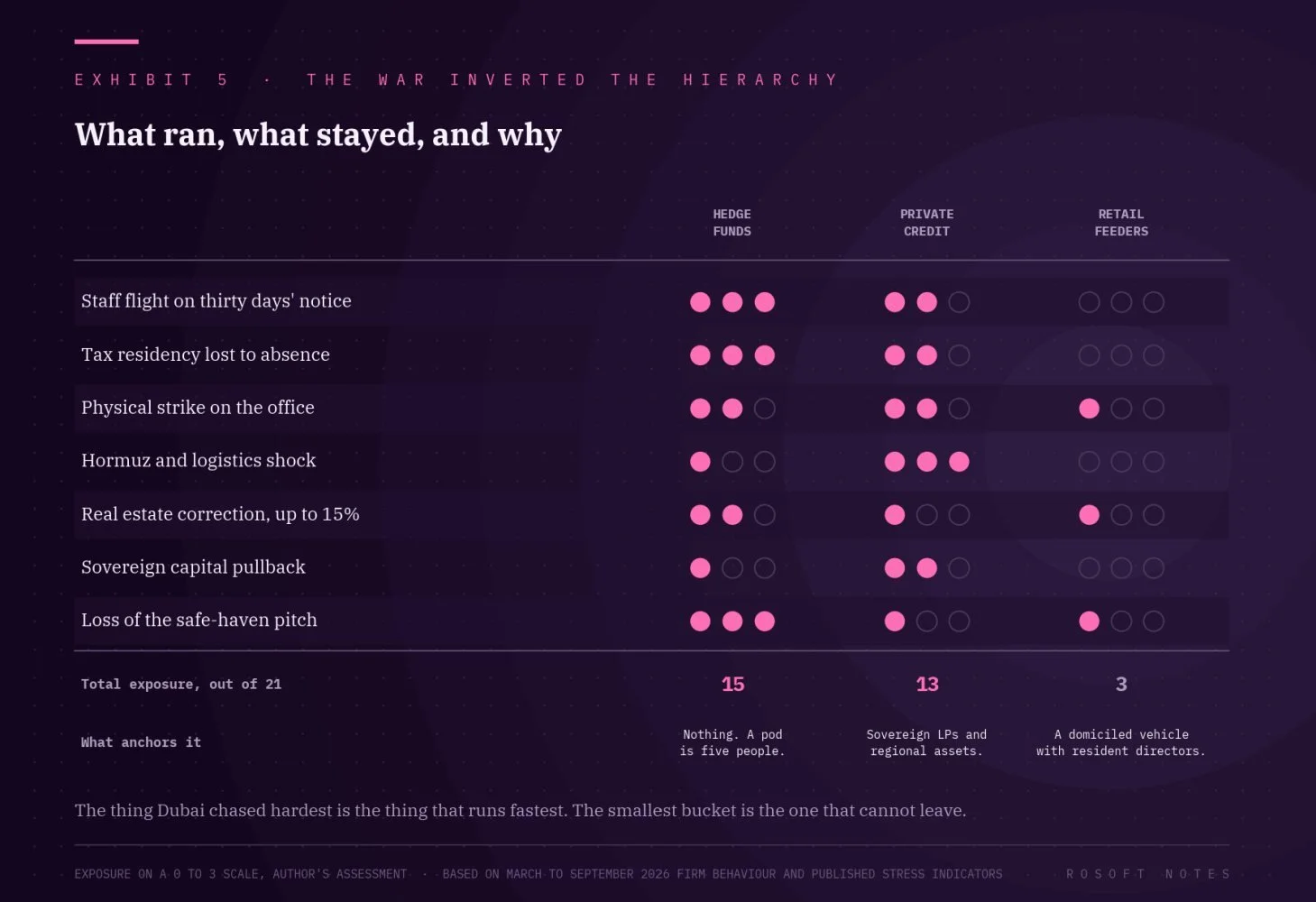
The thing Dubai chased hardest, hedge fund people, is the thing that runs fastest. There is no vehicle holding them, no locked capital, no ten-year fund life, no LPA. The relationship is at-will, and at-will relationships get tested by missiles.
The thing Dubai chased least, the locally domiciled retail feeder, is the thing that cannot leave. A DIFC public fund with resident directors and a DFSA registration does not evacuate through Muscat. It sits there. It is small, it is boring, and it is the most resilient structure the centre has.
Private credit sits in between. Regional assets are physically exposed, and Jebel Ali's berth fire is a reminder of what a regional deployment thesis actually means. But sovereign anchor capital is sticky. The region's seven main sovereign wealth funds accounted for 43% of all capital deployed by state-owned investors globally in 2025, and that money still needs managers. Fitch removed Qatar from negative rating watch on 5 September as risks to its LNG facilities eased. The capital is not going anywhere.
The mechanism nobody is pricing: the tax residency cliff
UAE tax residency depends on physical presence. A portfolio manager who left Dubai in March and has been running the book from Jersey or London since then may have already lost UAE residency for 2026, and with it the entire economic rationale for having moved. The DFSA's staff-location relief solves the regulatory problem. It does nothing for the tax problem, which sits with the Federal Tax Authority and, more dangerously, with HMRC and the IRS, both of which will take a keen interest in where a PM actually spent the year.
This is the single cleanest way the war attacks Dubai's core product. Not by destroying the office, but by dissolving the residency status the office was there to support.
> If you run a pod in Dubai, I would like to know. How many days have you spent outside the UAE since 28 February, and has anyone in your firm actually run the residency arithmetic for 2026? My suspicion is that the answer at most platforms is no, and that the reckoning arrives in the first quarter of 2027.
8. How Dubai gets through this
The unconditional safe-haven pitch has been tested and needs rewriting.. What replaces it has to be a resilience pitch, priced honestly for risk, and I think it has six components.
Convert presence into domicile. A pod can leave. A domiciled fund with resident directors cannot. The DFSA's Consultation Paper 173, which closed on 7 September, proposes a lighter, disclosure-led regime for professional investor funds and the removal of the External Fund Manager route. That is the right instinct at the right moment: make it cheap and fast for a hedge fund to stand up a DIFC-domiciled parallel vehicle, and the centre acquires an anchor it currently lacks.
Fix the residency cliff explicitly. One option open to the FTA is provision for the 2026 tax year, treating days spent outside the UAE during declared conflict periods as UAE days for residency purposes. Singapore did the equivalent during Covid. Until this exists, every PM who left is carrying an unquantified liability, and every PM thinking of coming has a reason to wait.
Deepen the servicing layer. Administration, depositary, prime brokerage. This is the layer that generates recurring revenue independent of any individual, and it is the layer Dubai has least of. Hillhouse buying Clara is the private sector moving first. The DIFC has a case for supporting it.
Build the network, not the node. Dubai, Abu Dhabi and Riyadh as a distributed regional platform with staff able to rotate between them under a single regulatory understanding. A firm with seats in all three is far harder to dislodge than a firm with one office in the DIFC, and Saudi's new Simplified Investment Funds framework of March 2026 makes Riyadh a real third leg for the first time.
Talk about the air defence. The UAE's interceptor performance in March was, by the accounts I have seen, performed well by every account I have seen. That is a selling point and nobody in the financial centre is using it. Physical security is now part of the product and should be marketed as such, alongside the Habshan-Fujairah bypass that lets UAE crude reach the Gulf of Oman without transiting Hormuz.
Price it. Rent, licence fees and the personal tax advantage should now be understood as compensation for geopolitical exposure, and the honest version of the pitch says so. A jurisdiction that acknowledges its risk premium is more credible than one that claims not to have one.
9. Where I come out
Dubai ran a clear-eyed strategy. It identified that fund domicile was sticky and unwinnable, that the mobile high-value asset was the individual, and that a distribution rule could force the one category of vehicle regulation can actually move. It left private markets to the emirate with the sovereign balance sheet and put its effort into people, lifestyle and speed. The result was a financial centre that looked larger on manager count than on assets, and that was exactly what it was engineered to be.
Then the war marked that bet to market. The signalling asset held: the endorsements from Millennium, Verition and Hudson Bay are real and they matter. The people asset wobbled, and the pods that went to Jersey are the strategy's known weakness showing up on schedule. The smallest and least glamorous bucket, the domiciled retail feeder, turned out to be the only one with nowhere to run.
The next chapter is whether Dubai learns the right lesson from that. The wrong lesson is to double down on recruiting portfolio managers with a bigger tax pitch. The right lesson is that presence without domicile is a lease, and leases get broken. The centre needs to convert the people it attracted into structures that stay when the people do not.
Dubai bought a workforce, a reputation and a wealth management franchise. It has not yet bought a fund industry, and the war has shown it why that distinction matters.
> Three things I would genuinely like to be argued out of. First, that the Jersey expansion at Millennium is temporary and the pods come back within a quarter of a settlement. Second, that the sovereign anchor is strong enough to hold the private credit cohort through a two-year conflict. Third, that a residency force majeure rule is politically achievable in Abu Dhabi. If you have a view on any of them, the comments are open and I read all of them.
Mohsin Qadir writes RoSoft Notes on financial services operations, fund structuring and market infrastructure. Views are personal and not investment advice or support of any political views.
Sources: DIFC 2025 annual results and H1 2026 results; DFSA Annual Report 2025 and Consultation Paper 173; DIFC and DFSA relief measures of 9 April 2026; ADGM 2025 and Q1 2026 releases; Bloomberg, Financial News and Hedgeweek reporting on firm behaviour, March to April 2026; GlobalSecurity daily conflict updates to 7 September 2026; World Bank, S&P Global, Moody's, Oxford Economics, Fitch and UBS estimates as cited; PwC GCC private credit projections; Lloyd's List Intelligence on Hormuz transits. Where a figure reflects a proposal or an estimate rather than a published outcome, it is described as such. The residency and force majeure points are the author's analysis and not tax advice.
Frequently asked questions
Why did Dubai focus on hedge funds instead of private equity?
A closed-ended private equity fund is a ten-year contract and can't be redomiciled mid-life, so it only arrives in a new jurisdiction as a new vintage. A hedge fund pod is a self-contained P&L that can move to the DIFC without touching the fund, the LPs or the prime broker. Abu Dhabi also holds the sovereign anchor capital that private markets funds need.
What is the UAE tax residency risk for portfolio managers who left Dubai in 2026?
UAE tax residency depends on physical presence. A portfolio manager who left Dubai in March 2026 and has run the book from Jersey or London since may already have lost UAE residency for 2026. The DFSA's staff-location relief covers the regulatory side only. The tax question sits with the Federal Tax Authority, HMRC and the IRS.
Why are DIFC retail feeder funds more resilient than hedge fund offices?
A locally domiciled DIFC public fund has resident directors and a DFSA registration, so it stays when people leave. UAE rules since April 2024 require public retail distribution through locally domiciled funds, which created these feeders. Hedge fund staff are at-will, and some moved out after the conflict reached the Gulf on 28 February 2026.
More of Mohsin Qadir's notes on fund structuring and private markets operations are on the research page. More RoSoft Notes research.
About the author
Mohsin Qadir is the founder of KauserOS, an AI-native operating platform for private equity and private credit managers. He was divisional CFO and COO of Private Assets at Fidelity International and interim Head of Investment Operations at Bridgepoint, and earlier worked at ICG and BNP Paribas CIB. He writes RoSoft Notes.