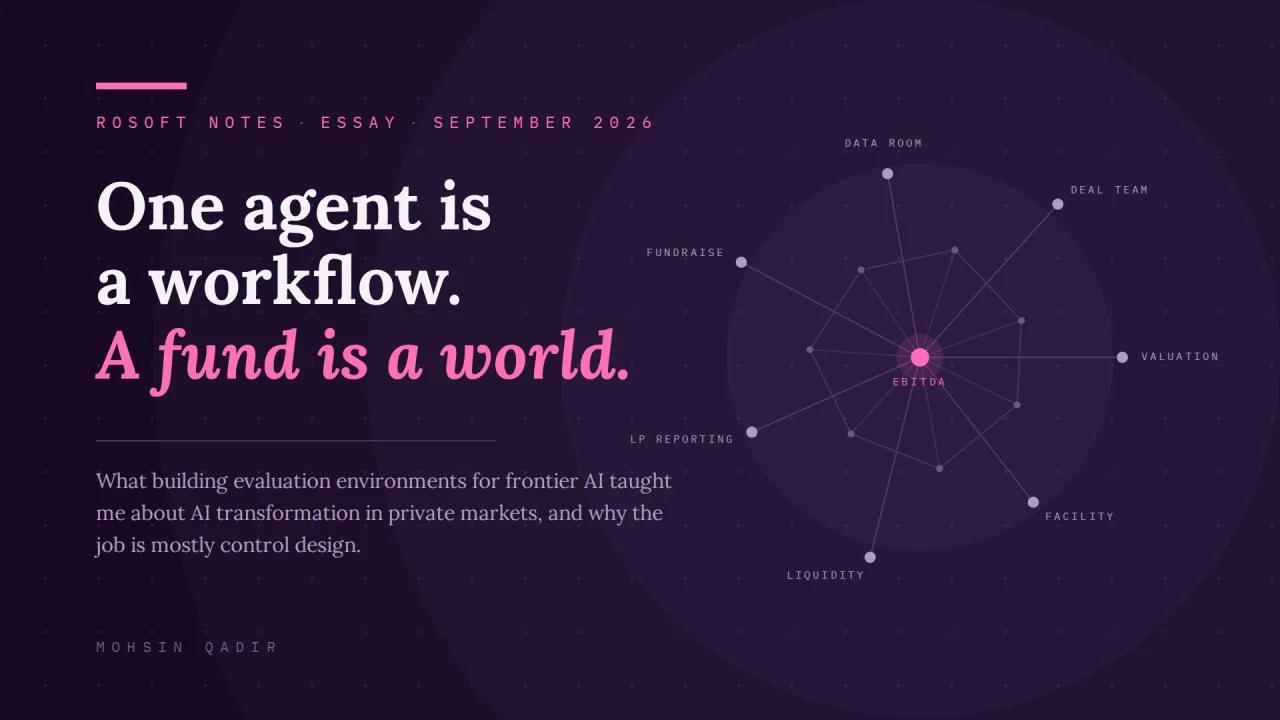
First published in RoSoft Notes on LinkedIn on 23 September 2026. Figures and market references are as of that date.
In short
AI agents in a private markets firm break where one number, such as EBITDA or NAV, has several legitimate bases and nobody wrote down which one governs. The fix is control design. Give every figure a lineage, write down the basis rules, entitle agents by task, test for restraint, and let a deterministic layer hold the arithmetic.
- In one published study, a leading model went from roughly 20% accuracy on financial retrieval using web search to roughly 90% when handed a structured data API.
- Top scores on the published finance agent benchmarks climbed from around 52% in May to the low sixties by September, mostly on retrieval questions.
- A single half-year EBITDA figure reaches more than ten destinations, from the NAV facility borrowing base to LP capital accounts, on at least four legitimately different bases.
- Single-workflow agents already work for bounded tasks such as drafting capital call notices, assembling covenant compliance certificates and first-pass KYC and AML file review.
- The EU AI Act's high-risk obligations took effect in August, and a supervisor's first question about an automated decision is how it was reached.
Private markets firms are hiring for AI transformation. Most of the job is deciding which number governs, and that problem is older than the technology.
I have been watching the same failure for about fifteen years.
It used to happen on ERP migrations. A firm would spend eighteen months and a serious budget moving onto a new platform, go live, and discover that three departments had been carrying different versions of the same number for years. Each version was defensible. Each had a history and an owner. Nobody had written down which one governed at the point of decision, because nobody had needed to: a controller somewhere in the middle reconciled them every month and mentioned it to no one.
When the system went live, that quiet monthly reconciliation went with it. The disagreement surfaced inside a quarter, and the vendor got the blame.
I now watch the identical thing happen to AI agents, except that it takes an afternoon rather than a year, and the agent does not hesitate the way a nervous analyst does. It does not remember that the CFO said in March that the facility definition overrides the management one. Unless someone wrote that down somewhere the agent can read, it is not there.
The finance seat is where you find out whether the architecture holds
I have never found the boundary between finance work and technology work particularly convincing, mostly because of where I have spent my time. Selecting and onboarding ERP, HCM and CRM platforms. Running OMS and PMS evaluations. Moving a valuations and portfolio monitoring function off spreadsheets and watching the investment committee cycle shorten by roughly a third. Onboarding administrators, custodians and banks across five jurisdictions. Writing control frameworks meant to survive an audit and a complete change of staff. And, across a few hundred conversations with software buyers and vendors in banking, asset management, wealth and insurance, hearing the same implementation stories from both sides of the table.
None of that is engineering. All of it is architecture, in the sense that matters commercially: deciding where a number comes from, who is allowed to change it, and what happens when two systems disagree. A platform can be well built, well configured and correctly integrated, and still produce a pack the valuation committee cannot defend, because the definition it used was not the definition the covenant references.
The question changed shape
Over the past couple of years I have been doing two kinds of work in parallel, and one of them has taught me a great deal about the other.
The first is the expected kind: putting AI agents into fund finance workflows, and advising firms on where they belong and where they do not.
The second is less usual. I work on how frontier models are trained and evaluated. That means writing the grading rulebooks a distributed group of reviewers uses to reach the same verdict on the same output, scoring agent trajectories against rubrics with several dozen criteria, classifying failures at the level of a phrase with a written justification for every call, and building the synthetic record sets the models get tested against.
If you have not seen that work, the shape of it is not what people assume. You do not sit there writing prompts. You build a company: a complete, internally consistent set of records for a fictional firm across a reporting period, then the deliverables a real professional would produce from it, then the correct answers, then the rules for grading them. Every figure in the record set declares where it comes from, either a named document or arithmetic on named parent figures. No number appears twice in two forms. Nothing references a fact that has not yet happened.
The design target is the reverse of anything in commercial software. You are not building something the model passes. You are building something it fails, so you can find out precisely where and why.
It took a classroom to connect the two. Partway through an executive MBA at The University of Chicago Booth School of Business Booth I took Sanjog Misra's Applied AI course expecting a survey of the technology, and got instead a course on how a model's behaviour is shaped by the environment you put it in. Within a couple of weeks I recognised the problem as the one I had spent fifteen years solving with control frameworks, under a different name. Since then I have stopped describing myself as a finance person who uses AI. The work is designing the operating model a GP will actually run on, with agents, deterministic logic and people each holding the rules they are fit to hold. A finance function built that way is AI-native in the only sense that matters: the controls were designed for the models from the start rather than retrofitted. That is a CFO's job to own, whatever the title ends up being.
Where single-workflow agents earn their keep
A good deal of the current generation works, and it is worth being specific about which parts.
Drafting a capital call notice from a commitment register and a drawdown schedule works. Assembling a covenant compliance certificate from a facility agreement and a month-end pack works. So does data room indexing and redaction, first-pass KYC and AML file review against a written policy, and a first draft of an LP due diligence questionnaire. The pattern is consistent: bounded input, template output, a reviewer who spends minutes rather than hours. Quick payback, small blast radius, which is why most GPs I speak to already have something like this running.
Then you hit the boundary, and it is always the same boundary. The agent works until the number it needs lives in another function's system, on another function's basis, and nobody wrote down which basis governs.
A GP is not fifteen workflows. It is one fact moving through fifteen seats.
Follow a single number through a firm and you will see the problem more clearly than any architecture diagram shows it.
A portfolio company board pack reports EBITDA for the half year. Management has added back a restructuring charge and a one-off legal settlement. Both add-backs are defensible.
That figure reaches portfolio monitoring, where it is normalised against the firm's house definition, which happens to treat one of those add-backs differently. The normalised figure goes into the valuation, meets a multiple drawn from a comparable set, and becomes a mark. The mark lands in the books and records as a carrying value and rolls into fund NAV.
From there it splits. It feeds the borrowing base of the NAV facility, where eligible NAV is struck after concentration haircuts and is not the NAV that appears in the accounts. It feeds the fund-level liquidity forecast, and separately the portfolio company's own cash profile and facility headroom. It feeds LP capital accounts and, through them, the IRR and TVPI on investor statements. It becomes the track record page in the next fundraise deck. It sits in the data room a secondary buyer will read. And it becomes a data point in the comparable set the deal team uses to price the next asset in that sector.
Around all of that sits the layer nobody puts on the diagram: investor onboarding, KYC and AML, payment authorisation, and the entitlement rules deciding who is allowed to see which version.
One number, more than ten destinations, at least four legitimately different bases. Each is correct in its own context, and none is written down anywhere as a governing rule.
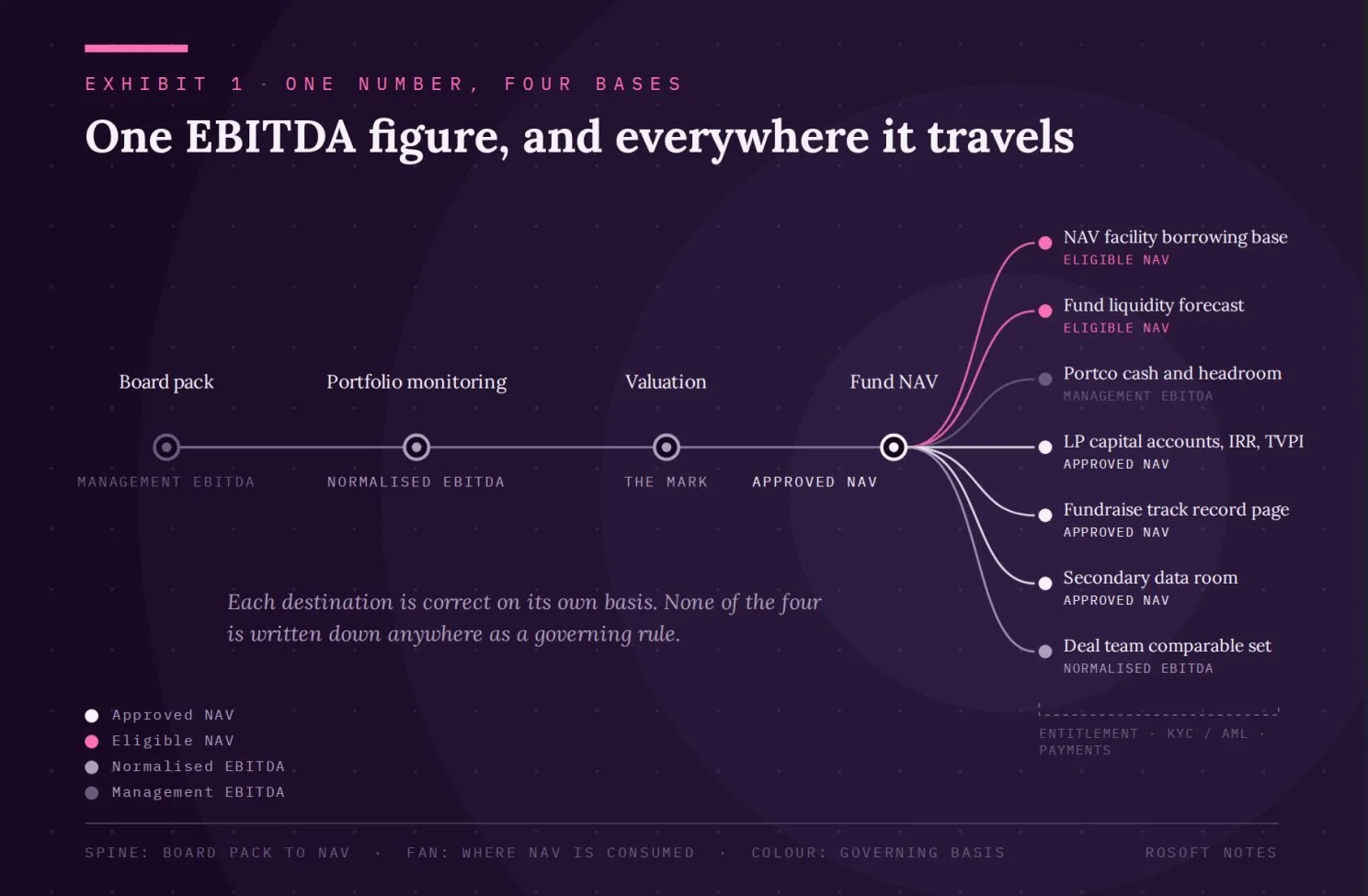
A human organisation absorbs this easily. There is a fund controller who knows the covenant references a different NAV, and a valuations lead who knows which add-back house policy rejects. That knowledge lives in people, moves by apprenticeship, and never reaches a procedure document. Point an agent at it and the knowledge is simply gone.
Four things the evaluation work taught me
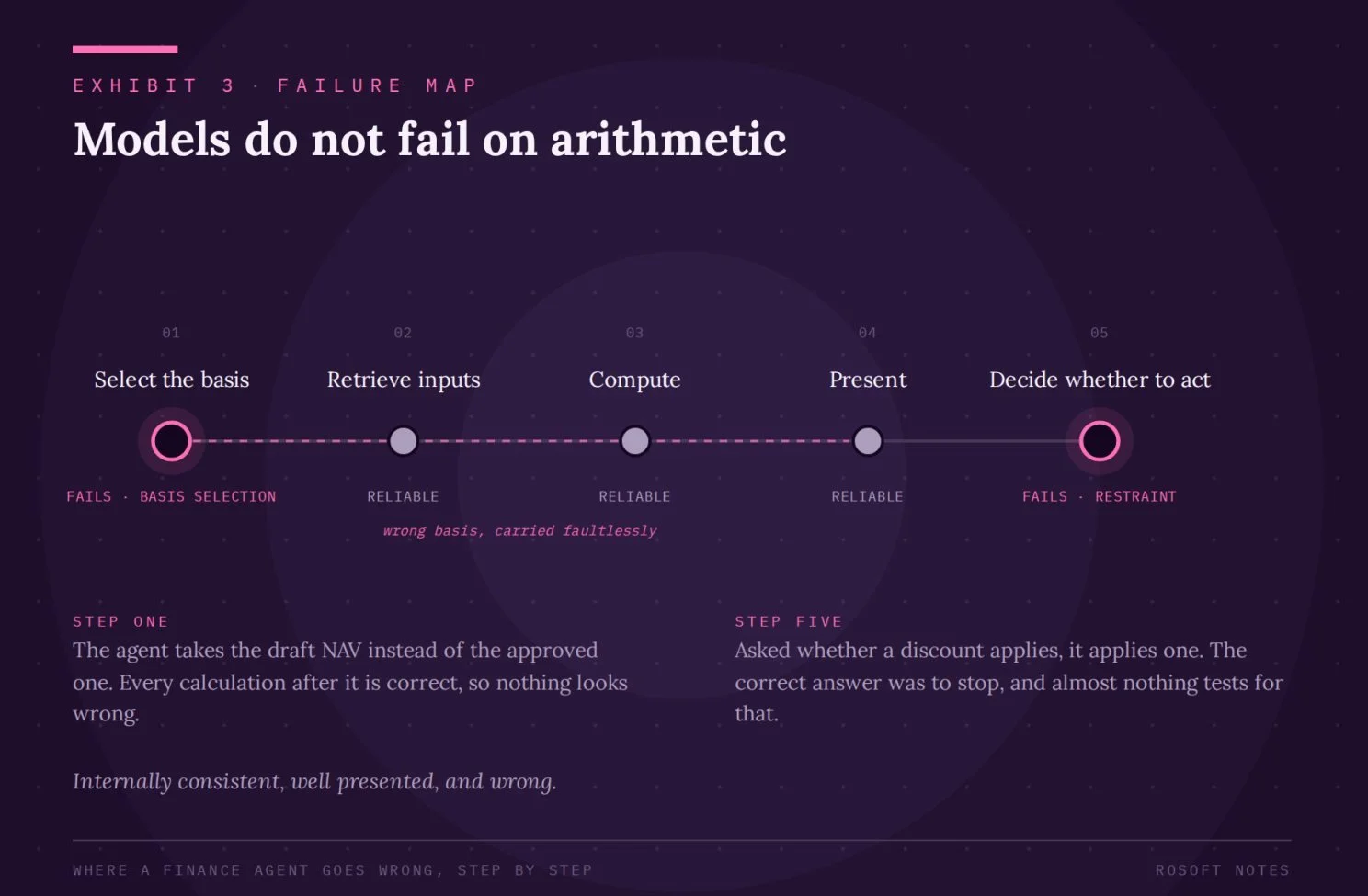
Models do not fail on arithmetic. They fail on basis selection and on restraint. A frontier model will rebuild your waterfall, your LTV and your capital account calculation correctly. What it does instead is pick the wrong version of an input at step one and carry it faultlessly through every dependent answer, so that everything downstream is internally consistent, well presented and wrong. Models are also poor at declining to perform a calculation they are capable of performing. Ask whether a discount applies and one gets applied. In valuation, tax and disclosure the correct answer is very often to stop, and almost nothing on the market tests for it.
What the agent can see matters more than which model you bought. In one published study, a leading model went from roughly 20% accuracy on financial retrieval using web search to roughly 90% when handed a structured data API. Same model; the plumbing was the capability. Entitlement is therefore not a wrapper around the control. It is the control. An agent given the full document repository will find the answer, including the answers it should never have been able to reach.
Grade the route, not just the output. A right answer reached by the wrong path is a failure that has not happened yet. This is the widest gap between how software gets accepted today and how it needs to be accepted when a model sits in the seat.
Difficulty has to be designed rather than discovered. An evaluation your system passes tells you nothing. Top scores on the published finance agent benchmarks climbed from around 52% in May to the low sixties by September, which sounds like progress until you look at what the questions test. Most of them are retrieval, so the climb tells you retrieval improved. When a vendor shows you an accuracy score, the useful question is what the hard cases were and who wrote them.
The prompt was never the skill as most of what the finance world has learned about AI in the past two years is how to talk to it. Prompt libraries, internal training on phrasing, a generation of capable people who can get a decent first draft out of a chat window and have reasonably concluded that this is the skill.
The shift to agentic AI makes short work of that. Nothing about how you phrase a question determines whether an agent gets a covenant test right. What determines it is what the agent can see, which source wins when two disagree, what it may decide without asking, what it must escalate, and what has to be true before the work counts as finished.
Every one of those is a control question, and finance people have been answering control questions their whole careers. We have just never had to write the answers down, because they lived in the people doing the work. Training an agent, in practice, looks less like machine learning and more like what a good controller does with a new joiner in their first month. Here is the source you trust. Here is where that definition changes. Here is what you may sign and what you may not. Here is where you stop and ask.
A few of those rules that are obvious to any practitioner and invisible to a model: an approved valuation overrides a draft NAV, even when the draft is newer. The LPA governs the waterfall, not the waterfall workbook someone has maintained for six years. Facility documentation governs eligibility, not the assumption baked into the borrowing base template. Treasury owns contractual LP timing, and the deal team's expected date is not the contractual one. Fully-loaded economics are not the headline IRR on the deal sheet.
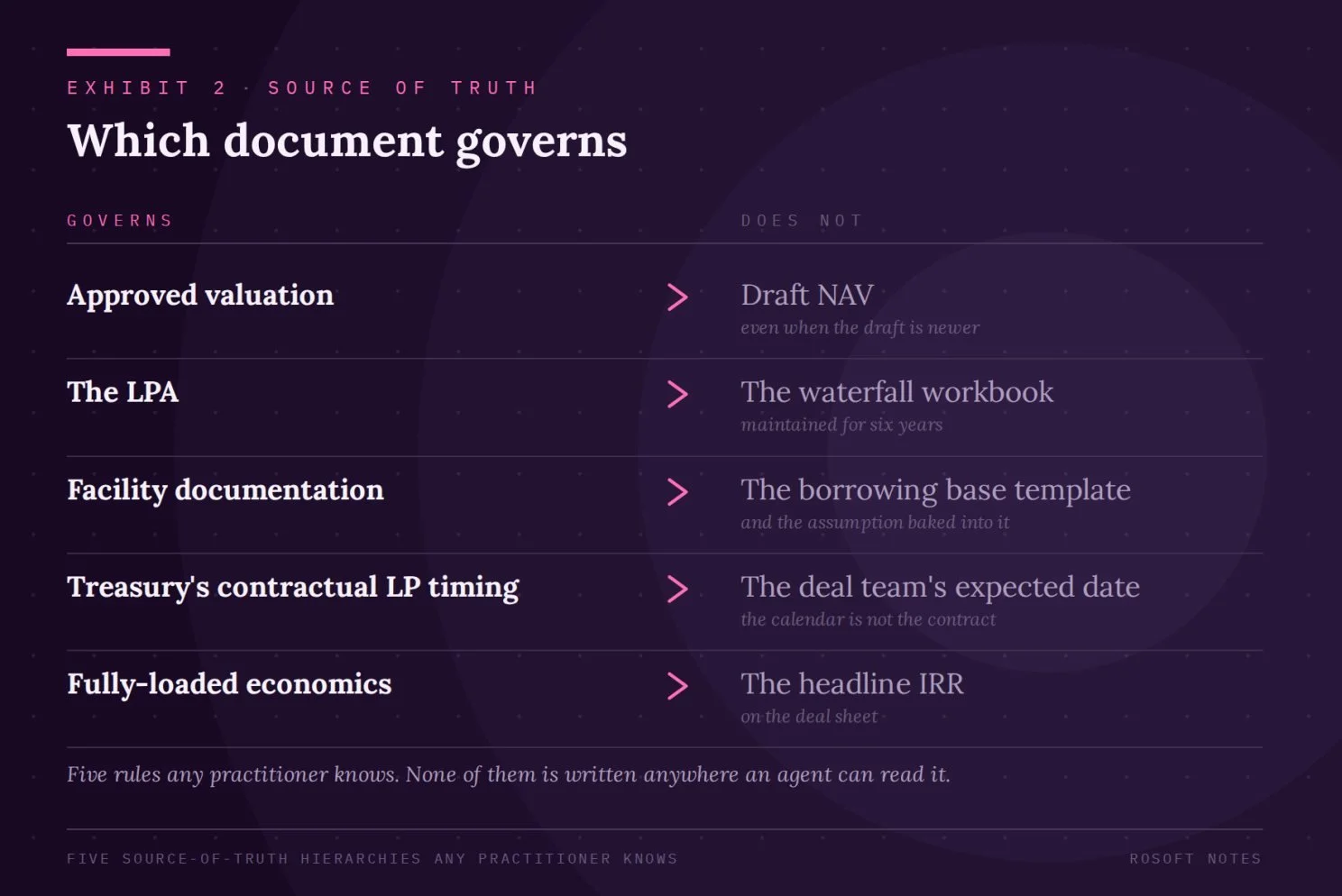
None of that is written anywhere an agent can read. Each one is a source-of-truth hierarchy, and writing them down is the job.
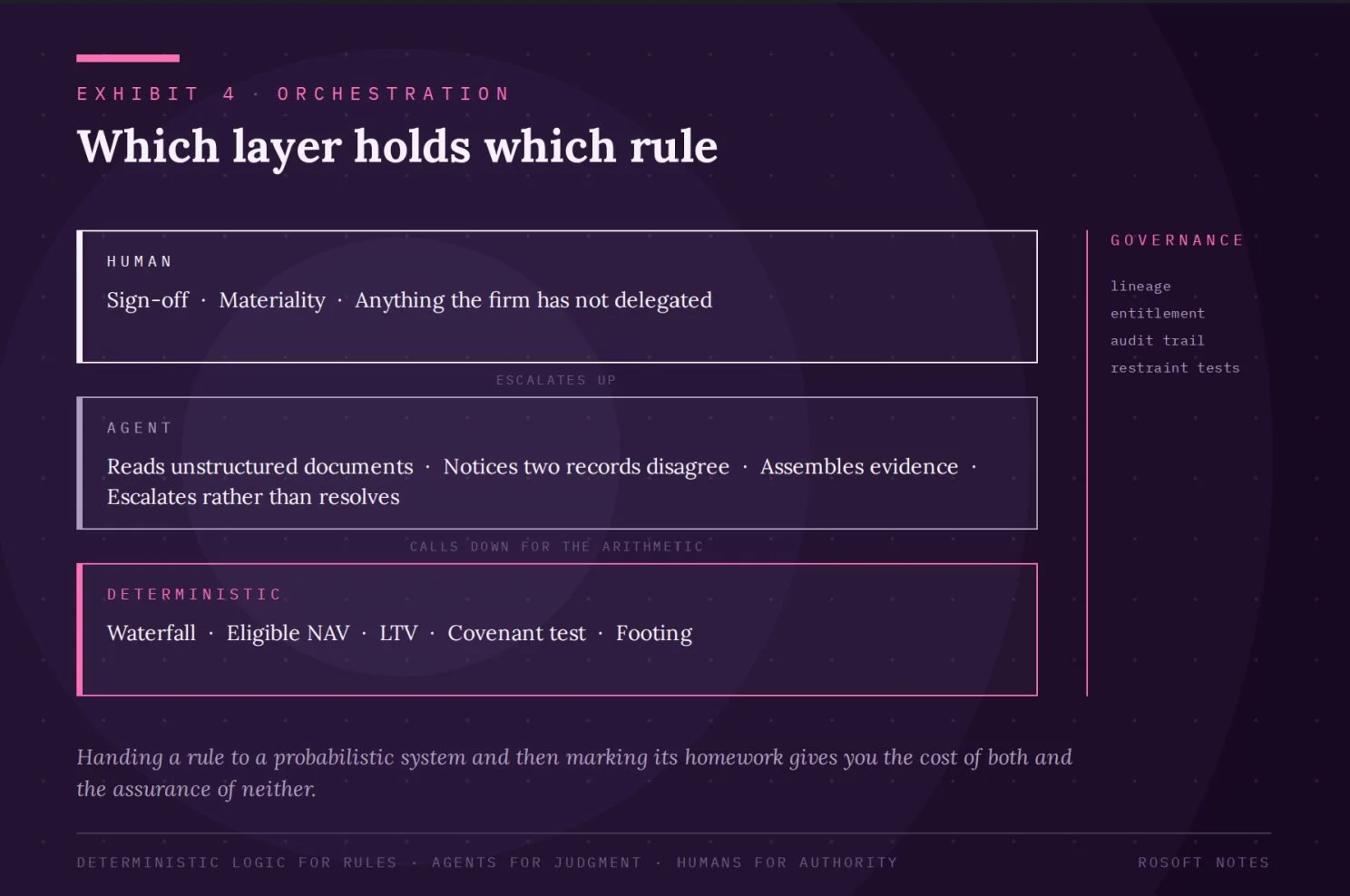
The other half of the job is deciding what should never reach a model at all. A waterfall is a rule. Eligible NAV after concentration haircuts is a rule. So is a covenant test. Handing a rule to a probabilistic system and then marking its homework gives you the cost of both and the assurance of neither, which is what a surprising number of pilots do. The orchestration question is which layer holds which rule, so that a deterministic layer carries the arithmetic and the model does what it is actually good at: reading an unstructured document, noticing that two records disagree, assembling the evidence, and escalating instead of resolving.
Where that line sits is a materiality and control judgment. It belongs to whoever signs the pack, not to whoever builds the pipeline.
Firms have started hiring for exactly this, under titles that are still settling: Chief AI Officer, head of AI transformation, AI operating model lead, occasionally something with "agentic" in it. In private markets the job specification is usually written by technology. The work, once you strip out the platform selection, is control design, model governance and deciding where human sign-off sits, which is to say it is a finance and operations job with a new name.
So the boring part of the job has quietly become the valuable part. Approval authorities, reconciliation, source hierarchies, audit trail, materiality thresholds, model governance. Nobody ever enjoyed writing any of it. It is now the specification.
Where I would start now if begninning? I would not start with an agent.
I would start with lineage. Every figure that reaches a committee, a lender or an investor declares whether it originates in a named source document or is derived from named parent figures, and if derived, names its parents. This is unglamorous, and it is the highest-return artefact in the stack, because the same document makes an agent safe to deploy and makes the pack defensible to an auditor and a regulator on the same afternoon. In my experience almost no firm has one.
Then write down the basis rules: which EBITDA governs the valuation, which NAV governs the covenant, which cash position governs the liquidity certificate.
Then entitle by task rather than by role. The agent preparing the covenant certificate gets the facility agreement and the approved NAV. It does not get the draft.
And build restraint cases into acceptance testing, because declining to act is the behaviour you cannot recover after the fact.
The part you cannot buy. This is not, at heart, a technology problem, which is inconvenient, because technology is the part you can procure.
Vendors will sell you agents for portfolio monitoring, investor communications, fund accounting and deal sourcing, and some of them are good. None of them can sell you your own basis rules, because those sit in your fund documents, your house policies, your facility agreements and your accounting elections. That work belongs to finance and operations rather than to engineering, and it does not survive being delegated.
In a regulated firm the standard is higher than accuracy anyway. A model that is usually right and cannot show its route is harder to defend to a regulator than one that is occasionally wrong and can. The EU AI Act's high-risk obligations took effect in August, and the first question a supervisor asks about an automated decision is the same one an auditor has always asked: show me how you got there.
Which is the part I find genuinely interesting. Designing control environments for people and systems, and designing them for models, turn out to be the same discipline. The tools have changed completely. The first question has not changed at all: where does this number come from, and who gets to say so.
About the author
Mohsin Qadir is a private markets finance and operations executive, formerly Divisional CFO and COO of a private assets platform, and is completing an Executive MBA at the University of Chicago. He writes KauserOS notes, essays on AI transformation, private equity, SAAS, ,capital markets, finance and the GP operating model, and works on how frontier AI models are trained and evaluated.
This essay is written in a personal and academic capacity. The views are the author's own and do not represent any current or former employer, client or institution, including Chicago Booth. The fund examples are illustrative and describe no real firm, fund or transaction. Benchmark and survey figures come from public sources as at September 2026. Nothing here is investment, legal, accounting or regulatory advice.
Frequently asked questions
Why do AI agents fail in private equity fund operations?
They rarely fail on arithmetic. They pick the wrong version of an input at the first step, for example a management EBITDA where the house definition governs, then carry it faultlessly through every dependent answer. The result is consistent, well presented and wrong, because nobody wrote down which basis governs at the point of decision.
What is a basis rule in fund finance?
A basis rule says which version of a figure governs a given decision. An approved valuation overrides a draft NAV even when the draft is newer. The LPA governs the waterfall, not the workbook someone has kept for six years. Facility documentation governs borrowing base eligibility. In most firms these rules live in people's heads, where an agent can't read them.
Where should a GP start before deploying AI agents?
Start with lineage. Every figure that reaches a committee, lender or investor should declare whether it comes from a named source document or from named parent figures. Then write down the basis rules, give each agent only the documents its task needs, and build restraint cases into acceptance testing, since an agent that should have declined can't be fixed after the fact.
KauserOS holds each fund's contractual facts once, with clause-level evidence, so agents and people read the same governing record. See how the KauserOS platform works.