First published in RoSoft Notes on LinkedIn on 5 October 2026. Figures and market references are as of that date.
In short
When AI agents shop, the agent platforms capture the most new value because they own the customer's intent. Card networks like Mastercard hold their position through disputes, tokens, fraud scoring and agent identity, while issuers lose most as agents push down rewards-funded interchange. The next margin goes to whoever can prove an agent did what the customer asked, and pays out when it didn't.
- Mastercard closed its purchase of BVNK on 3 August 2026 for $1.5 billion plus up to $300 million in earn-out, twice BVNK's $750 million valuation from December 2024.
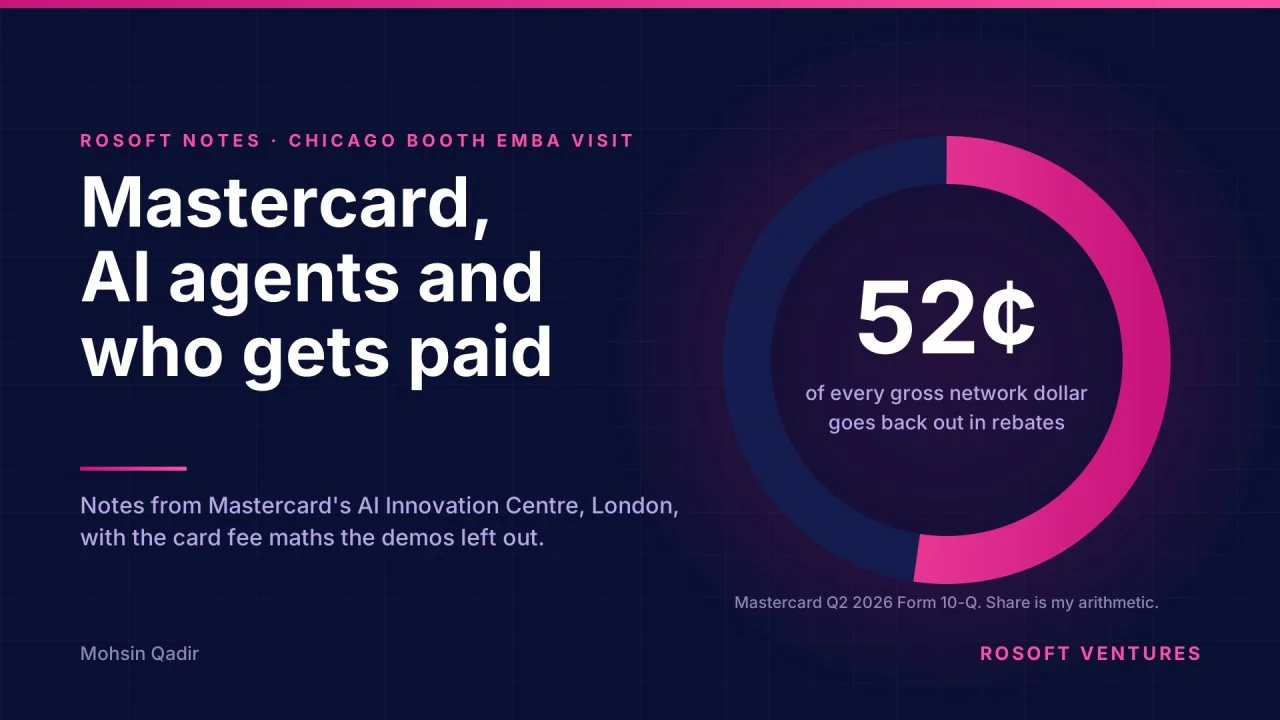
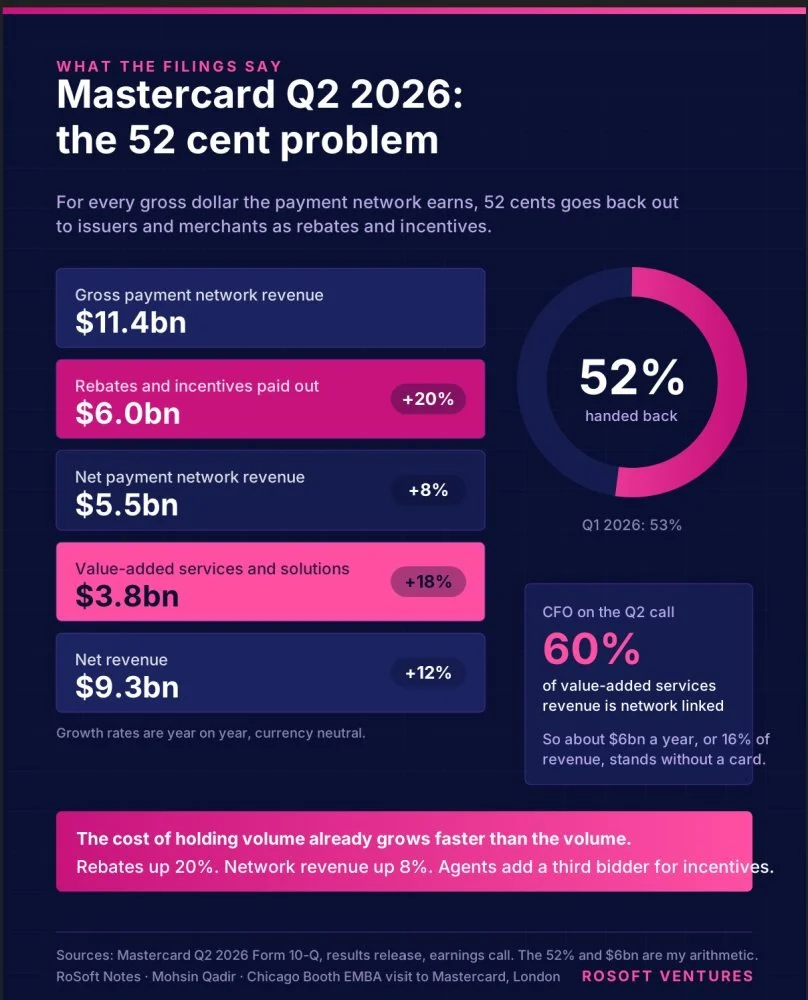
- In Q2 2026 Mastercard paid $6.0 billion in rebates and incentives against about $11.4 billion of gross payment network revenue, handing back 52 cents of every gross dollar.
- Value-added services grew 18% to $3.83 billion in Q2 2026, 41% of net revenue of $9.28 billion.
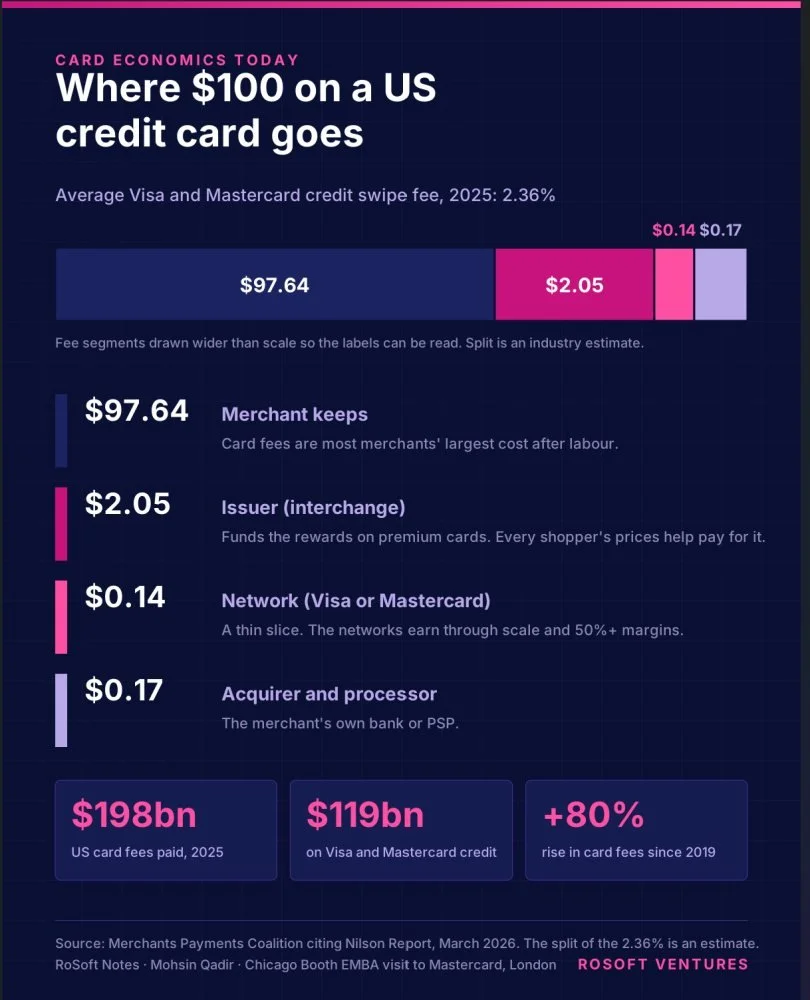
- US merchants paid $198 billion in card fees in 2025, with Visa and Mastercard credit cards making up $119 billion at an average rate of 2.36%.
- Morgan Stanley puts US agentic commerce at $190 billion to $385 billion by 2030, and a 4% agent fee on that volume runs about 1.7 times the card fee.
Notes from a Chicago Booth Executive MBA visit to Mastercard's London AI Innovation Centre, with the card fee maths the demos left out.
The lift at Mastercard's London office opens onto a floor that looks more like a product studio than a payments company. Our The University of Chicago Booth School of Business Executive MBA cohort filed in on a grey afternoon, took the coffee, and sat in front of a screen that read AI Innovation Centre.
I had one question in my notebook. If an AI agent picks what I buy, where I buy it and how I pay, what's left for a card network?
I've spent most of my career on the finance and operations side of financial services, in banking, private credit and asset management. So I watch a demo the way a CFO watches one. I want to know who gets paid, and whether that still holds in five years.
Two hours later I had a longer answer than I expected, and a page of arithmetic I did on the train home.
The travel demo
The Mastercard team opened with a travel proof of concept. Someone typed a request in plain English. Flight to New York, hotel near the meetings, stay inside budget, pay the cheapest way. The agent shortlisted options, explained its choice, and moved to verification and checkout.
Nobody in the room saw a checkout page. That was the point.
The interface was fine. The moment that stayed with me came when the agent chose how to pay. A person taps whatever card sits at the front of their wallet. An agent has no front of wallet. It weighs cost, credit terms, rewards and settlement speed, then picks. If payment choice becomes a scoring exercise, the rail with the lowest all-in cost wins more often.
Cards still bring a lot to that score. A credit line, chargeback rights, fraud liability rules and acceptance at more than 150 million locations all count. So I don't expect price alone to decide it. But I did write "price now matters at checkout" in the margin, and underlined it.
What Mastercard has built: Agent Pay, Verifiable Intent and BVNK
The product list ran longer than I expected.
Agent Pay lets an agent start a payment within limits the customer sets. Santander and Mastercard ran a live agent-initiated payment on Santander's infrastructure in March 2026, in a controlled setting.
Verifiable Intent, built with Google , keeps a tamper-resistant record linking what the customer authorised to what the agent then did. Mastercard built it on open standards so it works across AI platforms.
Agent Connect and Agent Suite for Merchants link shopping agents to merchant catalogues and checkouts.
Agent Pay for Machines launched in June 2026 with more than 30 backers. It covers machine-to-machine payments as small as a fraction of a cent.
And on 3 August 2026, Mastercard closed its purchase of BVNK , the London stablecoin infrastructure firm.
BVNK is the one I'd study. The 10-Q puts the price at $1.5 billion plus up to $300 million in earn-out. That's twice BVNK's $750 million valuation from December 2024. Coinbase walked away from talks at about $2 billion in November 2025. BVNK was also Visa's stablecoin settlement partner, and Visa put out a tender for a replacement on 18 August. In one deal Mastercard bought the pipes and took them away from its main rival.
Most of this is still in pilot. The direction is plain enough. Mastercard wants a seat in agent commerce even when the money doesn't move over a card.
Mastercard Dynamic Yield , the slide I photographed
Halfway through, a slide came up on Dynamic Yield, and I took a photo.
Mastercard bought Dynamic Yield from McDonald's in 2022. It sells personalisation to merchants: product recommendations, A/B testing, a conversational shopping tool called Shopping @Muse, and since July 2026 a set of agents that run campaign analysis for the merchant. Mastercard says it serves more than 80 million personalised sessions a day.
It sounds like a side business. I think it's the most interesting thing Mastercard owns in this area.
A card network earns at the moment of payment. Dynamic Yield earns earlier, when someone decides what to buy. Put Dynamic Yield on the merchant side, Agent Connect in the middle and Agent Pay at checkout, and Mastercard has a product at every step from discovery to settlement. If agents squeeze the payment step, the decision step is where the value goes.
The question I asked
Near the end, I asked about the hotel.
Say I ask for a flexible hotel near my meetings for under £300. The agent books a £220 room that's non-refundable and forty minutes away. The payment cleared. The booking went through. It still isn't what I asked for.
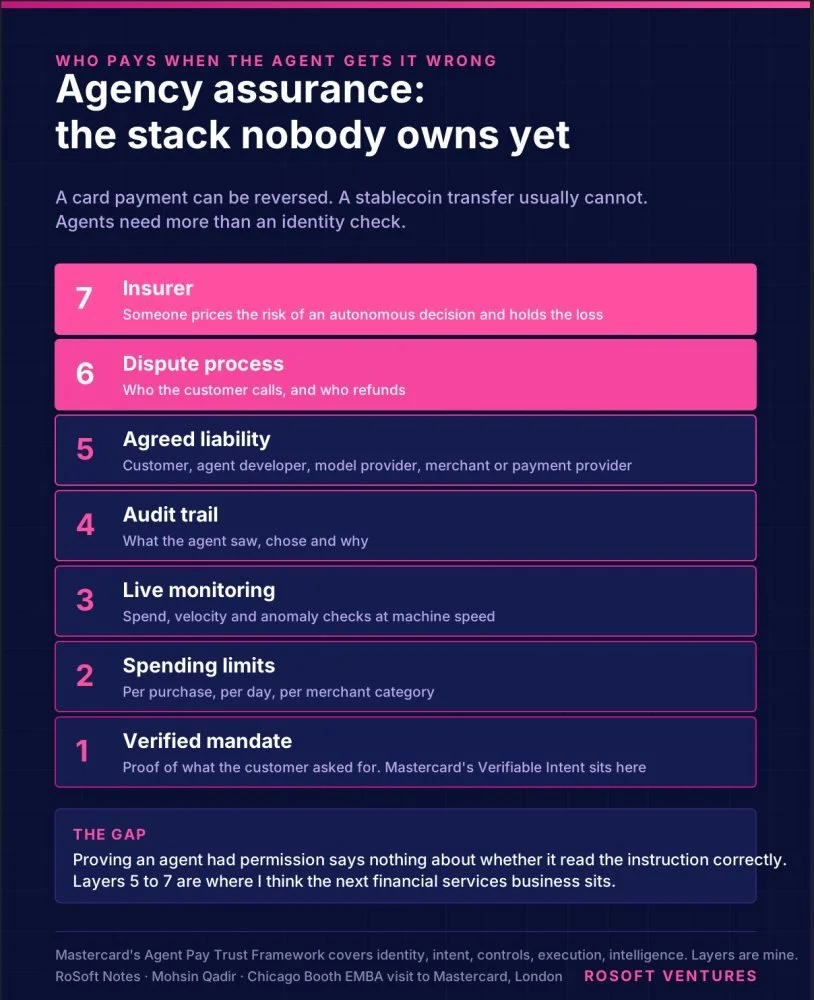
The answer pointed me to Know Your Agent, Verifiable Intent and the new Agent Pay Trust Framework, which covers identity, intent, controls, trusted execution and intelligence. All fair. But every one of those proves the agent had permission. None of them proves the agent read my instruction correctly.
Anyone who has worked under suitability rules in asset management will recognise the gap. An authorised trade can still be an unsuitable one. Agent commerce has no equivalent rule yet, and I think that gap is the biggest commercial opening in the whole area.
Who pays when the agent gets it wrong:
Card networks spent decades building chargebacks, dispute rules, fraud liability shifts and the honour-all-cards rule. Nobody wrote any of it for an agent that books the wrong flight.
When that happens, the fault could sit with the customer, the agent developer, the model provider, the merchant or the payment provider. Someone has to refund the customer, and nobody has agreed who. Stablecoins make it harder, because a card payment can be reversed and a stablecoin transfer usually can't.
So the market needs more than an identity check. I'd call it agency assurance: a verified mandate, spending limits, live monitoring, an audit trail, agreed liability, a dispute process, and an insurer willing to price the risk of an autonomous decision.
That last layer could be a business on its own. Someone has to price agent failure and hold the loss. Mastercard already runs dispute rules that issuers, acquirers and merchants accept. I'd back whoever writes the accepted rules on agent recourse over whoever offers the cheapest rail.
The maths on the train home:
On the train back I opened Mastercard's Q2 2026 filing on my phone.
Net revenue was $9.28 billion, up 12% currency-neutral. Value-added services grew 18% to $3.83 billion, now 41% of the total. Payment network revenue grew 8%.
The line I kept coming back to was rebates and incentives. Mastercard paid issuers and merchants $6.0 billion in the quarter to keep volume on its rails, up 20%. Gross payment network revenue was about $11.4 billion, so the network handed back 52 cents of every gross dollar. In Q1 it was 53.
Then I added the CFO's comment from the call that about 60% of value-added services revenue is network-linked. The other 40% is roughly $1.5 billion a quarter, or $6 billion a year. That's the slice that stands without a Mastercard transaction behind it, about 16% of revenue.
Agents and stablecoins aren't in these numbers yet. Two things are. The cost of holding volume already grows faster than the volume, and about a sixth of revenue would survive if transactions left the network. Agent Pay, Dynamic Yield and BVNK exist to widen that sixth.
The $198 billion pie:
Here's what the card system costs today. US merchants paid $198 billion in card fees in 2025, up 80% since 2019. Visa and Mastercard credit cards made up $119 billion of that, at an average rate of 2.36%.
On a $100 credit sale my rough split is $2.05 to the issuing bank as interchange, which funds rewards, 14 cents to the network, and 17 cents to the acquirer. The network's slice is thin. Mastercard makes its money from scale and a margin above 50%.
The fee is also under pressure from the courts. A judge gave preliminary approval on 9 June 2026 to the revised merchant settlement. It cuts credit interchange by 10 basis points for five years, caps standard consumer cards at 1.25% for eight, and lets merchants surcharge and refuse some card categories. KBW expects final approval in late 2026 or early 2027.
What my Booth strategy class would say
I kept reaching for frameworks from the competitive strategy course.
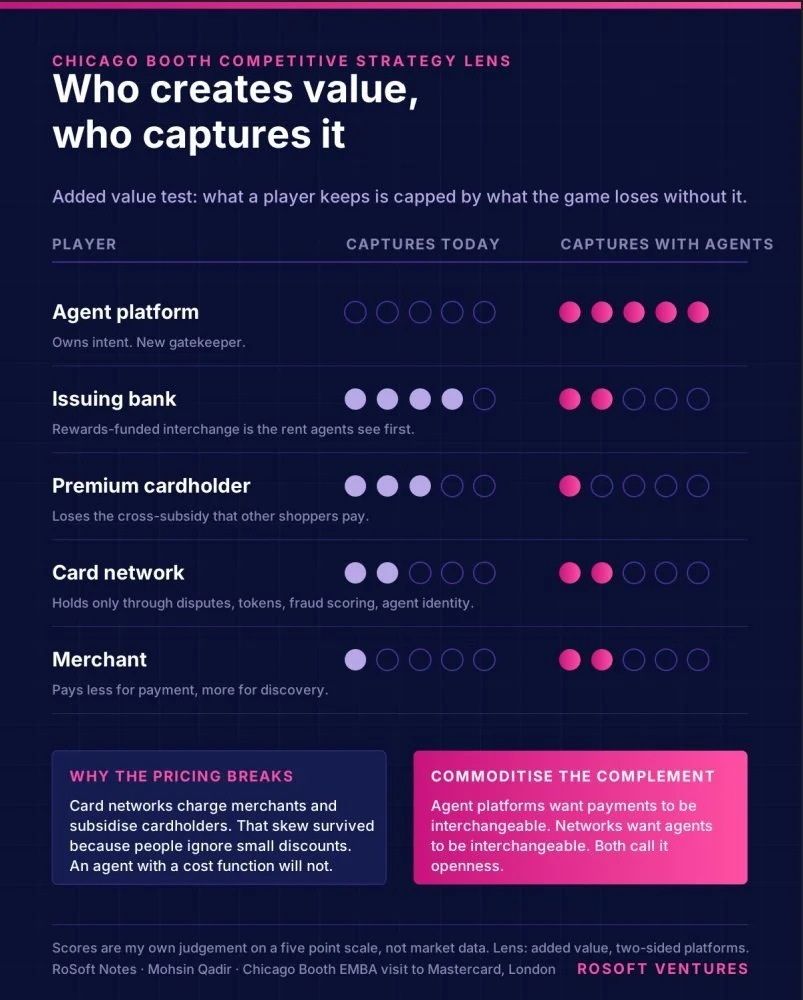
The first is added value. A player can only capture what the game loses without it. Take the network out of an agent purchase and the agent still pays over bank transfer, FedNow, Pix or a stablecoin. What it can't replace is the credit line, the chargeback and the fraud cover. So the network's added value shrinks to those services, and the value-added services line matters more than the network line.
The second is two-sided platform pricing. Card networks charge the side that can't walk away, merchants, and subsidise the side that can, cardholders, through rewards. That skew survived because shoppers ignore small nudges. Nobody switches cards for a 1% discount at the till. An agent with a cost function switches every time. Pair that with the settlement's new surcharging rights and steering becomes cheap for the first time. Premium-card interchange is the first thing agents will negotiate down.
The third is commoditise your complement. OpenAI and Stripe published the Agentic Commerce Protocol. Google launched AP2. Mastercard built Verifiable Intent on open standards. Each calls it openness. Agent platforms want payments to be interchangeable. Networks want agents to be interchangeable.
The fourth is raising rivals' costs. The BVNK deal looks like one. Visa lost its stablecoin settlement partner the day the deal closed.
The 2030 fee pool
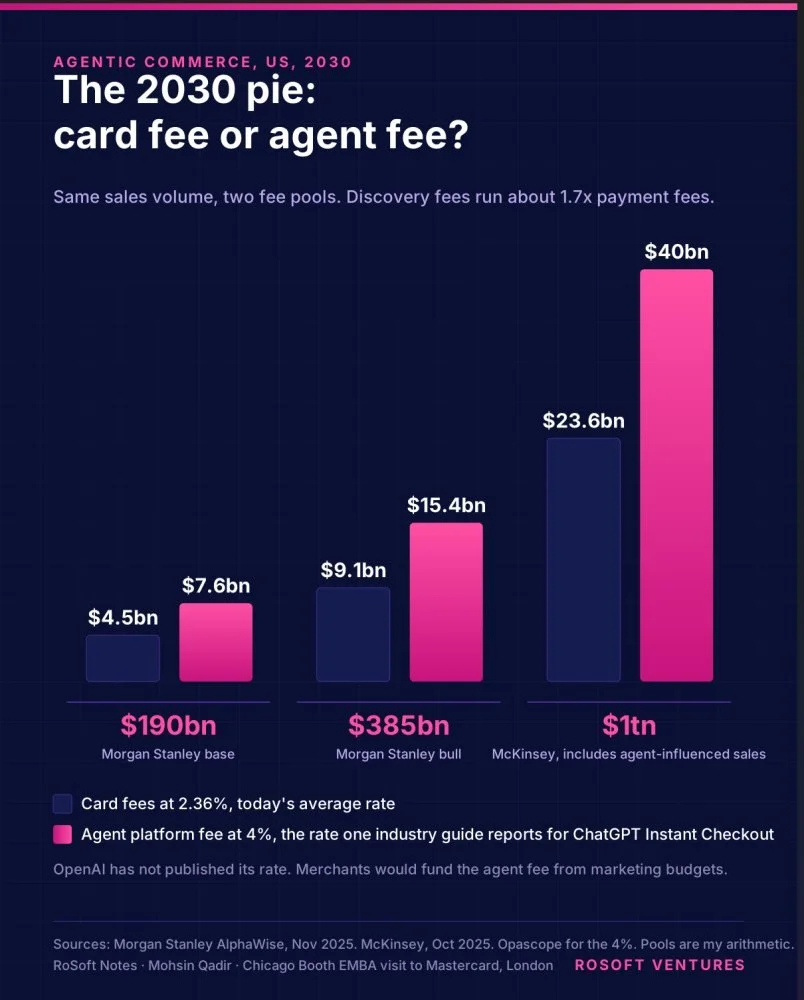
Morgan Stanley puts US agentic commerce at $190 billion to $385 billion by 2030. McKinsey says $1 trillion, but it counts sales an agent influenced as well as sales an agent completed.
OpenAI charges merchants a fee on each completed Instant Checkout purchase and hasn't published the rate. One industry guide reports 4%. I couldn't confirm that from OpenAI
On the same volume, the card fee at 2.36% and the agent fee at 4% give two different pools. At $190 billion that's $4.5 billion against $7.6 billion. At $385 billion it's $9.1 billion against $15.4 billion. The discovery fee runs about 1.7 times the payment fee, and merchants would pay it from the marketing budget that today goes to Google and Amazon
Apple Pay is the precedent. Apple takes roughly 0.15% from issuers for owning the interface. The agent platforms will ask for the same, and probably more.
Where I ended up
I came out less bearish than I went in. Agents and stablecoins can squeeze the card model. They also need dispute rules, fraud cover and identity checks, and Mastercard runs the largest set of those.
My ranking of who captures the new value: agent platforms first, because they own intent. Networks hold their position only through disputes, tokens, fraud scoring and agent identity. Issuers lose the most, because rewards-funded interchange is the rent an agent sees first. Premium cardholders lose the cross-subsidy with it.
The card networks built their moat on human habit at checkout. Agents don't have habits. The next margin goes to whoever can prove an agent did what the customer asked, and pays out when it didn't.
Sources: Mastercard Q2 2026 Form 10-Q, results release and earnings call. Merchants Payments Coalition citing Nilson Report, March 2026. Morgan Stanley AlphaWise, November 2025. McKinsey, October 2025. The 52 cent share, the $6 billion figure and the fee pool table are my own arithmetic.
Disclaimer :These are my own notes from an academic visit and my own reading of public filings. Nothing here comes from Mastercard, Chicago Booth or any firm I have worked with, and none of them has reviewed it.
The 52 cent share, the $6 billion figure and the fee pool table are my arithmetic on Mastercard's Q2 2026 10-Q and earnings call. The value capture scores are my judgement, not market data. Nothing in this piece is investment advice. I hold no position in Mastercard or Visa.
About the author Mohsin Abdul Q. has spent twenty years on the finance and operations side of financial services, in banking, private credit and asset management, including CFO and COO roles. He now advises on applied AI, enterprise software and private markets, and is completing an Executive MBA at Chicago Booth. He writes KauserOS Notes on LinkedIn and Substack.
#AgenticCommerce #Payments #ChicagoBooth #FinTech #Mastercard #Stablecoins #DynamicYield #PrivateEquity
Frequently asked questions
What is Mastercard Agent Pay?
Agent Pay lets an AI agent start a payment within limits the customer sets. Santander and Mastercard ran a live agent-initiated payment on Santander's infrastructure in March 2026, in a controlled setting. It works alongside Verifiable Intent, built with Google, which keeps a tamper-resistant record linking what the customer authorised to what the agent then did.
Who is liable when an AI shopping agent makes the wrong purchase?
Nobody has agreed yet. The fault could sit with the customer, the agent developer, the model provider, the merchant or the payment provider. Card dispute rules were written for people, and a stablecoin transfer usually can't be reversed. The author argues for agency assurance, meaning a verified mandate, spending limits, an audit trail, agreed liability and an insurer pricing the risk.
Why did Mastercard buy BVNK?
BVNK is a London stablecoin infrastructure firm. Mastercard paid $1.5 billion plus up to $300 million in earn-out and closed the deal on 3 August 2026. It gives Mastercard a role in agent commerce even when money doesn't move over a card. BVNK was also Visa's stablecoin settlement partner, and Visa put out a tender for a replacement on 18 August.
KauserOS applies the same test to fund operations: AI agents draft the work and a named person approves every decision. See how the KauserOS platform works.
About the author
Mohsin Qadir is the founder of KauserOS, an AI-native operating platform for private equity and private credit managers. He was divisional CFO and COO of Private Assets at Fidelity International and interim Head of Investment Operations at Bridgepoint, and earlier worked at ICG and BNP Paribas CIB. He writes RoSoft Notes.