First published in RoSoft Notes on LinkedIn on 13 October 2026.
In short
Whoever controls an agent's access, memory and permissions gains lasting power, and an agent's ability to act gives it no right to act. Around 70% of the variation in an agent's outcome traced back to the person who wrote its instructions. The author's rule is that the agent interprets, a deterministic control blocks, and a person decides, with the split set by the size of the consequence.
- In Anthropic's Project Deal, 69 employees with $100 each let Claude agents close 186 real deals, and buyers on the stronger model paid an estimated $2.45 less per item.
- In Project Swap, about 85% of the shortfall against the best possible allocation came from agents misreading what their principals wanted.
- The Bank of England and FCA's 2024 survey of 118 responding firms found 75% using AI and only 2% of use cases fully autonomous.
- Walmart's Pactum bot has reached agreements with 68% of tail-end suppliers approached, at around 3% savings.
- For a private equity firm, the author would start with the capital call, with three agents doing the work and a person authorising notices and cash movement.
13 Oct 2026 · Mohsin Abdul Q.
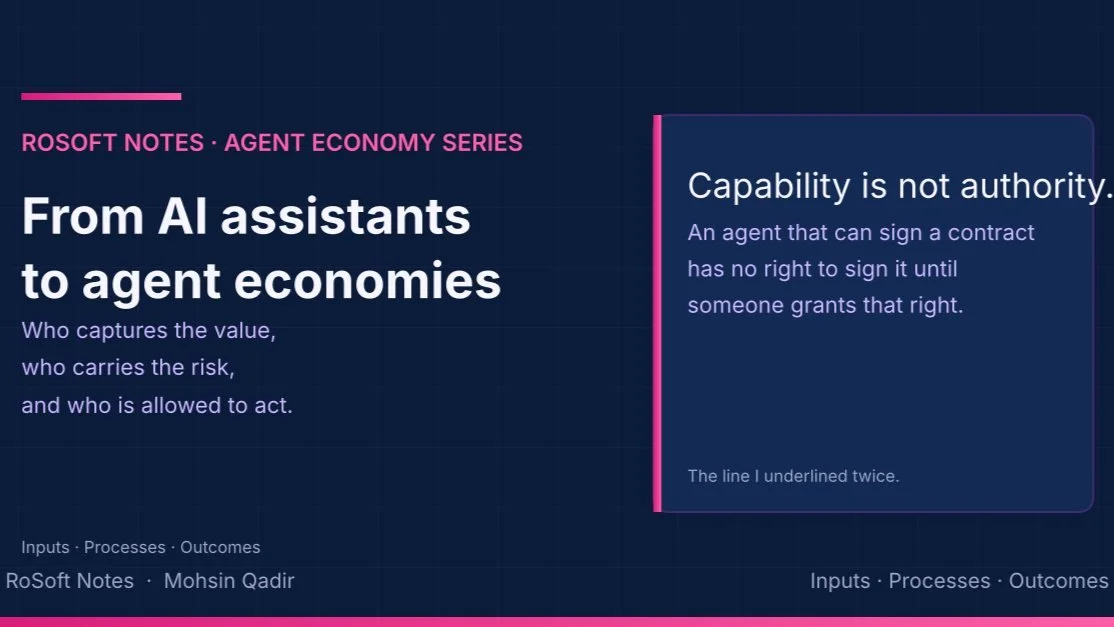
I came home from a roundtable at The University of Chicago Booth School of Business's Center for Applied AI with eight pages of notes and one line underlined twice. Capability is not authority.
I've spent twenty years on the finance and operations side of investing, most recently as interim head of investment operations at Bridgepoint, and before that as divisional CFO and COO for private assets at Fidelity International. Delegated authority was my whole world in those jobs. Who can approve a payment. Who can commit the fund. So when an economist said the agent economy turns on the gap between what an agent can do and what it's allowed to do, I had my frame for the day.
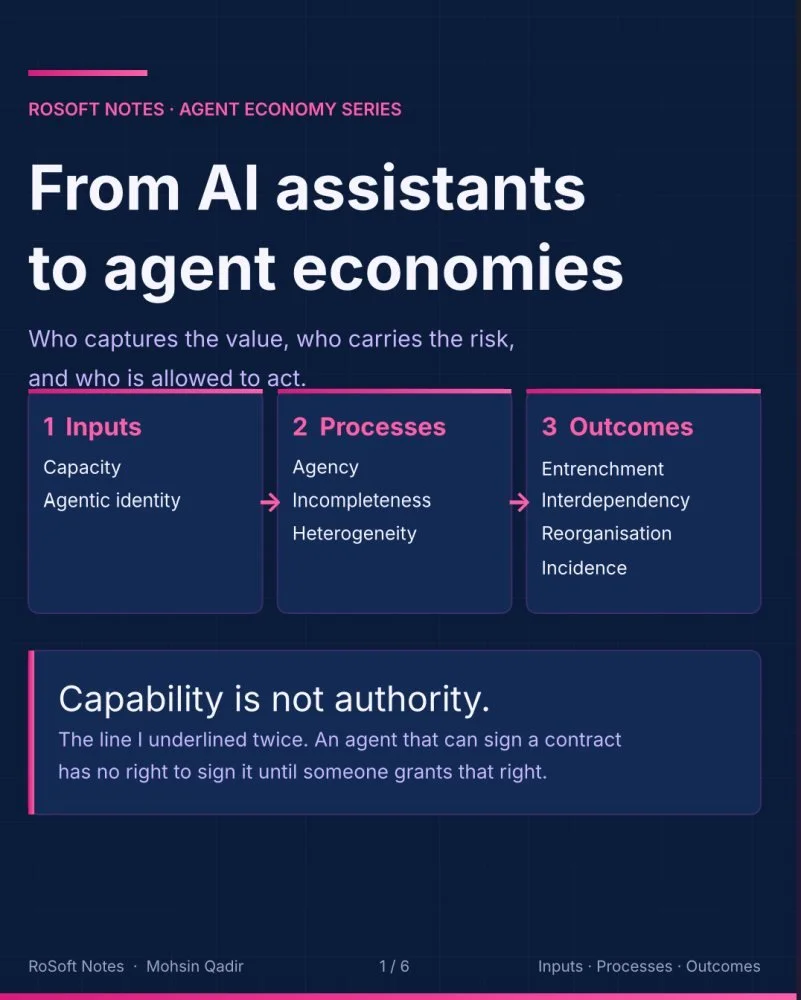
He also gave me a way to organise it. An agent acts. When agents deal with each other, decisions become interactions, and the agent economy is the sum of those interactions. He split that into inputs, processes and outcomes, which is the order a CFO would use to underwrite anything.
1. Inputs
Capacity
Agents are faster and broader than people, they run many tasks at once, and they combine judgement with action at scale. Every vendor deck says so. What the decks leave out is that capacity is the cheapest input to buy and the hardest to turn into an advantage.
Agentic identity
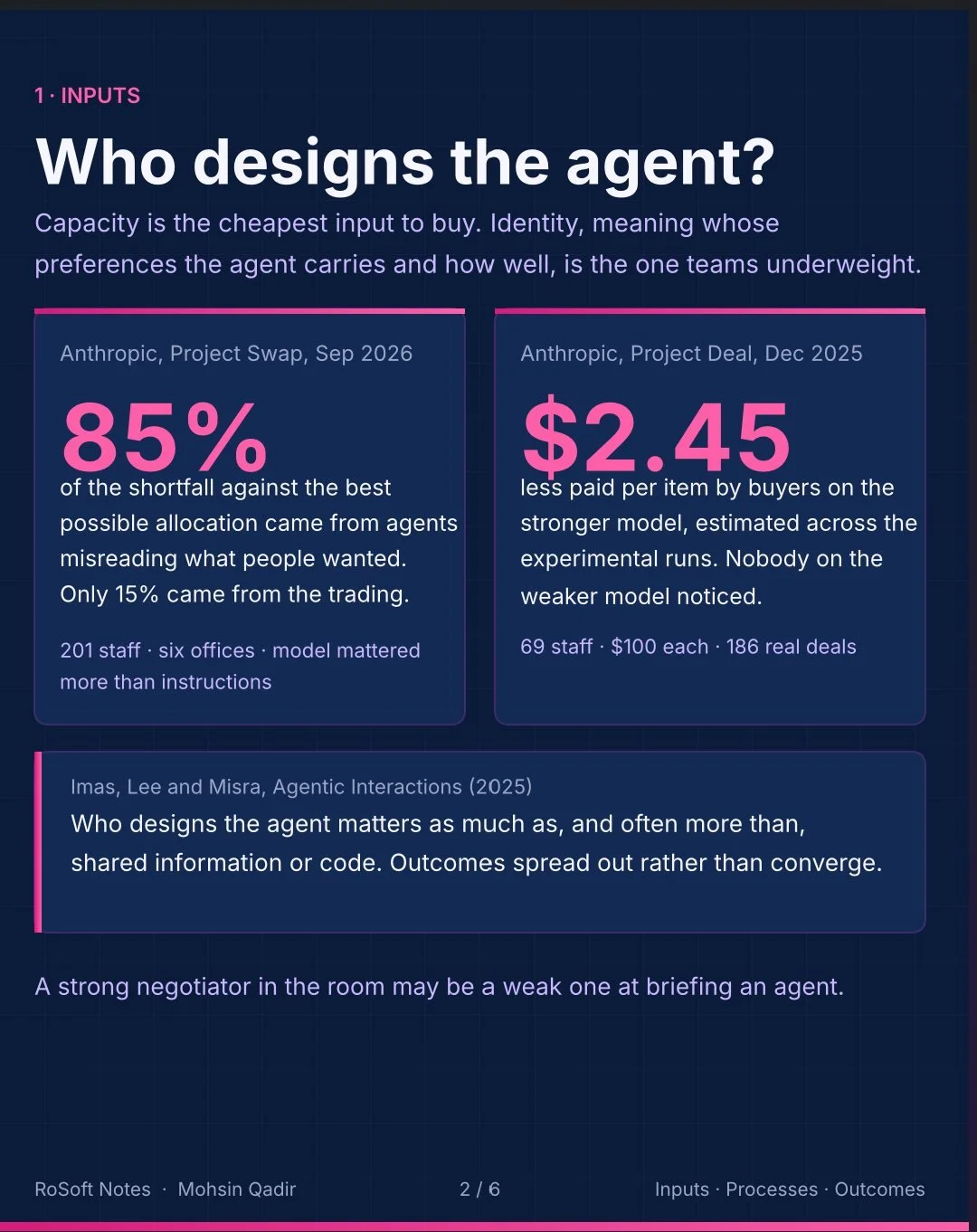
Whose preferences does the agent carry, and how well? The speaker's figures, as I took them down, were that around 70% of the variation in an agent's outcome traced back to the person who wrote its instructions, and that in one negotiation setting the seller's instructions explained 73% of the surplus split. The published paper behind that work, Agentic Interactions by Alex Imas, Kevin Lee and Sanjog Misra, puts it with more care. Who designs the agent matters as much as, and often more than, shared information or code.
Anthropic's experiments add two findings. In Project Deal, 69 employees with $100 each let Claude agents close 186 real deals. Buyers on the stronger model paid an estimated $2.45 less per item across the experimental runs, and nobody on the weaker model noticed. In Project Swap, published on 24 September, 201 employees across six offices let agents trade books on their behalf. About 85% of the shortfall against the best possible allocation came from agents misreading what their principals wanted. Only 15% came from the trading itself, and the model an agent ran on mattered more than its instructions.
So an agent can negotiate well and still bring home the wrong thing. A strong negotiator in the room may be weak at briefing an agent, and even a good brief leaves the agent guessing at taste.
2. Processes
Agency
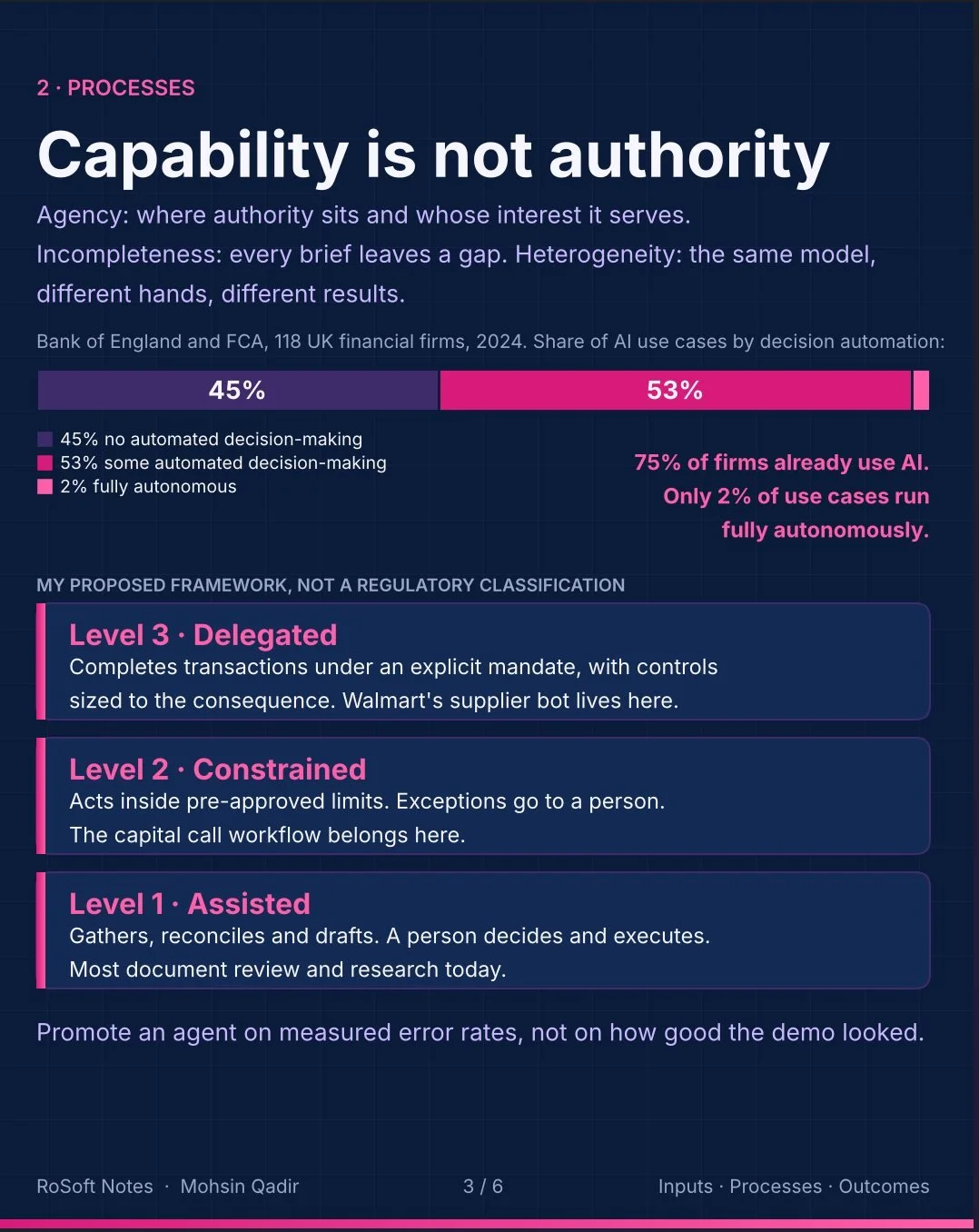
An agent that can sign a contract has no right to sign it until someone grants that right. The speaker called the design question agentic directives. Where do we place authority, and whose interest does it serve? An agent your bank gives you serves the bank's interest at the margin. An agent you pay for serves yours, within whatever its builder allows.
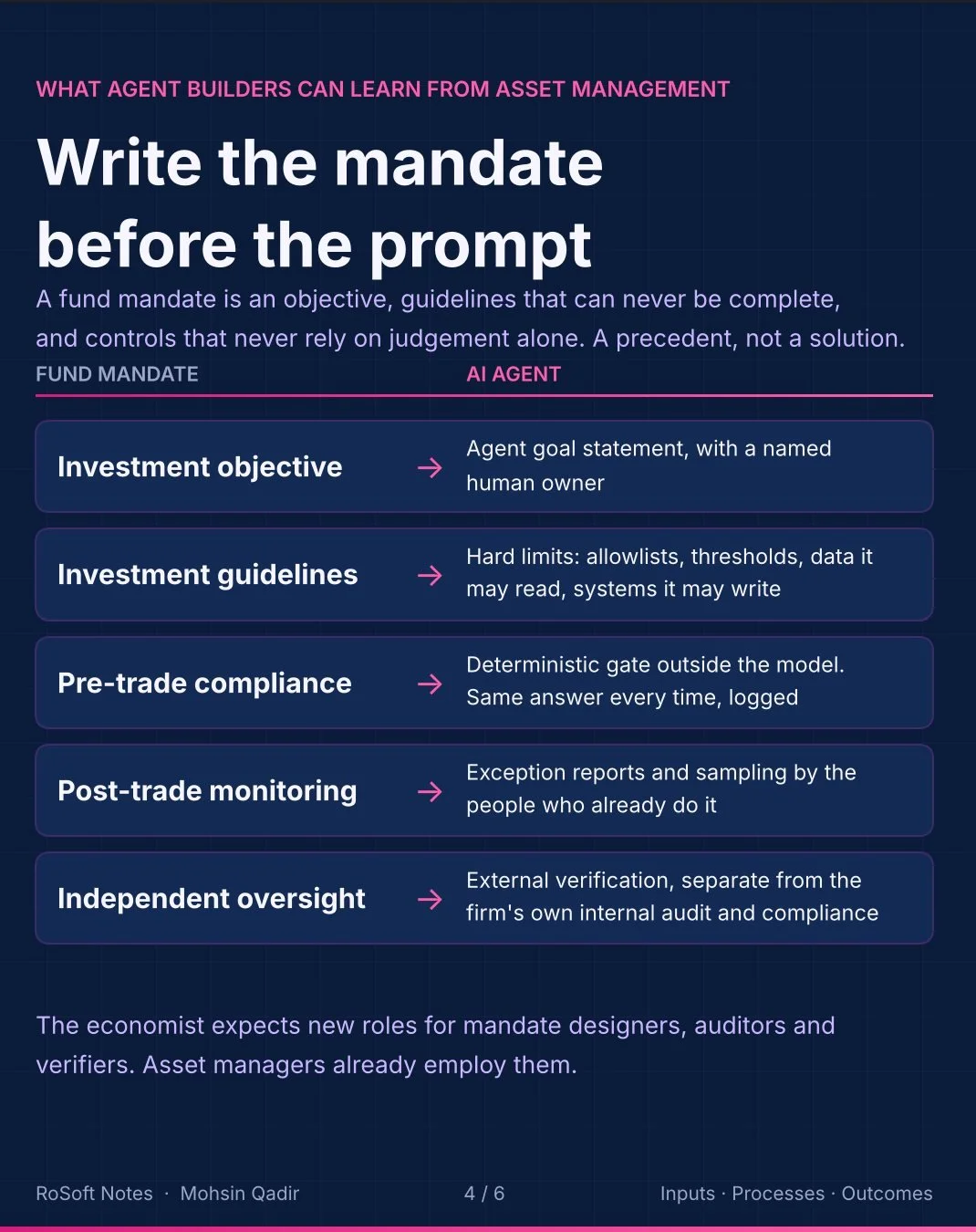
Investment management has a precedent here, and I want to be careful about how far it goes. An investment management agreement sets an objective, adds guidelines that can never be complete, and leaves the manager to fill the gaps. Pre-trade compliance blocks a breach before it happens. Post-trade monitoring catches what slips through. A depositary checks the manager from outside. That separates the authority to decide from the control that decides whether the decision can execute. It's a good starting point for agents, not a finished answer, because an agent meets situations across organisations that no mandate anticipated.
Write the mandate before the prompt, and put the controls outside the model. The Bank of England and FCA's 2024 survey of 118 responding firms found 75% using AI and only 2% of use cases fully autonomous. That gap is where the work sits.
Incompleteness
Every instruction leaves something to judgement. The speaker's example was a retailer like Zara asking an agent to price a sale. No one can write enough rules to cover every case, so who carries the liability for the gap? A manager makes that call once. An agent can make the same wrong call a thousand times before anyone looks. My rule is that the agent interprets, a deterministic control blocks, and a person decides, with the split set by the size of the consequence.
Heterogeneity
The same technology amplifies differences in how people direct it. Imas, Lee and Misra call the skill machine fluency, and it varies with the principal. Give everyone the same model and outcomes spread out rather than converge.
The opposite risk is agentic herding. If firms run similar models on similar data with similar objectives, their agents act in correlated ways, and the market concentrates around whoever supplies them. The speaker's name for the wider effect was the Lucas generalisation, after the Lucas critique. Relationships you measured when people made the decisions stop holding once agents make them. Retention, conversion and renewal rates were all built on human inertia.
3. Outcomes
Entrenchment
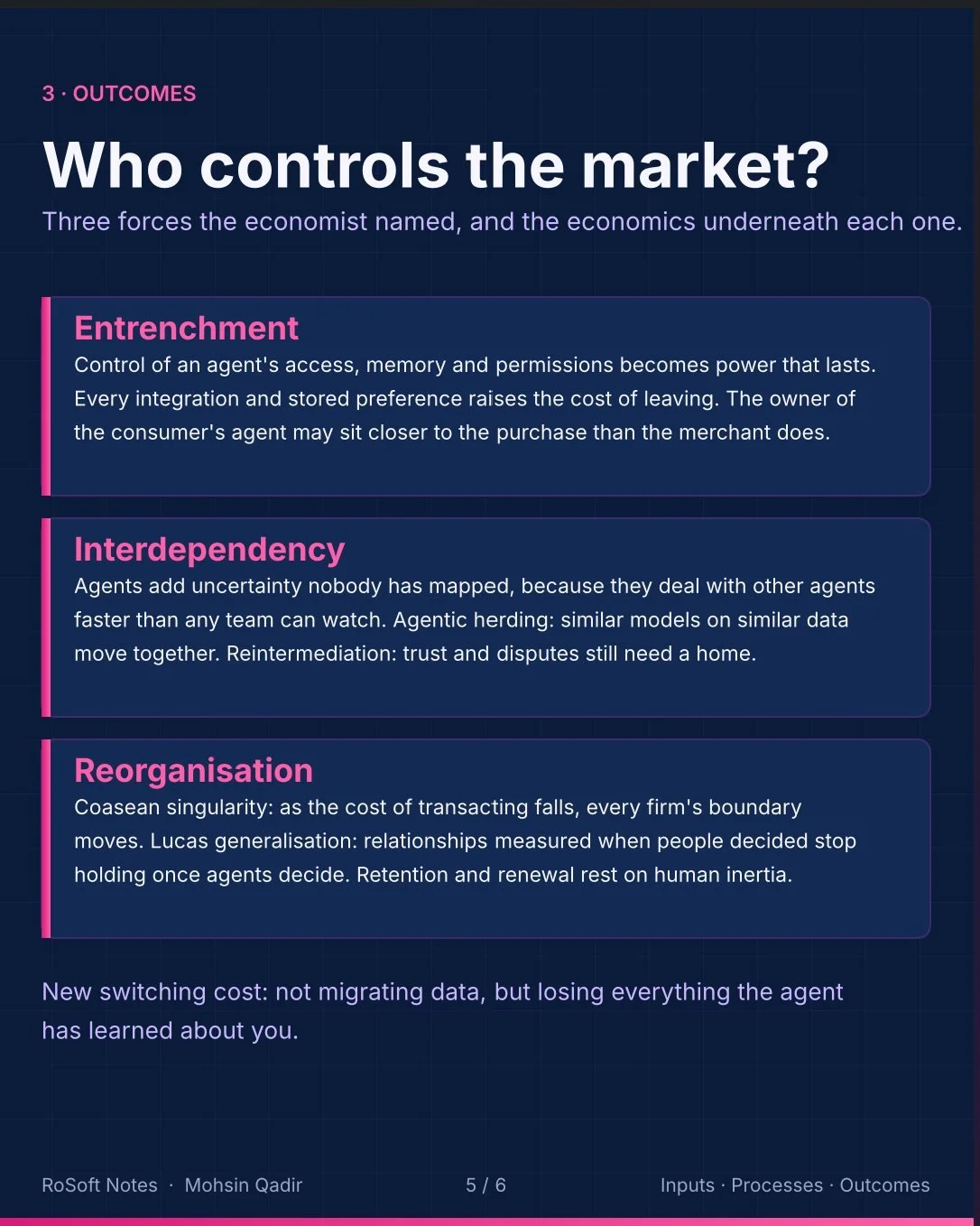
Whoever controls an agent's access, memory and permissions gains power that lasts. Every integration built and every preference stored raises the cost of leaving. That's the new switching cost, and the owner of the consumer-facing agent may end up holding more of the purchasing relationship than the merchant does.
Interdependency
Agents add sources of uncertainty we can't see yet, because they deal with other agents at a speed and scale nobody monitors. Agent-to-agent dealing removes some middlemen and creates others. Trust, verification and dispute resolution still need a home, so I expect reintermediation rather than disintermediation. The question for a risk function is what happens when a hundred agents respond to the same signal in the same second.
Reorganisation
The Coasean singularity, from a 2025 NBER paper by Peyman Shahidi, Gili Rusak, Benjamin Manning, Andrey Fradkin and John Horton, asks what becomes possible as the cost of transacting heads towards zero. Coase argued in 1937 that firms exist because using the market costs money. Push that cost down and the boundary of every firm moves. In a mid-market GP, fund administration and investor reporting have moved in and out of the firm over twenty years as costs shifted. Agents will move that line again, and I'd bet on smaller in-house teams supervising more outsourced work. The speaker predicted new roles too, mandate designers, auditors and verifiers. Asset managers already staff those in investment risk, compliance monitoring and internal audit.
Incidence
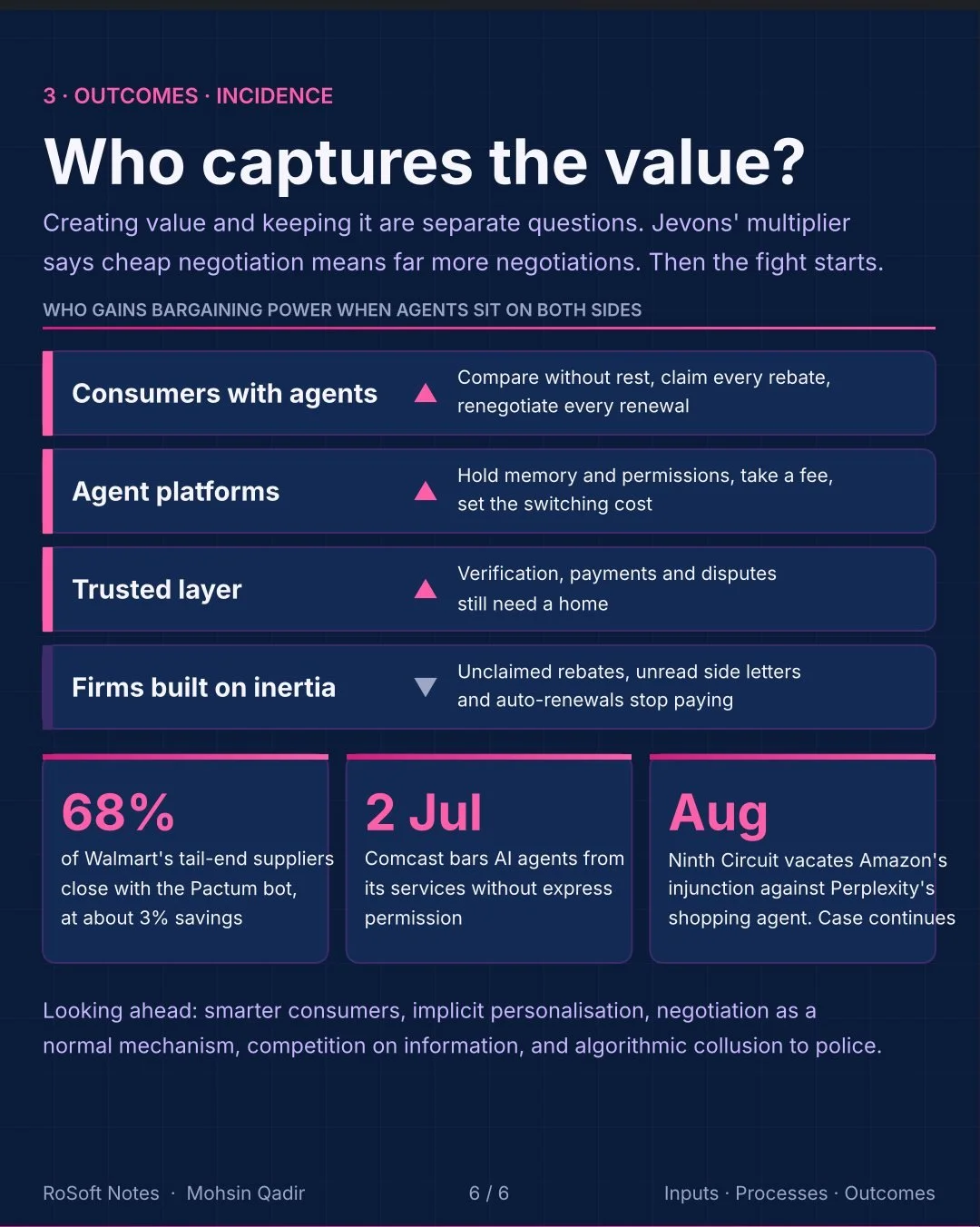
Creating more value doesn't decide who captures it. Walmart's Pactum bot has negotiated with tail-end suppliers since 2021, with reported agreements from 68% of suppliers approached at around 3% savings. Now give consumers the same tool. A lot of revenue in financial services comes from friction. Rebates nobody claims. Fee offsets nobody recalculates. Side letter rights nobody reads. Agents make it economical to pursue every one of them.
Jevons' multiplier says that when an activity gets cheaper, demand for it grows faster than its price falls. Cheap negotiation will create many more negotiations, down to transactions too small for a person to bother with. Who keeps the gain is the incidence question. Consumers may get lower prices, merchants may simplify terms, platforms may take a fee, and incumbents push back. Comcast banned AI agents from its services without express permission on 2 July. Amazon won an injunction against Perplexity's shopping agent in March and lost it on appeal in August, with the case sent back to the district court.
Looking ahead
Consumers will get smarter through consumption agents that compare continuously and remember everything. Implicit personalisation will let an agent act like a clone of your preferences without being told, which quietly widens its authority. Negotiation becomes a viable mechanism again, for a broadband renewal or a fund fee. Competition will feel different, fought on information across many dimensions rather than on price alone. And algorithmic collusion, where pricing agents learn to hold prices up without anyone agreeing to anything, will keep competition lawyers busy.
If I had to start one project tomorrow in a private equity firm, it would be the capital call. One agent calculates each investor's contribution from the approved funding requirement, the commitments and the governing documents. A second checks side letters and excuse provisions. A third prepares the notices and reconciles receipts. A person authorises the release of the notices and any cash movement. Every step has a cycle time and an error rate I can measure.
For anyone building these systems, I'd leave one question. When your agent negotiates on someone's behalf, whose interest does it optimise, who set the boundary, and who can prove afterwards that it stayed inside?
Sources: Imas, Lee and Misra, Agentic Interactions (SSRN, 2025). Anthropic, Project Deal (April 2026) and Project Swap (September 2026). Shahidi and co-authors, The Coasean Singularity?, NBER Working Paper 34468. Bank of England and FCA, AI in UK Financial Services (November 2024). Pactum and Walmart case reporting, company announcements and court filings.
#AgenticAI #AIAgents #PrivateEquity #FundOperations #AIGovernance #AIinFinance #FinanceLeadership
Frequently asked questions
What is the agent economy?
An AI agent is software that acts on someone's behalf. When agents deal with each other, decisions become interactions, and the agent economy is the sum of those interactions. A Chicago Booth economist split it into inputs, processes and outcomes, and argued it turns on the gap between what an agent can do and what it's allowed to do.
How should firms control AI agents that can sign contracts or move money?
Write the mandate before the prompt and put the controls outside the model. Investment management offers a starting point. A mandate sets the objective, pre-trade compliance blocks a breach, post-trade monitoring catches what slips through and a depositary checks from outside. The agent interprets, a deterministic control blocks, and a person decides, scaled to the size of the consequence.
How could AI agents be used in private equity fund operations?
A good first project is the capital call. One agent calculates each investor's contribution from the approved funding requirement, the commitments and the governing documents. A second checks side letters and excuse provisions. A third prepares the notices and reconciles receipts. A person authorises the release of notices and any cash movement, and every step has a measurable cycle time and error rate.
KauserOS works on this split. AI agents draft the work, deterministic engines do the maths, and a named person approves every decision. See how the KauserOS platform works.
About the author
Mohsin Qadir is the founder of KauserOS, an AI-native operating platform for private equity and private credit managers. He was divisional CFO and COO of Private Assets at Fidelity International and interim Head of Investment Operations at Bridgepoint, and earlier worked at ICG and BNP Paribas CIB. He writes RoSoft Notes.