First published in RoSoft Notes on LinkedIn on 28 October 2026. Figures and market references are as of that date.
In short
Anthropic's S-1 shows its biggest suppliers are also its shareholders, distributors and competitors. A company on a $67B unaudited run rate has signed roughly $637B of named obligations, about $431B of it minimum rent or take or pay. Damodaran's upbeat story values the equity at $1.475T, so a $1.5T price assumes that story is fully delivered and leaves no margin of safety.
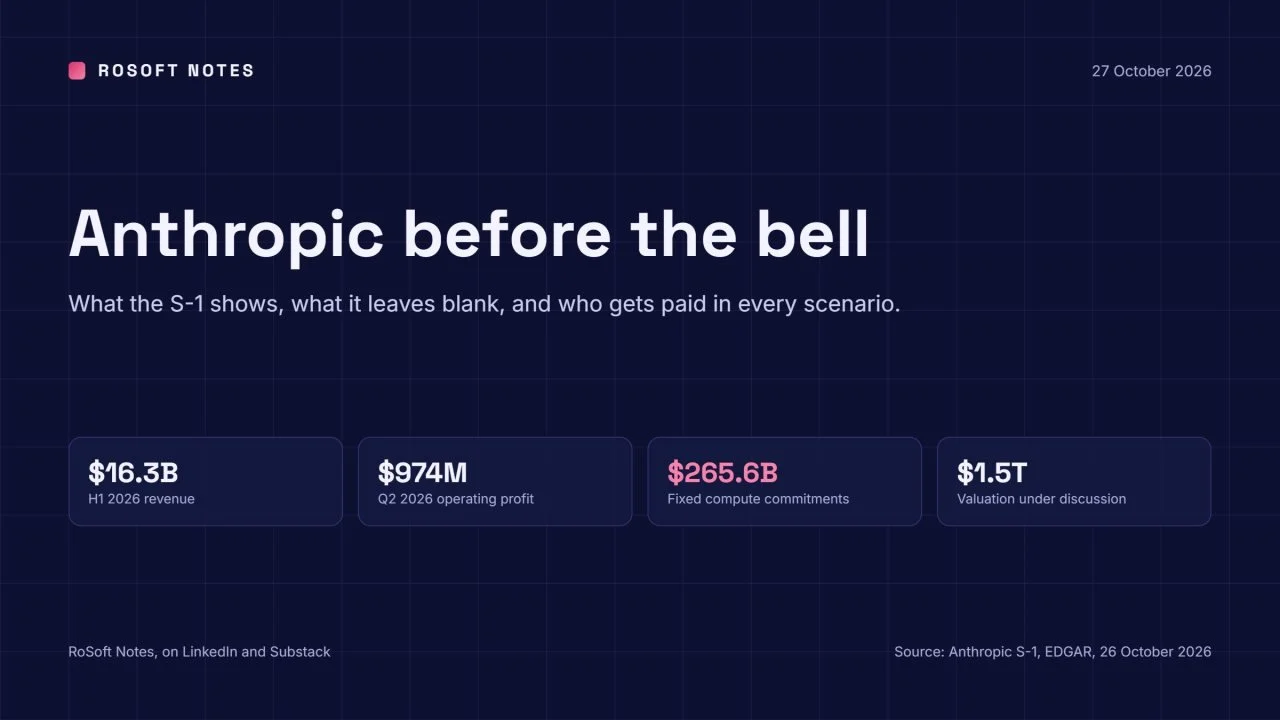
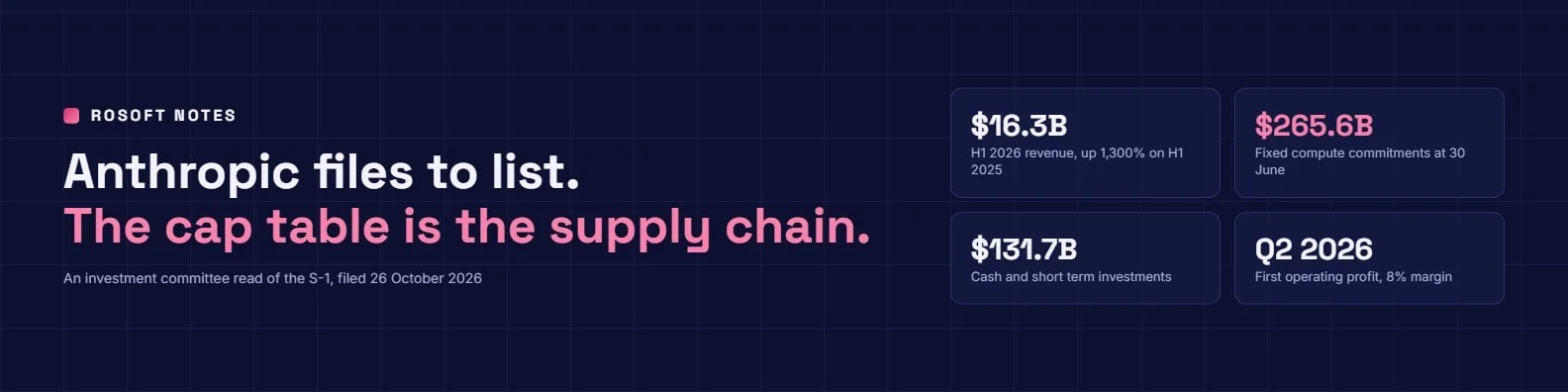
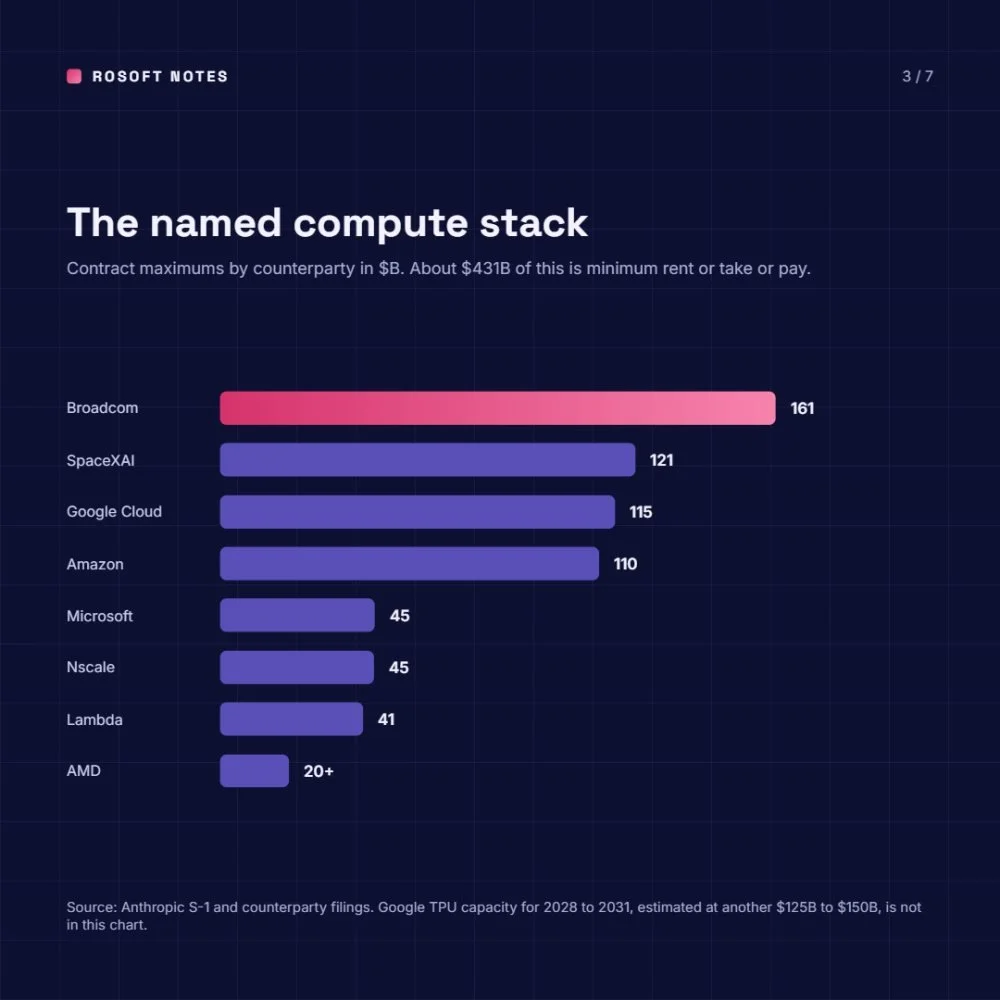
- Revenue grew from $41M in 2023 to $4.6B in 2025 and $16.3B in the first half of 2026, with a first operating profit of $974M in Q2 at an 8% margin.
- Broadcom holds roughly $161B of five year TPU leases, Google Cloud is owed at least $114.5B through 2033 and Amazon at least $110B to 2036.
- 48% of revenue clears through AWS, Google Cloud and Microsoft Azure storefronts, which held 58% of receivables at June.
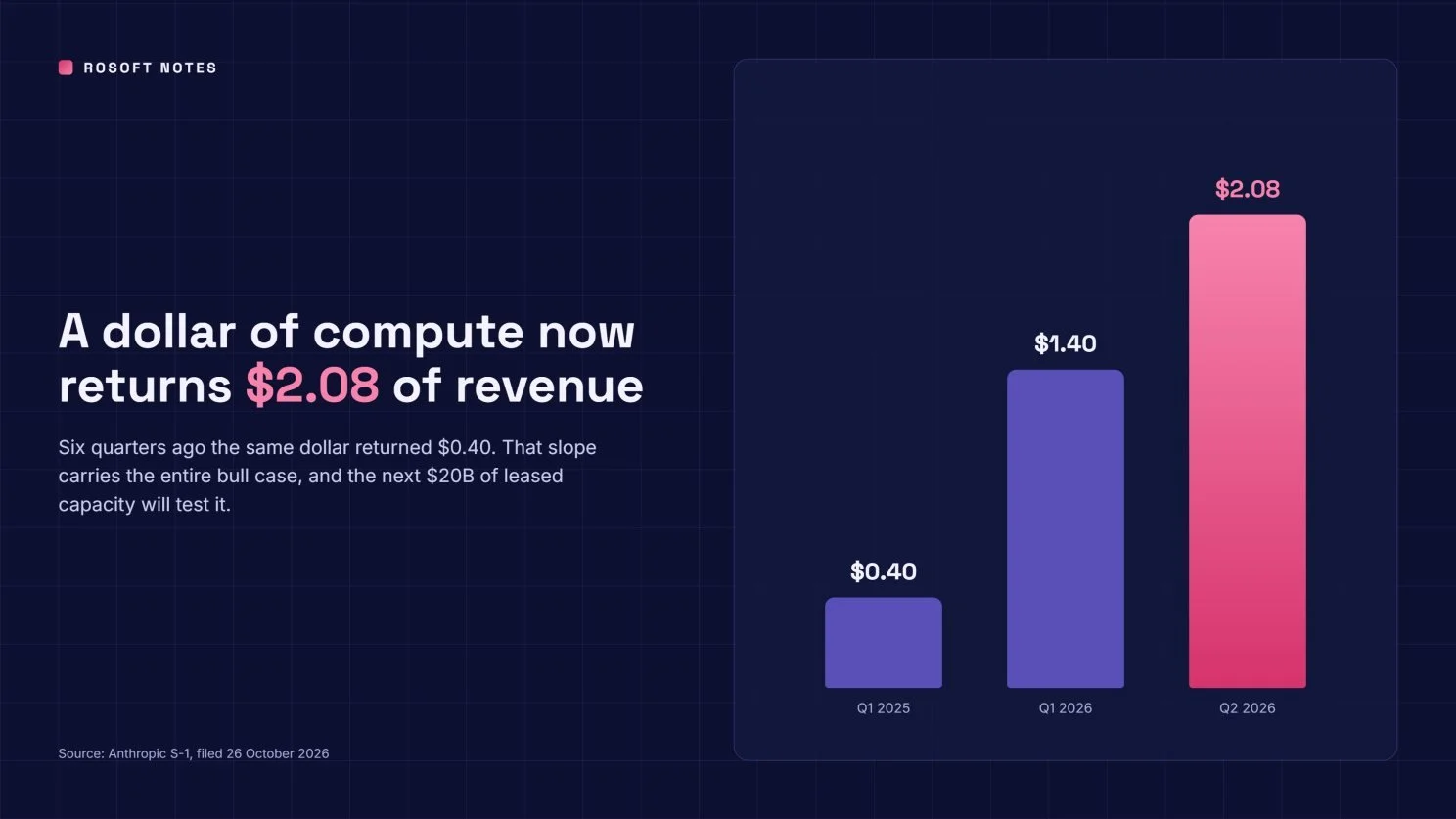
- Fixed commitments grew 4.9x in six months to $265.6B, and at Q3's $1.70 of revenue per compute dollar the $637B stack needs roughly $1.1T of cumulative revenue.
- A single Class F share carries 50.1% of the vote, and a $26.6B stock comp cliff vests on effectiveness.
RoSoft Notes, 28 October 2026. A personal read of the Anthropic S-1, filed 26 October, written for operators and allocators. I hold no position and this is commentary, not investment advice.
Everyone has now unpacked the headline arithmetic. Revenue of $41M in 2023, $386M in 2024, $4.6B in 2025, $16.3B in the first half of 2026, and a first operating profit of $974M in Q2 at an 8% margin. I sat with the filing for a day and the disclosure that stayed with me carries no dollar sign at all. It is a list of names.
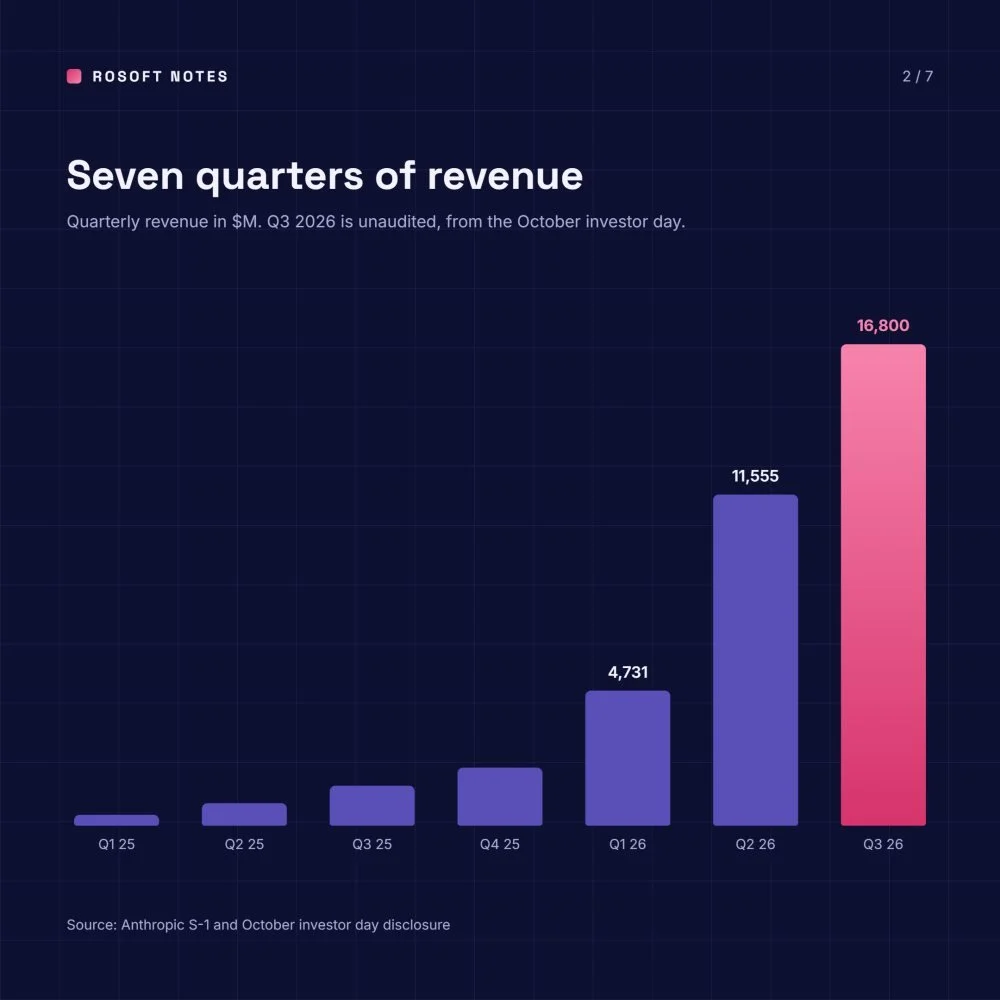
Read the commitments table. Broadcom, roughly $161B of five year TPU leases with cross default. Google Cloud, at least $114.5B payable regardless of usage through 2033. Amazon, at least $110B to 2036. Microsoft, $44.9B. SpaceX Super Intelligence , up to $120.5B at about $3.1B a month. Now read the shareholder register. Google and Amazon hold stakes capped at 14.99% and 12%. Micron Technology , Samsung Semiconductor and SK hynix , three of the four HBM makers on earth, bought into Series H. And 48% of revenue clears through Amazon Web Services (AWS) , Google Cloud and Microsoft Azure storefronts, which held 58% of receivables at June. The suppliers are the investors are the distributors are the competitors.
Porter, upside down
Business school scores Porter’s five forces separately. Here, three companies occupy four of the five boxes at once. Google is the cleanest example, an equity holder, a landlord owed at least $114.5B whatever the usage, the backstop on Hut 8’s $7B Louisiana lease, and a competitor through Gemini. Google gets paid on three of its four seats whatever happens to #ANT’s share price.
That is the frame for an investment committee. You are underwriting a credit structure in which a tenant on a $67B unaudited run rate has signed roughly $637B of named obligations, about $431B of it minimum rent or take or pay, partly financed by the landlords themselves through $77B of undrawn vendor notes. Professor Aswath Damodaran ’s valuation note cites a BB+ rating on the debt, so the rating desks already treat it as one.
The 2000 rhyme, and where it breaks
Vendor financing at this scale has one precedent, Lucent and Nortel funding their own telecom customers in 1999 and 2000. In Anthropic ’s favour, the sponsors fund from operating cash flow and Anthropic itself turned cash positive, $3.9B in H1 against $482M of capex. Against it, fibre had a twenty year life and demand eventually filled it, while 80% of Q3 revenue came from models under six months old. Twenty year leases on unbuilt data centres, five year chip leases, six months of model relevance. That is the widest duration mismatch I have seen inside a company that calls itself software.
What enterprise buyers are asking
The buyer conversation on AI spend has shifted twice this year. In spring, who wins coding. By summer, who keeps the margin. Since September it lands on routing. Microsoft cancelled most internal Claude Code licences for Copilot CLI while Claude still carries 90 to 95% of the usage underneath. A J.P. Morgan executive director said “for 90% of the tasks, you really don’t need @Opus.” Claude keeps winning the hardest tokens and keeps losing the seat. The margin follows whoever owns the router, and today that is the customer’s platform team. Meanwhile OpenAI is buying share back at 20 to 40% off list, and at Rippling its share of coding work went from 16% in May to 52%. So treat the 900% net revenue retention as a cohort artifact. When tokens per account outgrow revenue per account, routing has arrived at scale.
The one page numbers
The 85.4% derived gross margin is partly an accounting shadow. Take or pay moved compute from the variable column to the fixed column, so the marginal token looks nearly free while the real cost sits in the commitments table. High gross margin and high operating leverage are the same fact stated twice.Marketplace sales are booked gross and CSP fees go unquantified, so 22x at $1.5T is a floor on a net basis.Fixed commitments grew 4.9x in six months to $265.6B. At Q3’s $1.70 of revenue per compute dollar, covering the named $637B stack needs roughly $1.1T of cumulative revenue.Five share classes. A single Class F share carries 50.1% of the vote, Class A is capped at 49.9%, and the Long Term Benefit Trust elects the board majority. A $26.6B stock comp cliff vests on effectiveness, the Public Benefit Fund takes up to 2% more each time the price rises 50%, and insiders other than founders can sell 10% on day one. I would read the package as a dare to institutional investors, priced on the bet that they will swallow it. So do I.
The Economist's check
Now run all of it against the macro data. On 24 October, Apollo Global Management, Inc.’s chief economist Torsten Slok published charts under the heading no signs of AI payoff outside the tech sector. US total factor productivity shows no inflection since 2022. S&P 493 margins have sat near 10% since 2015 while Magnificent 7 margins climbed toward 30%, and real revenue per employee has reached about $780K at the Magnificent 7 against a sideways $520K for everyone else.
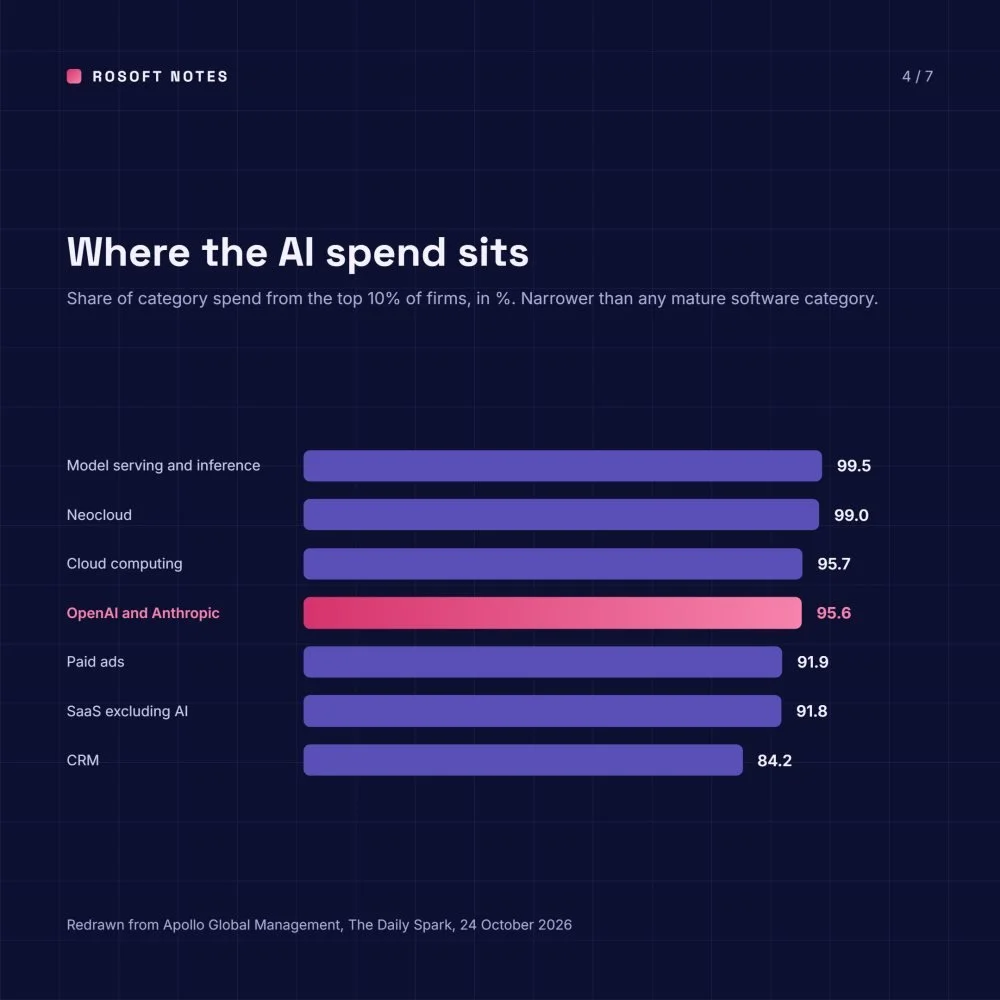
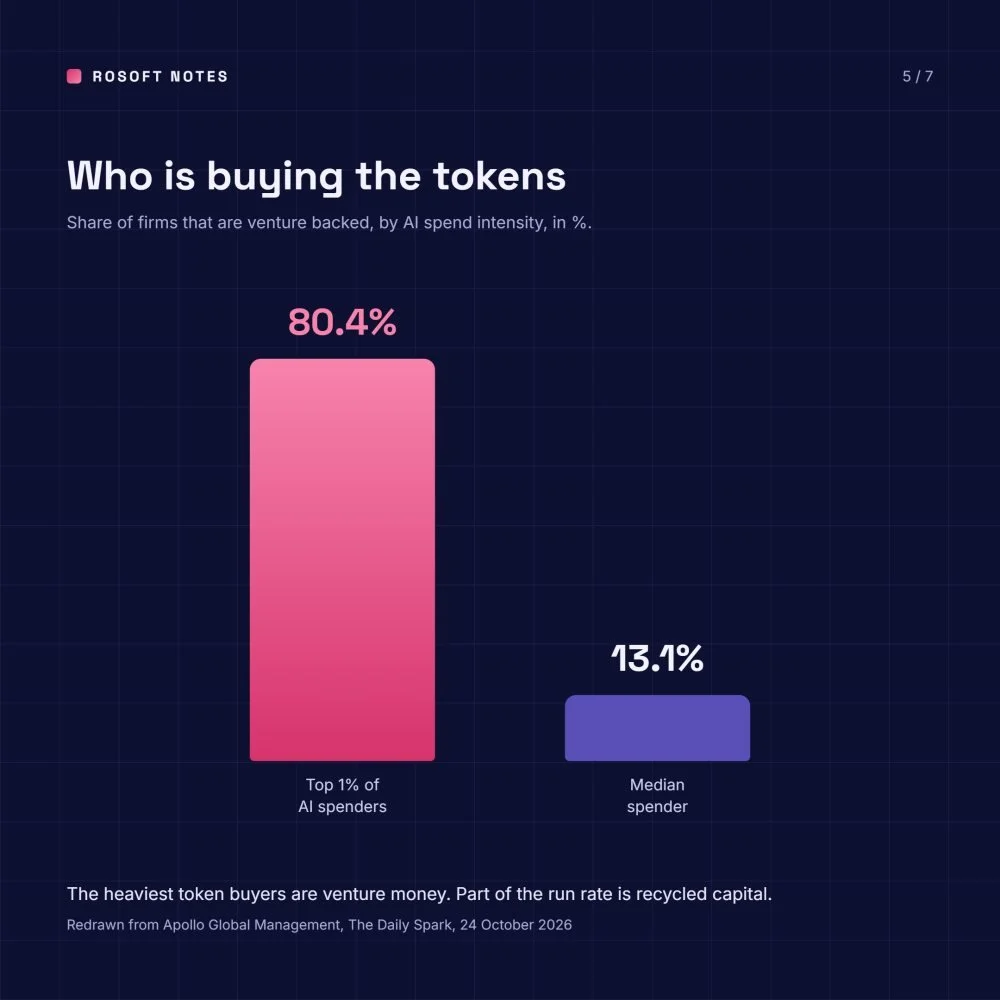
Two of Apollo's cuts land on this filing. Spending on OpenAI and Anthropic is narrower than any mature software category, with the top 10% of firms at 95.6% of it against 84.2% for CRM. And the marginal token buyer is venture money, 80.4% of the top 1% of AI spenders are VC backed against 13.1% of the median spender. Part of today’s run rate is recycled capital rather than enterprise P&L demand. That needs no cabal, and Damodaran is right to warn off conspiracy readings. Double counting and opacity are problem enough.
The counterpoints are real. Solow’s line about computers being everywhere except the productivity numbers held from 1987 to the late nineties, and Anthropic’s base is broadening, 11,900 customers above $100K against 950 a year ago. But a $637B commitment stack is sized for diffusion into the whole economy, and the whole economy has not signed up yet. If the payoff stays inside tech, Anthropic is selling picks to other pick sellers.
What a DCF says the story is worth
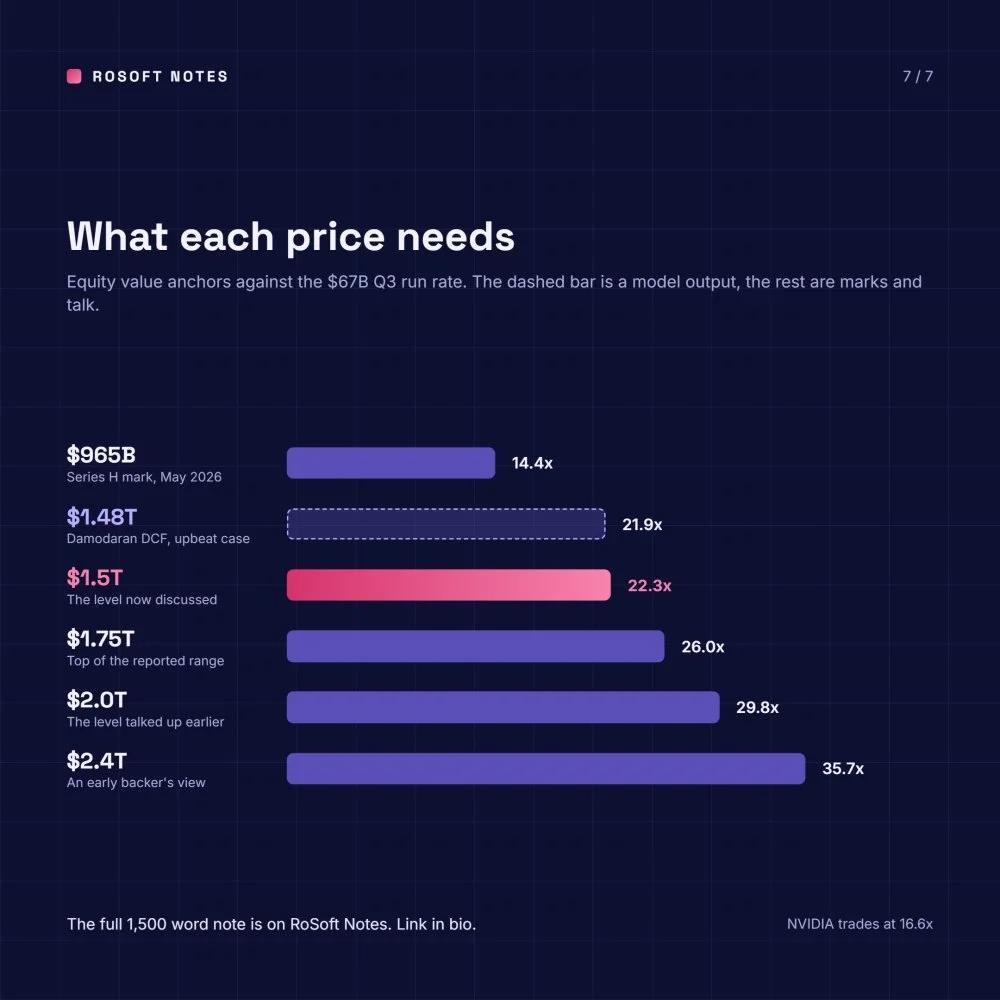
Damodaran valued the company within two days of the filing, and his number matters because it is not a multiple. His upbeat story needs a trillion dollars of revenue by 2036, more than any company books today, with Amazon and Walmart near $700B to $750B. Add a 27.5% operating margin after regulatory drag, a dollar of new capital per three of new revenue, a 9.74% cost of capital and a 10% failure chance, and the equity is worth $1.475T. His bear case, revenue stalling at $200B on mass market margins, leaves the equity worth minus $373B. His bull case reaches $4.04T.
What I take from his work is where the price sits inside that range. The talked down $1.5T offer lands exactly on an upbeat story fully delivered, so the walk from $2T was never a discount and the margin of safety at this price is zero.
Winners and losers, whatever the first print does
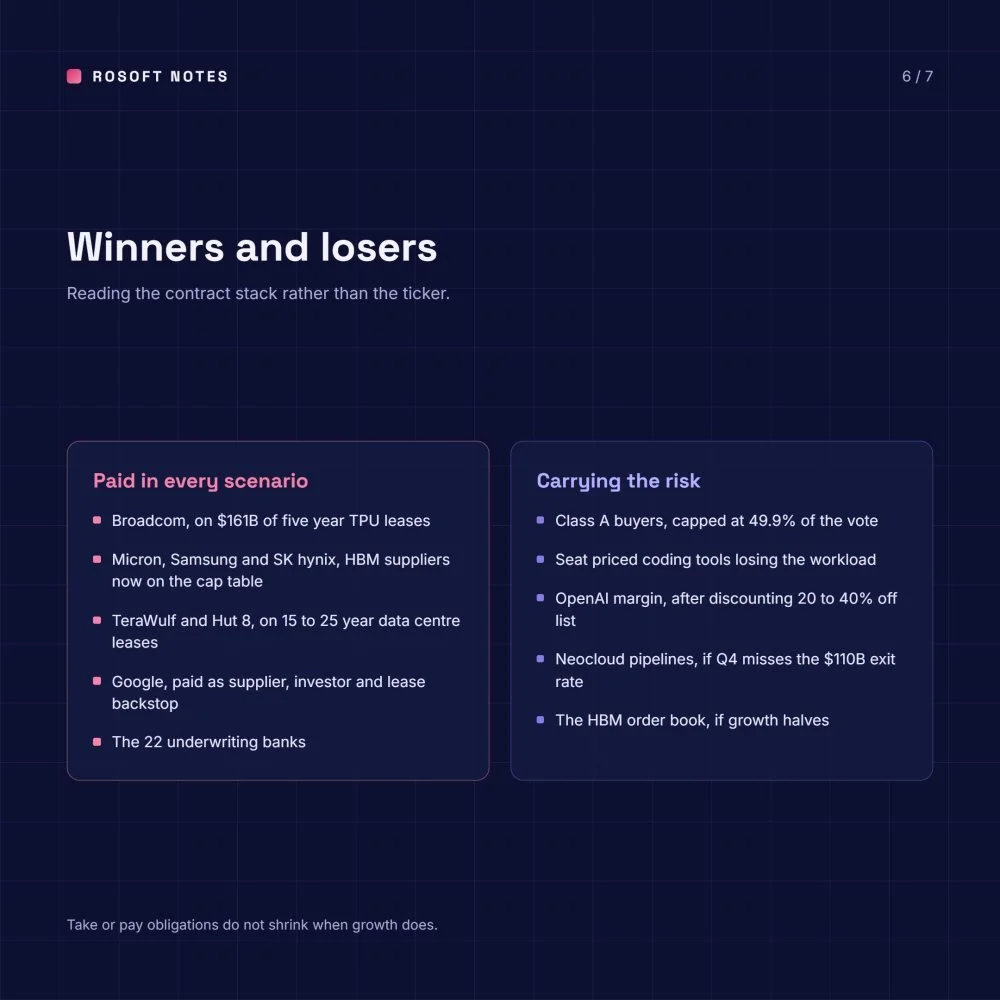
Paid in every scenario:
Broadcom on $161B of leases, TSMC and the HBM trio, TeraWulf on a $19B Kentucky lease, Hut 8 on $7B in Louisiana with Google behind the lease, the power counterparties, and 22 underwriting banks.
Winners if the thesis holds:
Class A buyers below $1.5T, integrators such as GitLab, the consultancies building the services layer, and TPU share against Nvidia, since the stack’s biggest contract is Broadcom built TPU capacity.
Losers if it holds:
seat priced developer tools, second tier labs, and OpenAI’s gross margin, because discounting 20 to 40% against an 85% margin leader is a war the discounter funds.
Losers if it cracks:
ANT equity first, because take or pay does not shrink when growth does. Then the HBM order books and the neocloud pipelines priced off the 2028 to 2031 Google TPU tranche of $125B to $150B.
How I would vote
The discipline this filing demands is one every operating CFO learns early. Price the obligations before you price the story. At $1.5T, ANT trades at 22x a gross run rate and 5.6x its own commitment stack. At the May Series H mark of $965B it was 1.5x that stack. The spread between those coverage ratios is a credit question, and the S-1/A still owes four blanks: the aggregate commitment total, the amount due within twelve months, the revolver, and audited Q3.
I would expect the stock to be priced rather than valued at the open, and personally will not short it because the market owes neither of us agreement.. I would own the toll roads rather than the car, pass above the Series H mark, and revisit on four falsifiable reads. The Q4 exit rate against the $110B investors expect. Gross margin once the SpaceXAI, nScale and Lambda capacity bills. Whether the amended filing quantifies marketplace fees. And whether the S&P 493’s margins finally move. There will be a day Anthropic is cheap too. Sane investors were able to buy Meta / Facebook at half its IPO price three months after passing on it. A perma bear would compress the bear case into three words, “Nobody 10xes forever.” Fair. Also, Nobody has grown 14x at a $67B run rate before either. Both sentences are true. Only one of them is in the price...which only time will tell, who was right.
Sources: Anthropic S-1 and exhibits on EDGAR, accession 0001628280-26-067168, dated expert calls and same day coverage compiled in my 27 October primer, Apollo’s Daily Spark of 24 October 2026 by Torsten Slok, and Aswath Damodaran’s Anthropic IPO valuation with its spreadsheet at pages.stern.nyu.edu. Personal views only, not investment advice.
Frequently asked questions
Who are Anthropic's biggest suppliers and investors?
Largely the same companies. Google and Amazon hold stakes capped at 14.99% and 12%, and they're also owed at least $114.5B and $110B for compute. Micron, Samsung and SK hynix, three of the four HBM makers, bought into Series H. Google also competes with Anthropic through Gemini, so it holds three or four seats at once.
What is Aswath Damodaran's valuation of Anthropic?
Damodaran's upbeat story values Anthropic's equity at $1.475T. It assumes a trillion dollars of revenue by 2036, a 27.5% operating margin, a 9.74% cost of capital and a 10% chance of failure. His bear case, with revenue stalling at $200B, leaves the equity worth minus $373B. His bull case reaches $4.04T.
Why is Anthropic's 85.4% gross margin misleading?
Take or pay contracts moved compute from the variable column to the fixed column. The marginal token then looks nearly free, while the real cost sits in the commitments table. So the high gross margin and the high fixed cost base are the same fact stated twice. Marketplace sales are also booked gross, and the cloud providers' fees aren't quantified.
More of Mohsin's analysis of AI company finance and market structure is on the KauserOS research page. More RoSoft Notes research.
About the author
Mohsin Qadir is the founder of KauserOS, an AI-native operating platform for private equity and private credit managers. He was divisional CFO and COO of Private Assets at Fidelity International and interim Head of Investment Operations at Bridgepoint, and earlier worked at ICG and BNP Paribas CIB. He writes RoSoft Notes.