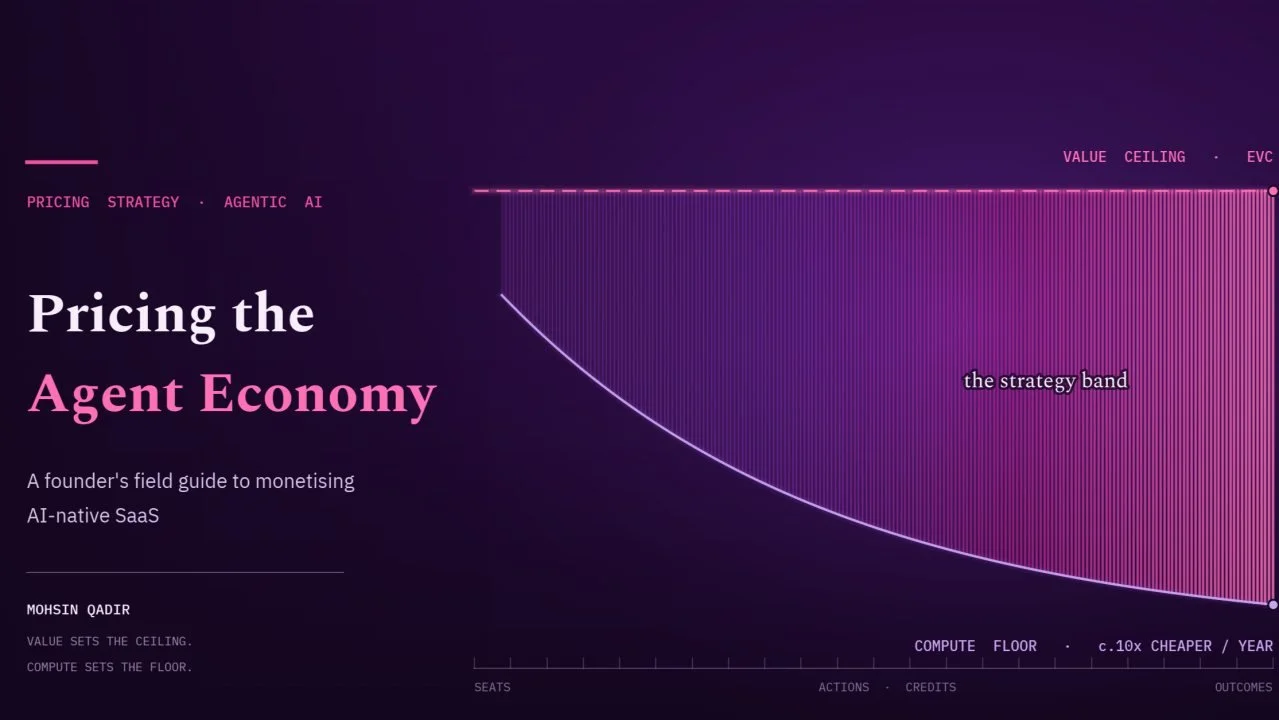
First published in RoSoft Notes on LinkedIn on 14 July 2026. Figures and market references are as of that date.
In short
An AI agent should be priced inside a band. The economic value it creates for the customer sets the ceiling, and compute sets a real but falling floor. Mohsin Qadir's model has four parts: a platform fee, a metered credit pool priced per action, an outcome fee governed like carried interest, and a value split the vendor can defend.
- Inference prices have fallen by roughly an order of magnitude a year, so an agent's price competes with its own cheaper future.
- Salesforce sells Agentforce at about $2 per conversation, Flex Credits at roughly $0.10 per action and digital labour licences at $125 per user per month, all at once.
- Sierra has priced on outcomes from day one and reached more than $150m of ARR in eight quarters.
- At roughly $0.99 per resolution against a human benchmark near $6, an outcome-priced agent captures something like 17% of the value it creates.
- At a 60% resolution rate, the true cost per delivered outcome is two thirds higher than a naive token dashboard suggests.
What a term of pricing strategy at Chicago Booth taught me about AI agents, token economics, and the question every AI-native founder eventually has to answer: what, exactly, are you charging for?
I have spent more than two decades in finance and operations in global asset management, and I recently completed the Pricing Strategies course at Chicago Booth's London Executive MBA under Professor Sanjog Misra. One line from the final session has stayed with me:
Value sets the ceiling. Compute sets the floor.
Six words that contain, I think, the entire monetisation playbook for agentic AI. It is the lens I would use if I were founding an AI-native company today, and the lens I would use writing a cheque into one. What follows is an attempt to make it operational, with the numbers attached and, I hope, without the usual hand-waving.
1. The economics genuinely changed
Classic SaaS had one beautiful property: near-zero marginal cost. Build once, serve millions, and the cost of the next customer rounds to nothing. Gross margins ran above 80%, pricing became a pure value-capture exercise, and the per-seat subscription conquered the enterprise.
Large language models broke that symmetry. AI keeps the enormous fixed cost (training runs are sunk, and expensive) but adds something software had forgotten: a real marginal cost per answer. Every time an agent reasons, retrieves, retries or calls a tool, you pay. Software economics quietly became utility economics.
Two consequences follow, and they pull in opposite directions.
First, margins compress. Many early AI-native applications operate materially below mature SaaS levels, often in the region of 50% to 60% in the near term, although the range varies enormously by use case and architecture. A retrieval-light classifier and a multi-step research agent burning frontier tokens for ten minutes are not the same business.
Second, that floor is collapsing. Inference prices have fallen by roughly an order of magnitude a year. Your unit cost is deflating faster than almost any input in commercial history, which means your price competes with your own cheaper future. Anchor to today's cost and tomorrow's you will undercut it.
So the viable price for an AI agent lives inside a band. Economic value to the customer sets the ceiling. Compute sets a real, but sinking, floor. Everything strategic happens in between.
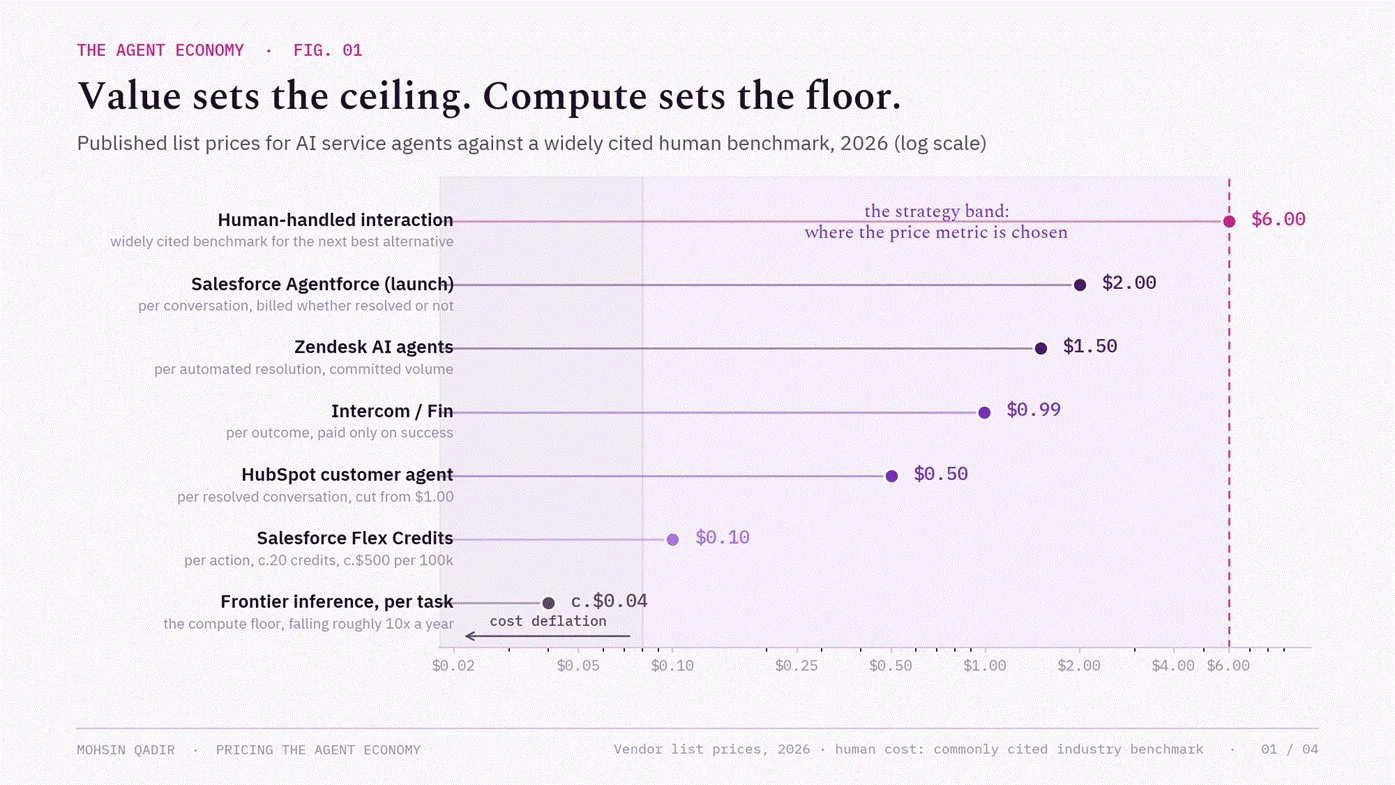
Figure 1. Value sets the ceiling, compute sets the floor. Vendor list prices, 2026; human cost is a commonly cited industry benchmark.
2. The market context, briefly
Estimates of the agent market vary wildly, and the dispersion is itself informative. Grand View Research puts it at roughly $7.6bn in 2025 and $10.9bn in 2026, reaching about $183bn by 2033 at a 49.6% CAGR. BCC Research sees $8bn growing to $48.3bn by 2030 at 43.3%. MarketsandMarkets projects $7.84bn to $52.62bn by 2030 at 46.3%. When credible houses disagree by a factor of three, it is because nobody agrees what is inside the category. Agents do not sit tidily in the software budget.
Directionally, though, the signals are consistent. Gartner expects around 40% of enterprise applications to embed task-specific agents by the end of 2026, up from under 5% in 2025; in its best-case scenario, agentic AI could account for roughly 30% of enterprise application software revenue by 2035, over $450bn, up from about 2% today. Gartner also predicts (a prediction, not a measurement) that agents will intermediate more than $15tn of B2B spending by 2028. Enterprise AI spend reached about $37bn in 2025, more than triple the prior year. Vertical, domain-specific agents are the fastest-growing architecture segment, at roughly a 62.7% CAGR, and financial services is among the largest end-user verticals.
3. What are you actually priced against?
The framework underneath all of this is economic value to the customer:
EVC = reference value + positive differentiation value − negative differentiation value
The reference value is the price of the customer's next best alternative. The positive term is the monetary worth of everything you do better. The negative term, which AI founders routinely forget, is the monetary worth of everything you do worse: integration effort, change management, hallucination risk, model governance, audit exposure, vendor concentration. Enterprise buyers price those explicitly, and in regulated industries they price them brutally.
The fashionable claim is that AI agents are now priced against labour rather than software. That is true in a narrower set of cases than the enthusiasm suggests. Where an agent completes an end-to-end workflow with no human in the loop, labour or an outsourced service becomes the relevant reference. Where the product is a copilot, an assistant or an embedded feature, the next best alternative may still be incumbent software, an internal build on raw APIs, rules-based automation, the existing manual process, or simply tolerating the problem.
This distinction is the most expensive one in AI pricing, and it cuts both ways. Price a copilot against a salary and you will lose every deal at procurement. Price an autonomous agent against a software licence and you will leave most of the surplus on the table.
The discipline is unglamorous. For each buyer, write down what they would genuinely do if you did not exist, and what that costs them fully loaded. Widely cited industry benchmarks put a human-handled customer contact at several dollars (around six is the number most often quoted) against cents for an automated one. Bret Taylor, whose company Sierra sells outcome-priced customer agents, sizes global customer-service spend at roughly $400bn a year, most of it wages. If your agent truly resolves the ticket end to end, that is your reference value. If it drafts a reply for a human to approve, it is not.
4. There is no single customer, so there is no single price
This is the piece most AI pricing commentary skips, and the one my professor would have circled in red. There is no single EVC and therefore no single optimal price. Each segment has a different reference alternative, a different risk tolerance, a different usage profile and a different willingness to pay.
Consider five buyers of the identical agent:
The seed-stage startup. Wants low commitment and self-serve. Its reference alternative is building it themselves on raw APIs over a weekend. Price sensitive, cheap to serve, prone to churn.The mid-market buyer. Wants a number it can budget. Its reference is the incumbent SaaS tool plus a junior hire. It will pay a premium for predictability and simplicity.The regulated global enterprise (banking, asset management, wealth, insurance). It is buying governance, auditability, resilience, data residency, indemnity and someone accountable. Its reference alternative is an internal build that its own risk function will not approve. Least price sensitive, most expensive to serve.The BPO or outsourcer. Replacing labour at industrial scale. High willingness to pay in principle, but the volume and sophistication to demand aggressive unit rates, and the capability to build if you overreach.The software vendor embedding your agent inside its own product. It is buying cost of goods sold, not features. It will squeeze, and it should.
One price cannot serve those five. The task is to design a menu of packages such that each segment self-selects into the one intended for it. The fences between tiers must be real: capacity, latency, model class, deployment mode, support, compliance depth, indemnity, data residency. Psychological fences do not survive procurement, and they will survive even less once the buyer sends an agent of their own to evaluate you.
5. The metric is the strategy, but outcome pricing is not automatically the answer
A price metric is not a billing detail. It is an incentive contract.
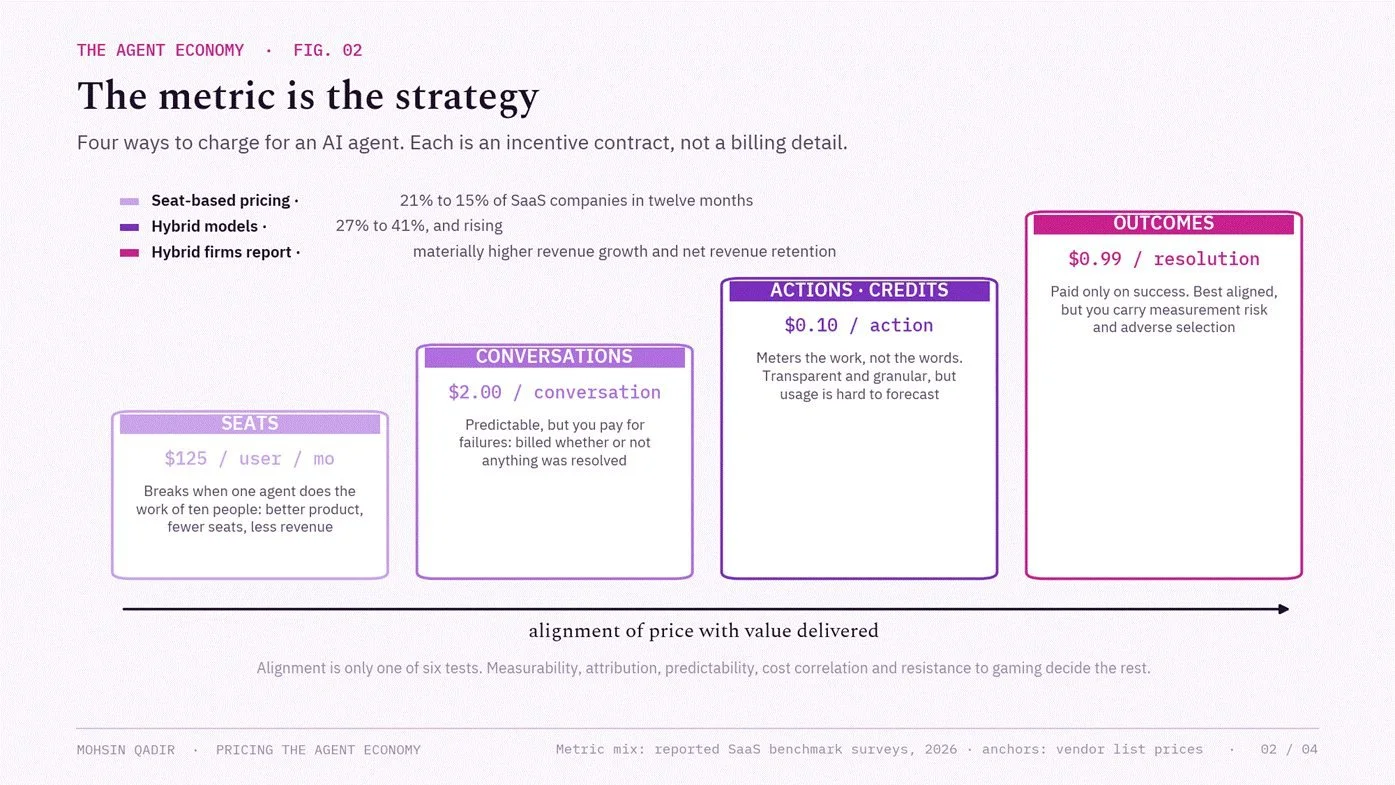
Figure 2. Four ways to charge for an AI agent. Each is an incentive contract, not a billing detail.
Six tests separate a good metric from a fashionable one:
1. Does it track value the customer actually recognises?
2. Can it be measured cleanly, by both parties?
3. Is the result attributable to you, and within your control?
4. Is it predictable enough for a buyer to budget?
5. Does it correlate with your own cost?
6. Can it be gamed, by either side?
Outcomes score brilliantly on the first test and poorly on the second, third and fourth. Seats score well on the fourth and badly on the first. No metric wins all six, which is why the honest answer to "which model should I use?" is that it depends on what you sell:
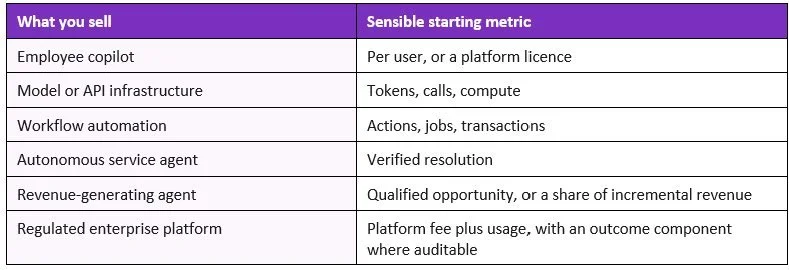
Outcome pricing works where the outcome is observable, attributable, timely and auditable. It works badly where performance depends heavily on the customer's own data, policies, products or people, which describes most enterprise deployments. If you cannot write the definition of a billable outcome in a sentence your customer's auditor would accept, do not price on it yet.
The incumbents are running this experiment in public. Salesforce launched Agentforce at about $2 per conversation, billed whether or not anything was resolved. It then added Flex Credits at roughly $0.10 per action (about 20 credits, sold at around $500 per 100,000). It has since added per-user "digital labour" licences at $125 per user per month. Three metrics, one product, running simultaneously. Read that not as chaos but as a market that has not converged, and a vendor letting customers self-select rather than forcing one model on all of them. Then, on 15 June 2026, Salesforce signed a definitive agreement to acquire Fin, formerly Intercom, for approximately $3.6bn, expected to close in the fourth quarter of its fiscal 2027 (Salesforce press release). Fin's agent is reported to resolve, on average, 76% of support volume end to end. Buying the outcome-native player rather than retrofitting the metric is itself a strategic statement.
Sierra is the purest expression of the outcome model: outcome pricing from day one, more than $150m of ARR in eight quarters, over 40% of the Fortune 50 as customers, and a $950m round in May 2026 at a post-money valuation of roughly $15.8bn, up from $10bn the previous autumn. Its co-founder is simultaneously forecasting a market correction within two years. Both things can be true, and the second is worth remembering when you build your plan.
Microsoft shows the incumbent's counter-move, and it is more subtle than the headlines. From 1 July 2026 it raised Microsoft 365 commercial list prices across Business, Enterprise and Frontline suites (roughly 5% on Microsoft 365 E5, considerably more on some frontline SKUs), while folding baseline Copilot Chat capabilities and additional security into those suites at no extra charge. The deeper Microsoft 365 Copilot licence remains a separate per-user add-on, and a new premium tier bundles agent governance tooling. So this is not simply bundling AI into the seat. Baseline AI becomes table stakes inside the seat; the genuinely agentic layer is priced separately; and governance becomes its own SKU. The seat is not dead. It is being defended, repriced and re-fenced.
6. The architecture I would build
Pulling it together, a defensible AI-native model has four components.
One: a platform fee. The fixed leg of a two-part tariff. Price what enterprises have genuine fixed willingness to pay for: security, SSO, audit trails, observability, data residency, model governance, SLAs, indemnity. In regulated industries this is where the quiet money sits, and it is what makes you budgetable.
Two: a metered credit pool with volume tiers. Credits are the tokenisation of work. Meter the work, not the words: per-token pricing rewards verbosity, per-action pricing maps cost to what the agent actually did. Design volume discounts to induce the automation of new workflows, not to reward volume the customer would have run anyway.
Three: an outcome component, where outcomes are contractible. And govern it as what it is: a performance fee. Coming from asset management, the analogy is irresistible. Platform fee equals management fee. Outcome fee equals carry. Which means you need the fee machinery my industry spent forty years building. A high-water-mark equivalent: bill only for outcomes above the customer's pre-AI automation baseline, so you are charging for alpha rather than beta. Symmetry: credits when quality or SLA thresholds are missed. And audited definitions, because what counts as a billable resolution varies enough between vendors to move an invoice by 30% to 50% on identical volume, and some definitions quietly count customer abandonment as success. The agent economy needs its GIPS standards, and the vendor who publishes them first will win the enterprise.
Four: a value split you can defend. At roughly $0.99 against a human benchmark near $6, an outcome-priced agent is capturing something like 17% of the value it creates and leaving the rest with the customer. That is a deliberate penetration position on an experience good. As trust and switching costs build, capture rates in the 25% to 35% range are the realistic ceiling before the buyer's participation constraint bites and they build it themselves.
7. The cost side: buy intelligence wholesale, sell completed work retail
An AI-native business is a spread business. You buy intelligence wholesale, priced per token, and sell completed work retail, priced per outcome, action or seat. The spread is the gross margin, and unlike classic SaaS it must be actively managed, weekly.
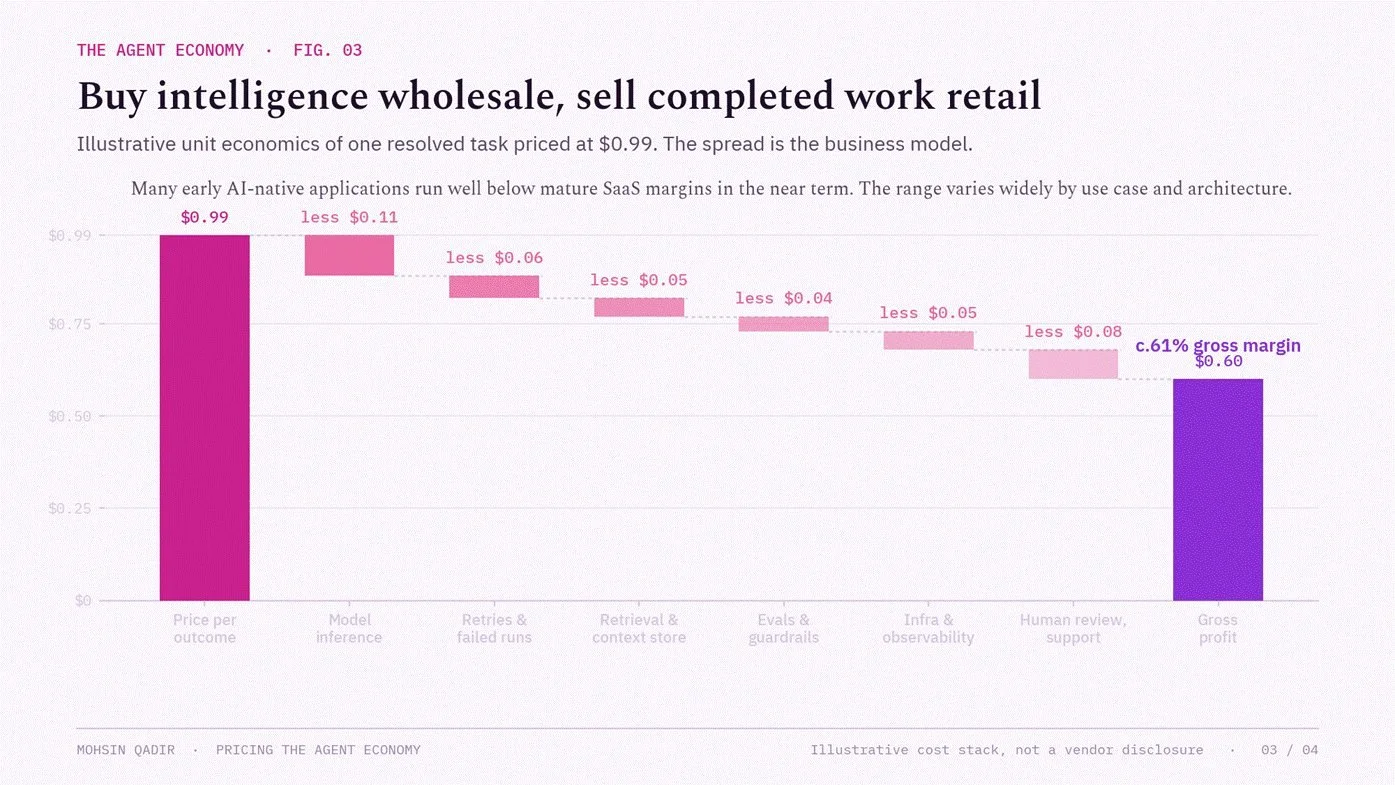
Figure 3. Illustrative unit economics of one resolved task priced at $0.99. The spread is the business model.
The single most useful number on an AI-native dashboard is not cost per token or cost per conversation. It is:
Fully loaded cost per successful outcome = (model inference + retries and failed runs + retrieval and vector store + tool and API calls + evaluation and guardrails + human review + observability + support and implementation) ÷ verified successful outcomes
Notice what the denominator does. Failures stay in the numerator. At a 60% resolution rate, your true cost per delivered outcome is two thirds higher than a naive token dashboard suggests. Retries are the silent killer of AI gross margin.
The cost levers are a treasury function in disguise:
Route by task. Cheap models for routine steps, frontier models for hard reasoning, which also keeps your suppliers competing and stops any single model provider capturing your margin.Cache, batch, distil. Prompt caching and batch endpoints cut inference cost materially, and distilling your highest-volume tasks onto smaller owned models is vertical integration of the cheap tail.Buy inputs like a commodity. Committed-use agreements hedge a volatile, deflating input.Price the tail, not the average. Sell unlimited usage on a metered cost base and your heaviest, happiest customers become your loss-makers. Every large account deserves its own gross margin line.
When your customers pass agent access through to their own users, the same discipline applies one layer down: per-tenant metering, pooled allowances, fair-use thresholds, rate limits as fences, and overage pricing that keeps the marginal conversation gross-margin positive.
8. Discounts must buy a change in behaviour
An earlier draft of this piece argued for pre-committed price reductions of 15% to 20% at each renewal, on the logic that compute is deflating. A sharp reader pushed back, and was right. Input cost is not the only thing moving. As the agent becomes more capable, more integrated and more trusted, customer value rises too. Handing back the cost curve automatically gives away precisely the value you spent two years earning.
The stricter principle: a discount should purchase a change in customer behaviour that would not otherwise have happened. Offer declining unit rates in exchange for committed volume, longer duration, broader workflow adoption, lower cost to serve, reference rights or customer-approved data rights. Never in exchange for the passage of time.
9. Where the moat actually lives
Agent capability is the layer everyone discusses and the hardest to defend. It rides frontier-model capital expenditure you do not own, and it resets with each model generation. A feature a competitor can ship next quarter creates real value and captures almost none, because competition drives the price of replicable benefits toward zero.
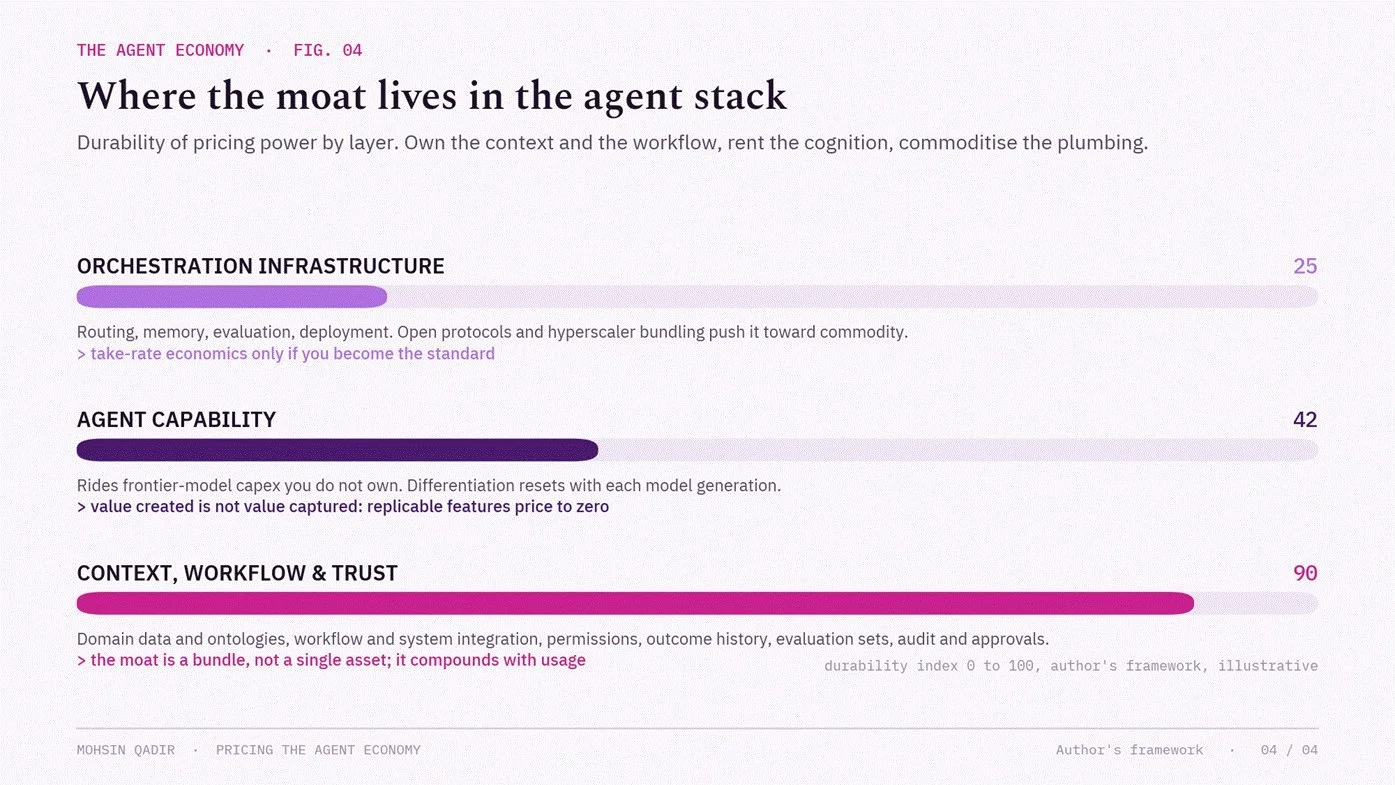
Figure 4. Durability of pricing power by layer. Own the context and the workflow, rent the cognition, commoditise the plumbing.
Orchestration is being commoditised deliberately. Open protocols and hyperscaler bundling are pushing routing, memory, evaluation and deployment toward the plumbing layer. Excellent business if you become the standard. Poor business if you do not.
What endures is a bundle, and I want to resist the tempting oversimplification that proprietary data is the only moat. Customer data is frequently owned by the customer, often not reusable across accounts, and usually contractually fenced. The durable position combines domain-specific data and ontologies you genuinely own; deep workflow and system integration; permissions and identity; an accumulating history of outcomes and feedback that improves the product; proprietary evaluation datasets (underrated, and perhaps the most defensible asset in the entire stack); regulatory approvals and demonstrable auditability; implementation know-how; distribution; and the switching costs all of that creates.
Own the context and the workflow. Rent the cognition. Commoditise the plumbing.
10. What I would ask in diligence
If I were evaluating an AI-native agent business, in order: the written definition of the billable unit and who verifies it; gross margin trajectory rather than a point estimate, showing cost per successful outcome falling faster than price per successful outcome; unit economics of the heaviest 5% of accounts, not the blended average; net revenue retention decomposed into usage, seats and price; the token supply strategy, including model mix, committed cover and single-provider concentration; whether a genuine segmented menu exists and whether buyers actually self-select across it; and finally, an honest inventory of which moat layers are owned and which are merely rented.
The SaaS era asked how much per seat. The agent economy asks a harder and better question: what is a completed unit of work worth, who verifies it, and how is the surplus split? The frameworks that answer it are old. Economic value, price metrics, fences, two-part tariffs and lifecycle pricing were in the textbook long before transformers existed. What is new is the arena and the speed. Founders who treat pricing as a product feature, versioned and re-tested every quarter, will out-monetise better technology that is priced lazily.
Views entirely my own. I would genuinely welcome disagreement: founders, operators and investors in agentic AI, what is working in your pricing stack?
#AgenticAI #AIAgents #PricingStrategy #GenAI #LLM #AgentEconomy #DigitalLabor #AInativeSaaS #Monetization #TokenEconomics #UsageBasedPricing #OutcomeBasedPricing #UnitEconomics #B2BSaaS #EnterpriseAI #VentureCapital #Founders #ArtificialIntelligence #CFOInsights #FinTech
Frequently asked questions
How should AI agents be priced?
Between two limits. The value the agent creates for the customer sets the ceiling, and the cost of compute sets the floor, which is falling about tenfold a year. Mohsin Qadir suggests a platform fee for security and governance, metered credits priced per action, an outcome fee where outcomes can be audited, and a share of the value the vendor can defend.
When does outcome-based pricing work for AI agents?
It works when the outcome is observable, attributable, timely and auditable, such as a support ticket the agent resolves on its own. It works badly when results depend on the customer's own data, policies or people. A simple test: if you can't define a billable outcome in a sentence the customer's auditor would accept, don't price on it yet.
How is AI agent pricing like fund fees in asset management?
The platform fee works like a management fee and the outcome fee works like carried interest. So agent vendors need the fee machinery funds already use: a high-water-mark equivalent that bills only for outcomes above the customer's pre-AI baseline, credits when service levels are missed, and audited definitions of what counts as a billable resolution.
More of Mohsin Qadir's research on AI economics and private markets operations is collected on the KauserOS research page. More RoSoft Notes research.
About the author
Mohsin Qadir is the founder of KauserOS, an AI-native operating platform for private equity and private credit managers. He was divisional CFO and COO of Private Assets at Fidelity International and interim Head of Investment Operations at Bridgepoint, and earlier worked at ICG and BNP Paribas CIB. He writes RoSoft Notes.