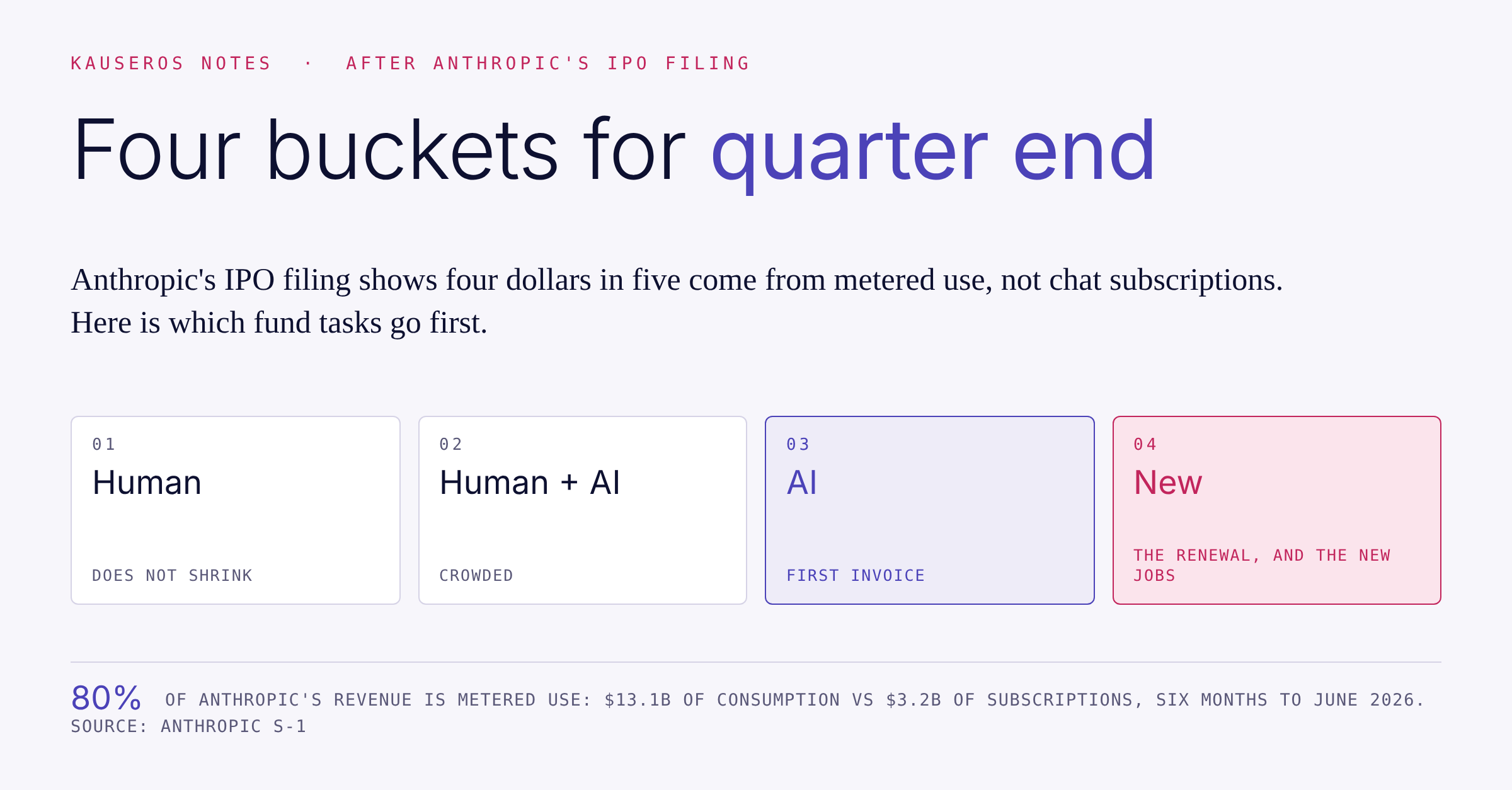
First published in KauserOS Notes on Substack on 12 November 2026. Figures and market references are as of that date.
In short
Anthropic's IPO filing shows 80% of its revenue, $13.1 billion in the six months to June 2026, is metered use billed by the token. Applied to a private equity fund's quarter end, AI takes the checking work first. Valuation calls and key person decisions stay with people, like the one Nvidia's board faced when Jensen Huang resigned on 12 November.
- Anthropic set its IPO range at $70 to $78 a share, up to $1.404 trillion. ANT is expected to trade around 19 November.
- Net revenue retention is about 900%. A customer who spent $1 a year ago now spends about $9.
- The AI bucket pays the first invoice: reconciliations, fee checks, capital call packs.
- The New bucket earns the renewal: owning the definitions every team's model reads.
- Nvidia shares fell as much as 14% on 12 November. CFO Colette Kress is interim CEO.
AI in private equity will take the checking work at quarter end first: reconciliations, fee checks, capital call packs. The judgment stays with people. Anthropic's IPO filing, updated this week, shows why. Four-fifths of its revenue is metered use, billed by the token as businesses wire the model into their work. One-fifth is subscriptions, people paying to work alongside it.
In my last note I argued that the private markets back office is the crown jewel, because the same portfolio EBITDA lives in eight places and whoever holds the one record every team trusts gets the renewal. The comments split two ways. CFOs asked which workflow to hand over first. People at the labs asked where the money is. This note answers both. The operating stack map and the vendor census follow in a later note.
What Anthropic's IPO filing says about the money
On Tuesday Anthropic set its IPO range at $70 to $78 a share. It is selling 825 million Class A shares on Nasdaq under the ticker ANT, raising $57.75 billion to $64.35 billion. At the top of the range the company is worth $1.404 trillion fully diluted, up from $965 billion at its May round and below the $2 trillion talked about a few weeks ago. The gap has a date on it. On 5 November the Nasdaq 100 fell 6.4%, its worst day since March 2020. Trading in ANT is expected to start around 19 November.
The headline numbers are big in both directions. Run-rate revenue of $81 billion at the end of October. A nine-month net loss of $104 billion. $900.9 billion of compute and infrastructure commitments.
The line I read twice sits in the MD&A. In the six months to June, consumption revenue, billed by the token, was $13.1 billion, or 80% of the total. Subscriptions were $3.2 billion, or 20%. The consumption share was 75% in 2024 and 83% in 2025. Net revenue retention is about 900%, so a customer who spent $1 a year earlier now spends about $9. More than 11,900 customers spend over $100,000 a year, up from more than 950 a year before.
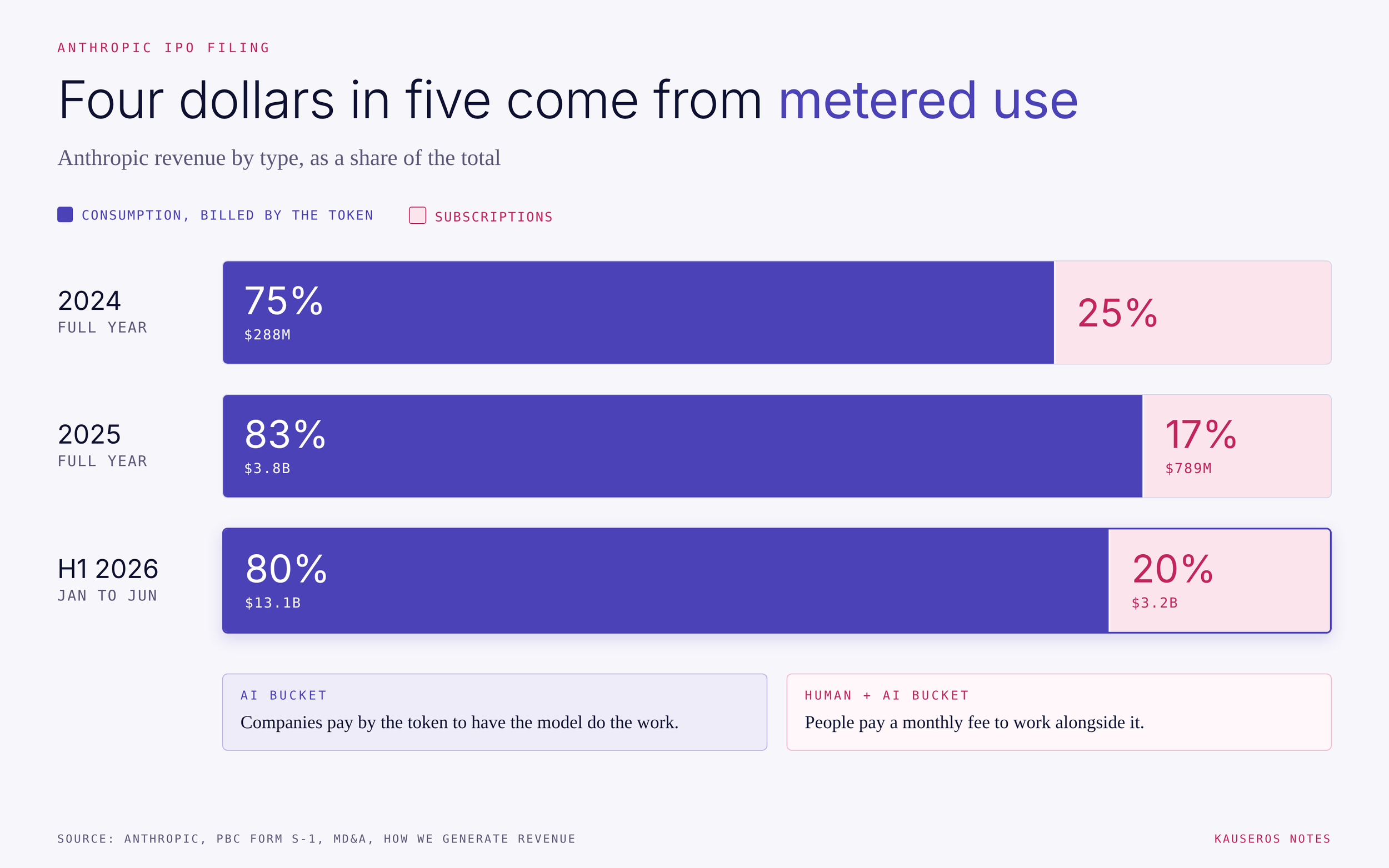
Put plainly, people pay a monthly fee to work alongside the model. Companies pay by the token to have it do the work. That split is the grid I want to use on a fund.
The four buckets
The tool I keep reaching for is a four-bucket grid I saw in a talk, adapted from Anthropic's task-level research. Every task is moving into one of four buckets. Human, where a person still owns the judgment. Human plus AI, where the model makes the person better. AI, where the model owns execution. And New, work that only exists because AI exists. Anthropic's Economic Index shows the same split from the usage side. On Claude.ai, use still leans toward augmentation. On the API, the two workflows whose share at least doubled between November and February were sales outreach automation and automated trading and market operations. The prospectus now puts a price on it.
Sorting the quarter end
I took one quarter end and sorted every task I could remember into the grid.
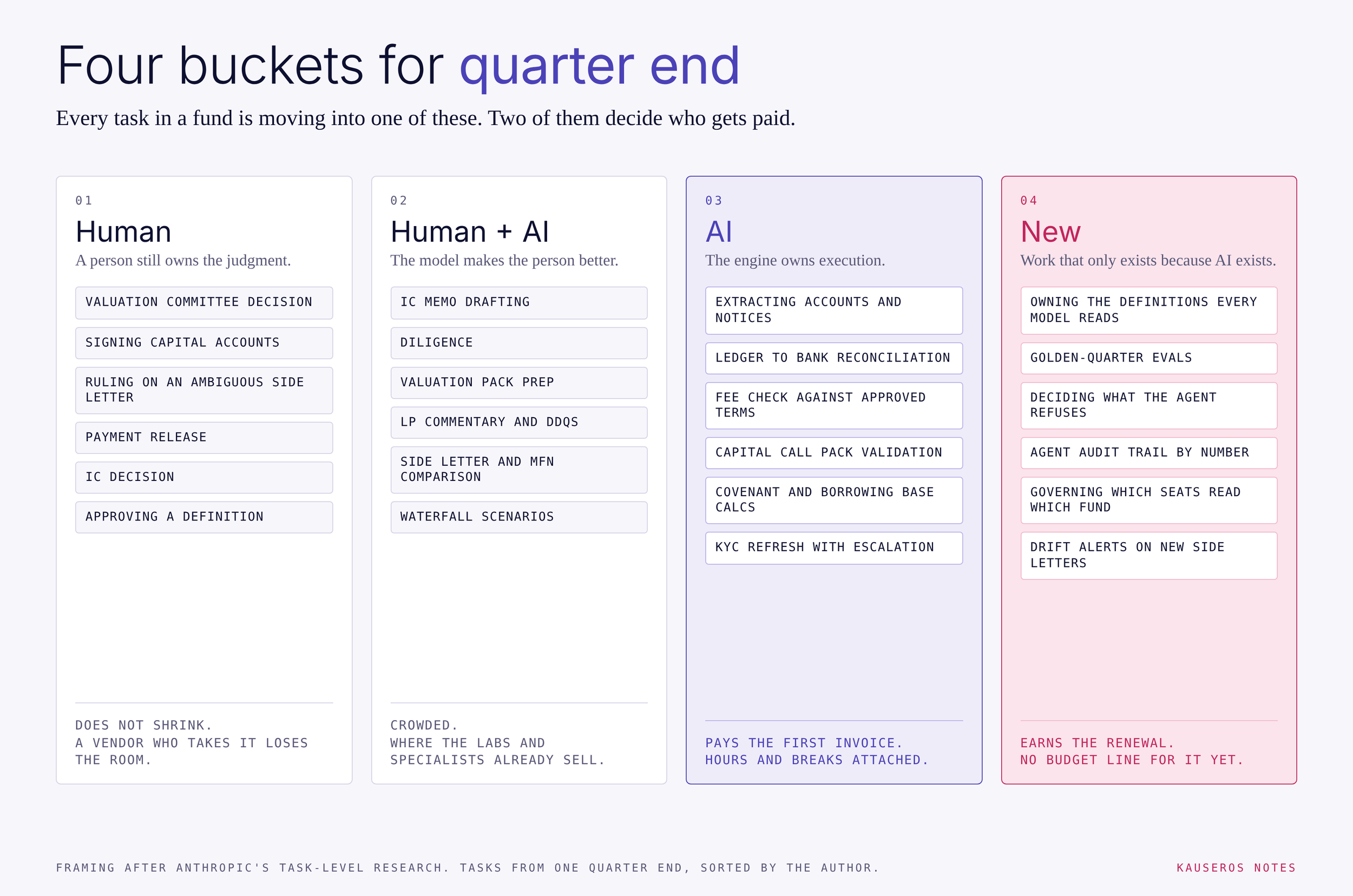
Human is the smallest bucket and it does not shrink. The valuation committee's decision. The CFO's signature on the capital account statements. The call on an ambiguous side letter. Payment release. A regulator or an auditor needs a name on each of those, and a vendor who tries to take them loses the room. This quarter the valuation call is harder than usual. Public AI comparables fell hard in the week of 5 November, and any GP marking an AI-exposed company at 31 December has to decide how much of that move belongs in the mark. A model can pull the comps and rerun the multiples in minutes. The committee still owns the number.
Human plus AI is the crowded bucket. IC memo drafting, diligence, LP commentary, side letter comparison, waterfall scenarios. This is where Rogo and Hebbia sell and where both lab products started. It looks like the subscription fifth of Anthropic's revenue. It is also where a new entrant should not fight, because the incumbents have the demos and the deal teams have already adopted.
AI is the bucket that pays the first invoice. Extracting portfolio company accounts and notices. Reconciling the administrator's ledger to the bank. Checking management fees against the approved terms. Validating a capital call pack. Covenant and borrowing base calculations. Every one of these has hours attached, a break count attached, and a controller who would rather not do it at 11pm on day four of the close. The output is a number that has to match the books, so it suits a versioned engine more than a chatbot, and the saving is measurable inside one quarter. It is the same kind of work that makes up Anthropic's metered four-fifths.
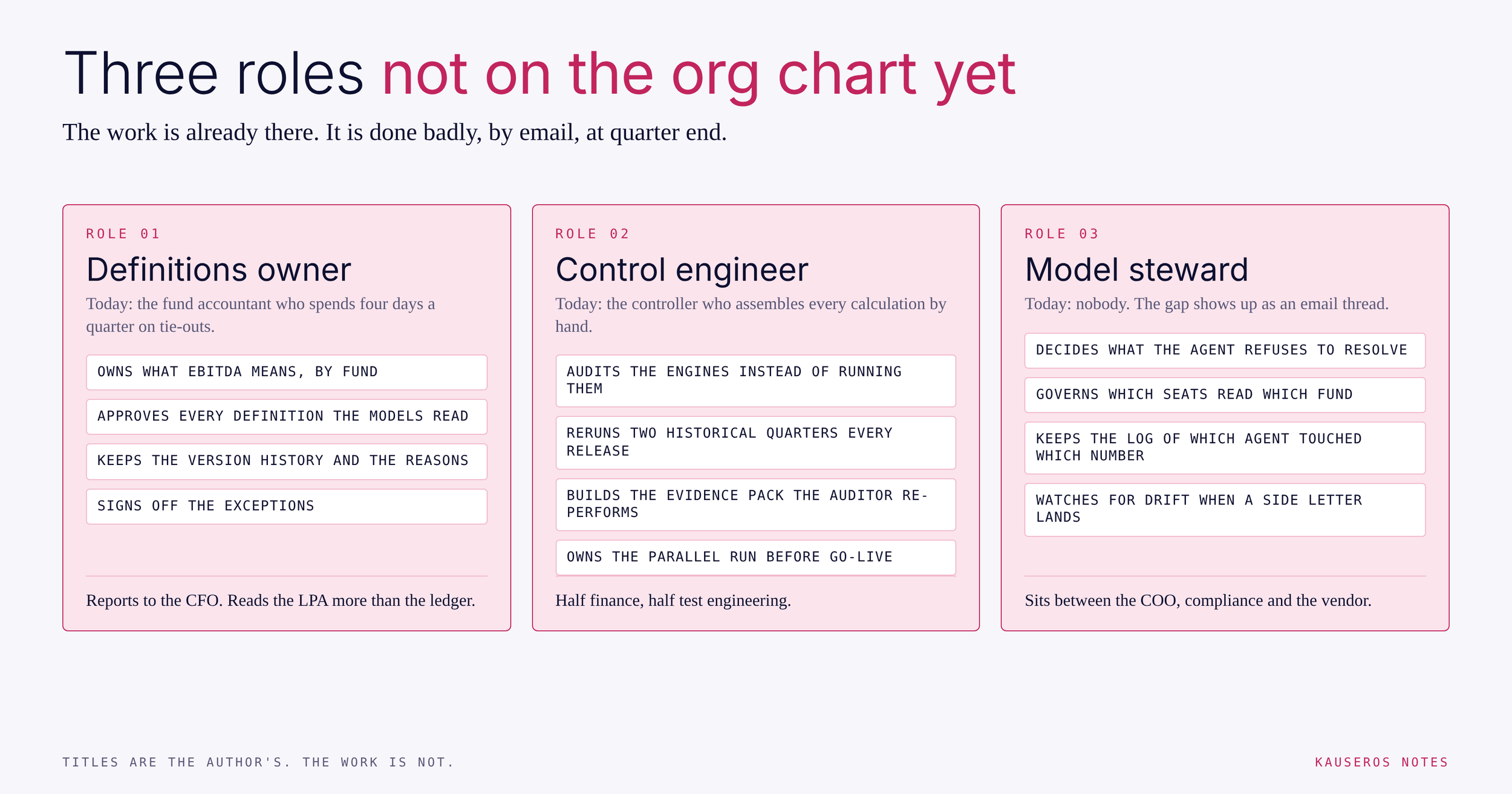
New is the bucket nobody has a budget line for yet. Someone has to own the definitions every team's AI reads, and keep them versioned. Someone has to run the evals that prove last quarter's numbers still reproduce. Someone has to decide what the agent refuses to resolve on its own, and keep the log of which agent touched which number. Someone has to govern which AI seats can read which fund's data, and watch for drift when a new side letter lands. None of that existed three years ago. All of it is work.
Nvidia's CEO resigned. Who calls a key person event?
The week's other big story sits in the Human bucket too, and it moved fast. On Sunday Nvidia's board opened an independent investigation after Jensen Huang told staff he had had an affair with a woman The New York Times reported was gathering information on Nvidia's technology. Beijing called the spying claim unsubstantiated, and the board said it still had confidence in him. On Thursday Huang resigned as chief executive with immediate effect, after further reports of a second affair with an executive who reported to him. CFO Colette Kress is interim CEO while the board looks for a successor. Huang owns about 3.6% of Nvidia and is also leaving its board. The shares fell as much as 14% on Thursday, on top of the 24% the stock had lost in the past month. Nvidia reports earnings on 17 November, and it is putting $10 billion into Anthropic as one of seven partners buying $26 billion of stock alongside the IPO.
Every fund has a version of this written into its LPA. The key person clause names the people LPs are backing and says what happens if they stop giving the fund their time, often an automatic suspension of the investment period until LPs vote to lift it. Anthropic's own prospectus lists its version as a risk: it is highly dependent on its co-founders. Deciding whether a key person event has happened, and what to tell LPs, is a Human bucket call. Knowing which definition applies is not. Fund III's clause, Fund IV's clause and three side letters with their own triggers can all say different things. Keeping those definitions straight, versioned and readable by every team's model is New bucket work.
The wedge, and the right to win
The sequence falls out of the grid. Start in the AI bucket with one bounded workflow, a fee check or a capital call pack, because that is where the controller feels the pain and the CFO can see the saving. Run it in parallel for two historical quarters and one live cycle, amended LPAs and side letter exceptions included. Then move to the next workflow. Anthropic's 900% retention shows what happens once the first workflow works: spend follows the next one, and the one after. The pricing follows the same logic. A paid diagnostic to sort the tasks, a deployment fee for the first fund, a subscription for the engine once it runs on its own.
The right to win sits in the New bucket. The AI bucket is contestable. Any lab template, any incumbent connector, any administrator with a budget can automate a reconciliation. What they cannot easily copy is the registry of definitions and rulings that every team's model reads, with a named owner on each one and a change log behind it. That is the switching cost. It is the same reason Palantir's ontology compounded, and the same reason the eight-versions problem exists in the first place. Nobody owns the definition.
Two honest caveats. The administrator fee catch from my last note still applies: if AI removes hours from a process the administrator runs, the GP does not save the fee unless the contract changes. And not every Human plus AI task is on its way to the AI bucket. Some stay with a person for good, because fiduciary responsibility does not automate.
What this does to the stack, and to the jobs
The operating stack itself changes shape. Today it is a column of systems, each holding its own copy of the number. The grid pulls it into two layers. Below, versioned engines doing the AI bucket work against one record. Above, people doing the Human and Human plus AI work with the time the engines gave back. The incumbents do not disappear. Menlo found almost no evidence of enterprises ripping out their core systems for AI, and a fund ledger is as sticky as it gets. They become the places the engines read from and write to.
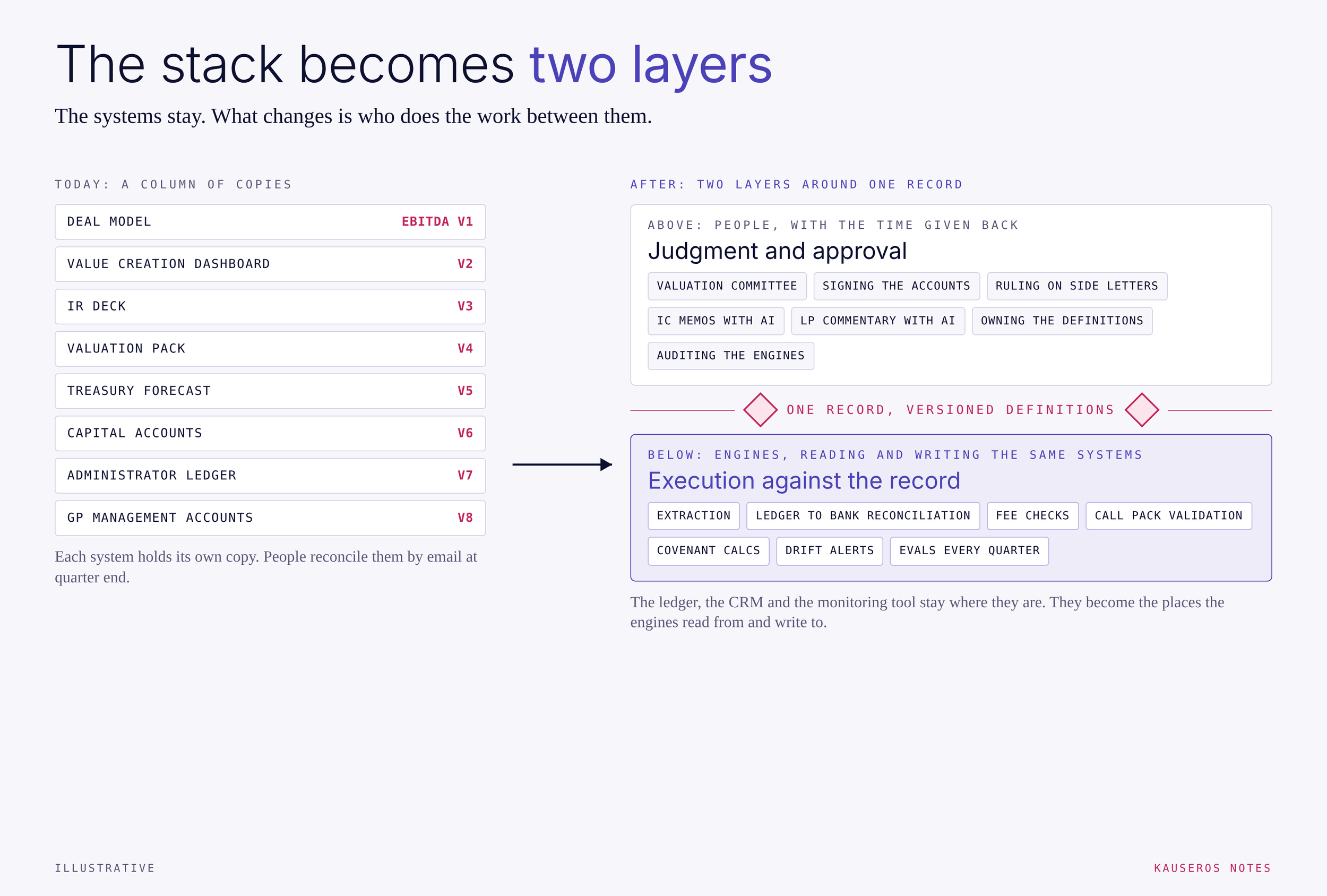
The jobs change more than the systems. The fund accountant who spent four days a quarter on tie-outs becomes the person who owns the definitions and signs off the exceptions. The controller stops assembling the calculation and starts auditing the engine. A new role appears that I have not seen on a GP's org chart yet: whoever curates the record, runs the evals and governs what the agents may touch. Call it the definitions owner, the control engineer, the model steward. The title will settle. The work is already there, done badly by email at quarter end.
The four-bucket slide was made for the labour market. It fits the fund back office because the fund back office is the labour market in miniature. Anthropic's prospectus says the money is in the AI bucket. I think the next decade of jobs in this industry gets written in the New one.
In a later note: the operating stack map, the vendor census, and the two stages of the GP lifecycle with no software category at all.
Frequently asked questions
What is Anthropic's IPO price range and when does it start trading?
Anthropic set a range of $70 to $78 a share on 10 November 2026 and is selling 825 million Class A shares on Nasdaq under the ticker ANT. At the top of the range it raises $64.35 billion and is valued at $1.404 trillion fully diluted. Trading is expected to start around 19 November.
What does Anthropic's IPO filing show about how businesses use AI?
In the six months to June 2026, 80% of Anthropic's revenue ($13.1 billion) came from usage billed by the token, the way businesses pay to run Claude inside their own products and workflows. Subscriptions were 20% ($3.2 billion). Net revenue retention was about 900%, so customers a year in spend roughly nine times what they did at the start.
Which private equity back office tasks will AI take over first?
The checking tasks with a number that must match the books: extracting portfolio company accounts, reconciling the administrator's ledger to the bank, checking management fees against the LPA, validating capital call packs and covenant calculations. Valuation decisions, the CFO's sign-off and side letter rulings stay with people.
Why did Jensen Huang step down as Nvidia CEO?
Huang resigned on 12 November 2026, four days after Nvidia's board opened an independent investigation into his relationship with a woman The New York Times reported was gathering information on Nvidia's technology. Reports of a second affair, with an executive who reported to him, followed. Beijing denies the spying claim.
Who is Nvidia's interim CEO?
Colette Kress, Nvidia's chief financial officer, is interim CEO while the board searches for a permanent successor. Huang, who co-founded the company in 1993 and owns about 3.6% of its stock, is also leaving the board. Nvidia reports quarterly earnings on 17 November.
What is a key person clause in a private equity fund?
It is a term in the fund's LPA that names the people investors are backing. If they stop devoting the agreed time to the fund, the clause often suspends new investments until LPs vote to lift it. Deciding whether an event has happened is a human call, while tracking which version of the clause applies can be automated.
Sources: Anthropic S-1 and amended S-1 (SEC EDGAR); TechCrunch and Fortune, 10 November 2026; Bloomberg via Swissinfo, 5 November 2026; Nvidia board statement, 8 November 2026; Al Jazeera and Reuters, 8 November 2026; BNN Bloomberg, ABC News and CoinDesk, 12 November 2026; Gulf News, 9 November 2026; Anthropic Economic Index, March 2026 report. Four-bucket framing after Anthropic's task-level research, as presented by Vaibhav Sisinty. Menlo Ventures, 2026: The State of Enterprise AI. Personal views only, not investment advice.
KauserOS starts with fund finance: one record of each facility, call and fee, checked against the administrator at every close. More KauserOS Notes on AI and the private markets operating stack.
About the author
Mohsin Qadir is the founder of KauserOS, an AI-native operating platform for private equity and private credit managers. He was divisional CFO and COO of Private Assets at Fidelity International and interim Head of Investment Operations at Bridgepoint, and earlier worked at ICG and BNP Paribas CIB. He writes RoSoft Notes.